


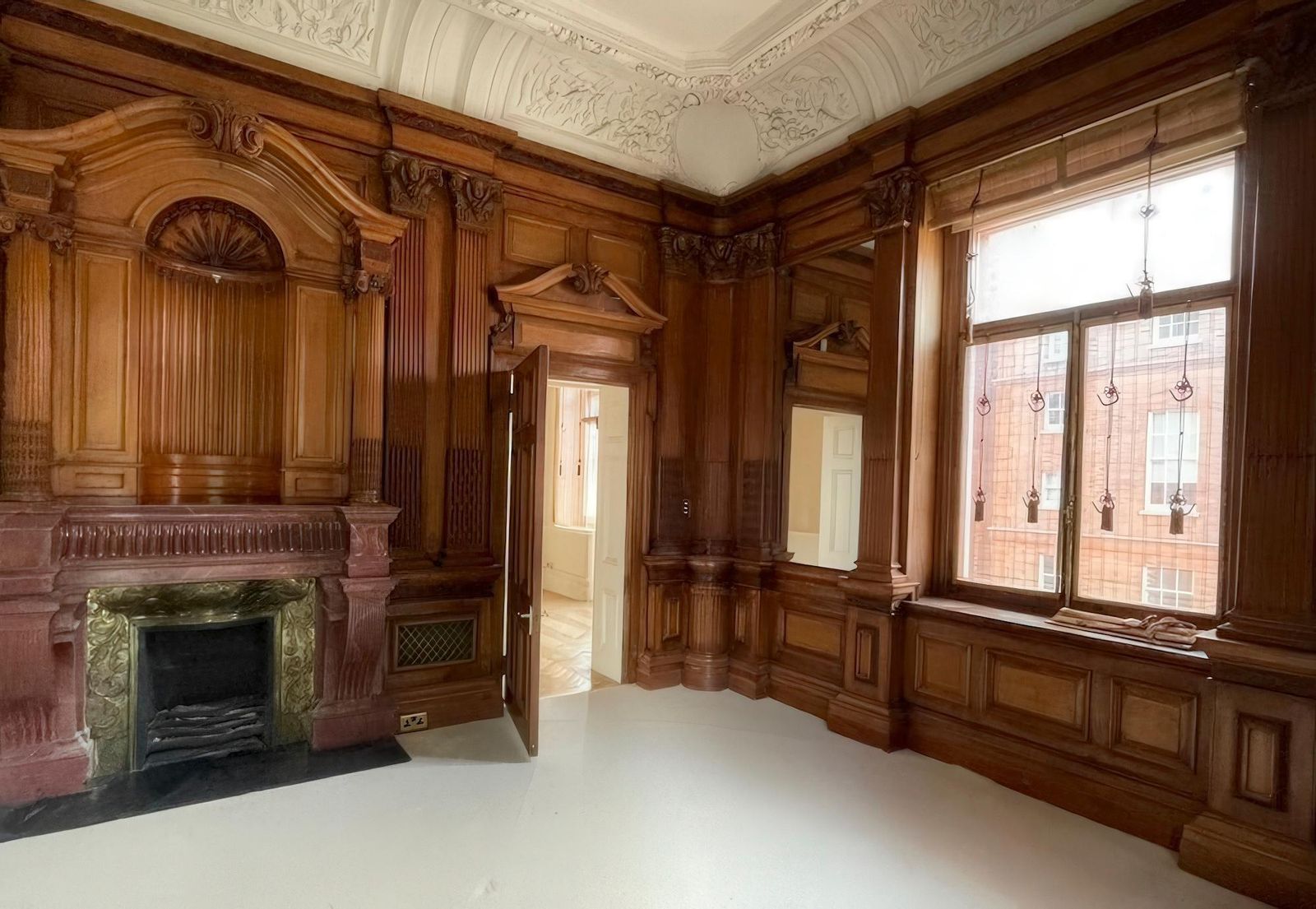
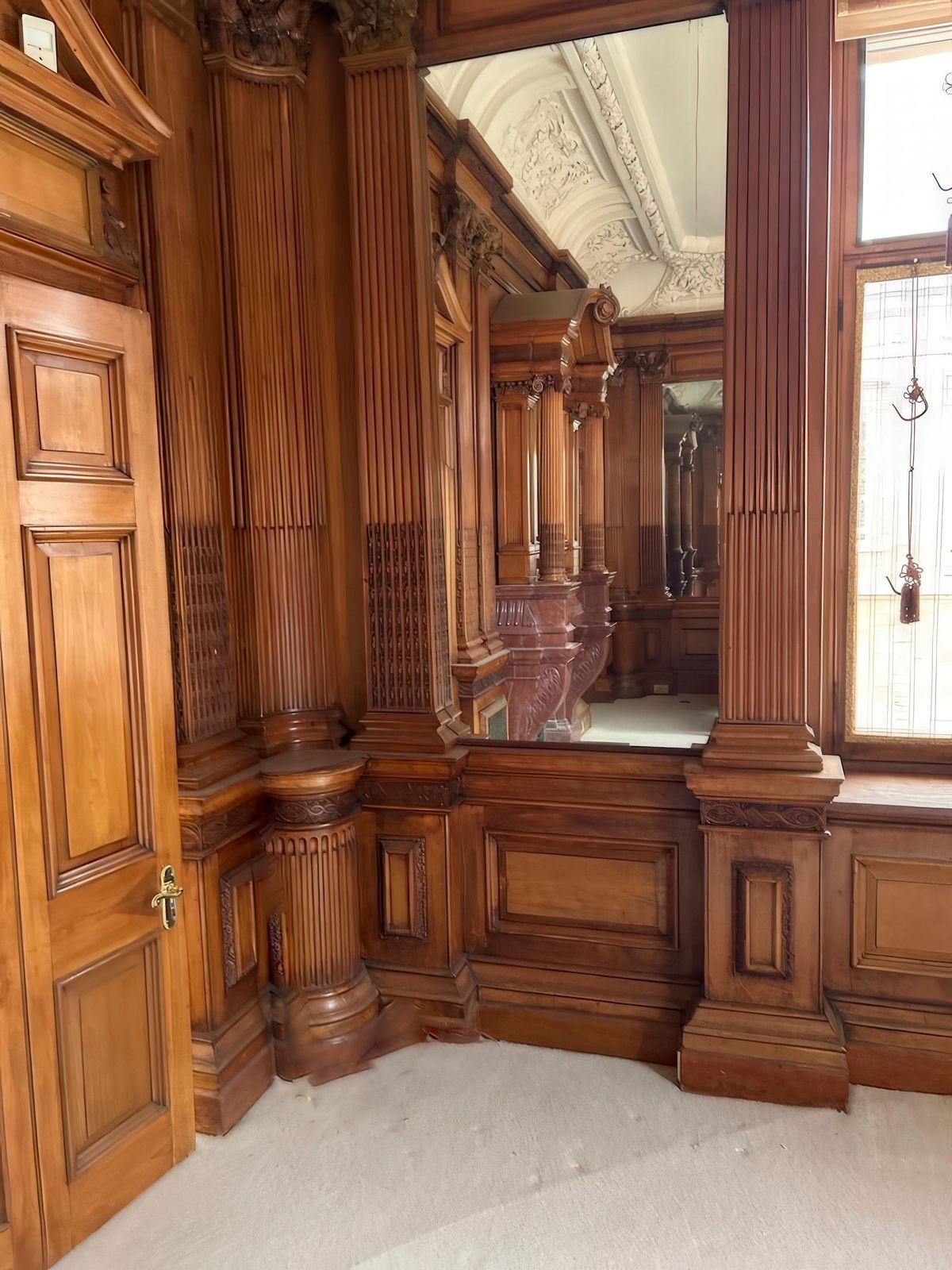
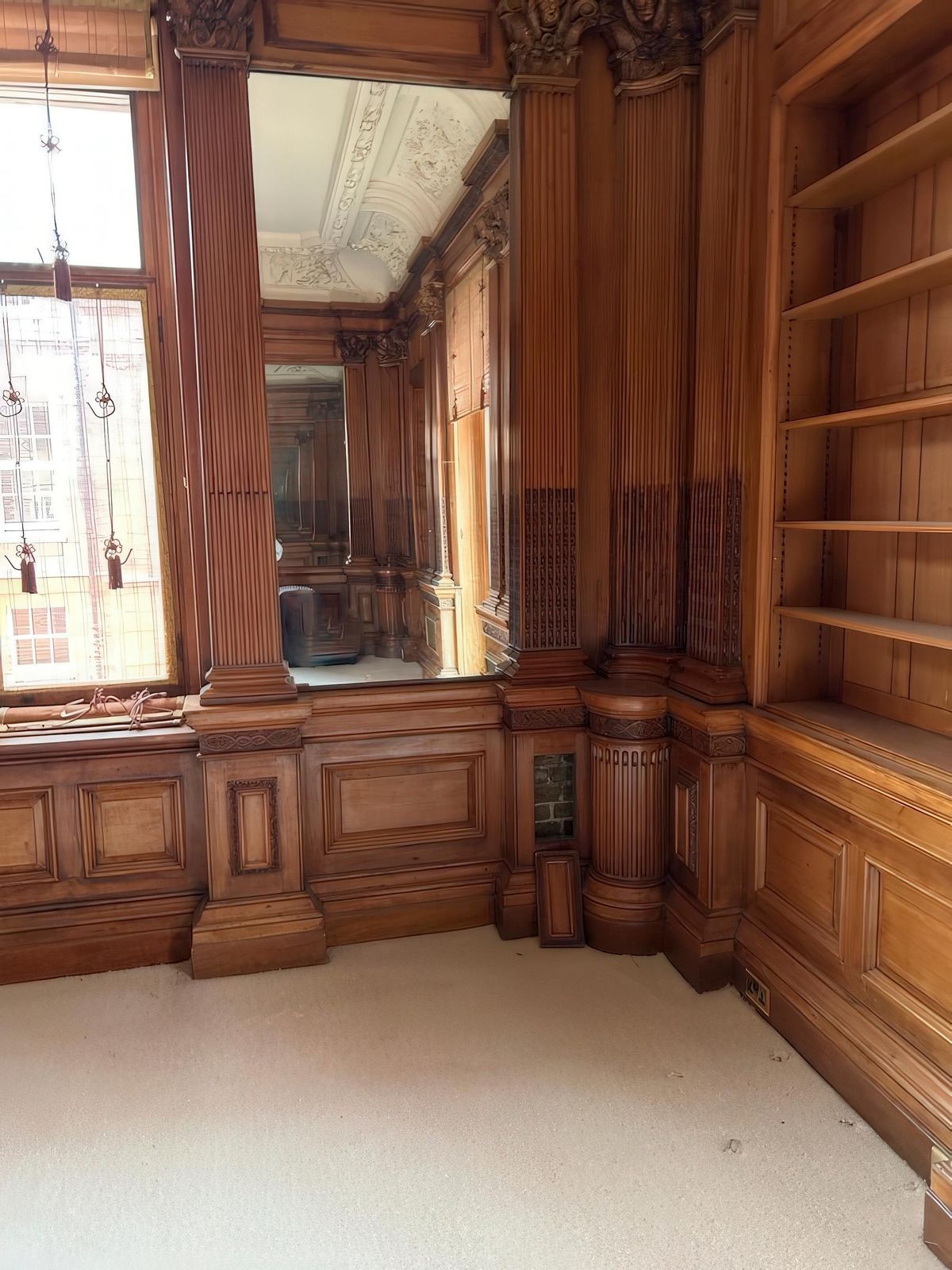
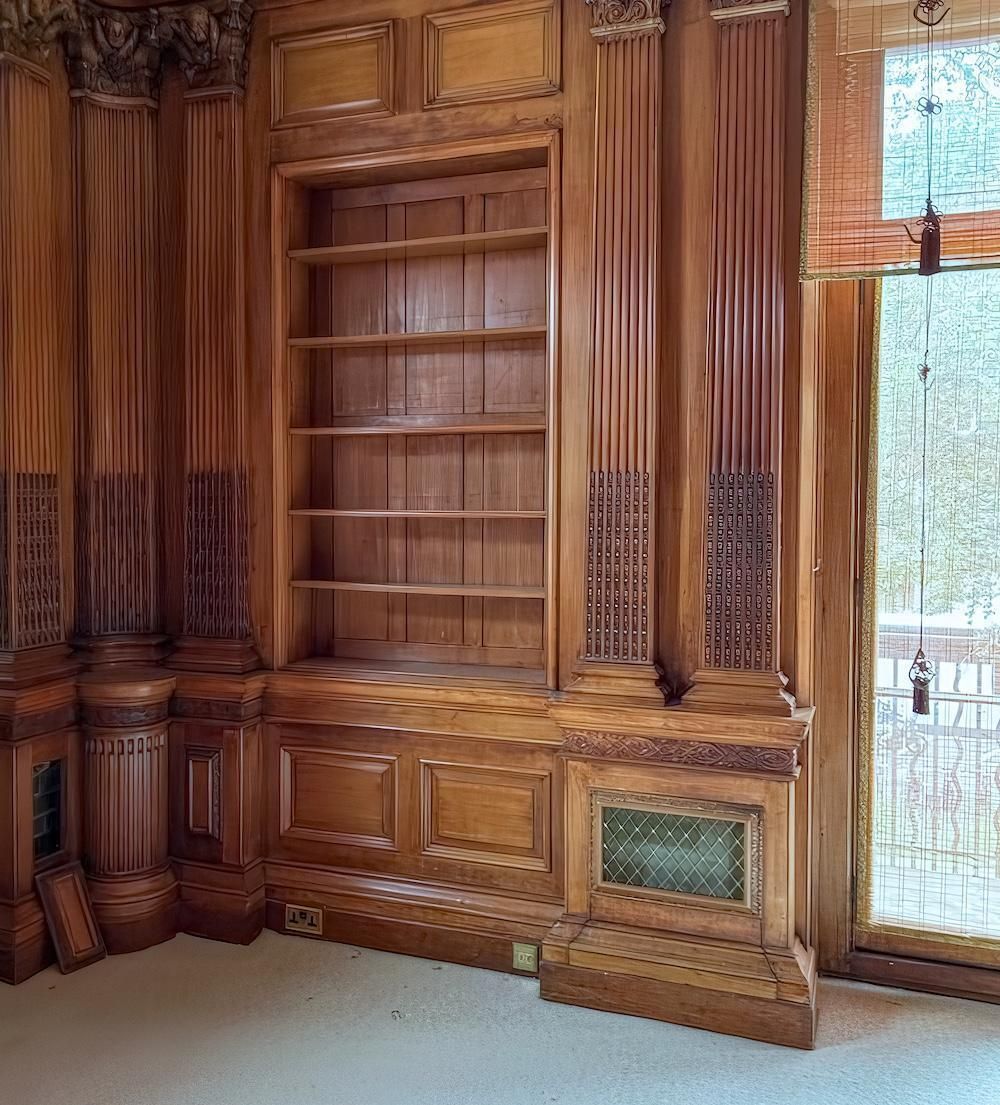
George Trollope & Sons Fireplace & Room, Paris Exhibition 1878 Gold Medal Winner

 Southwold, United Kingdom

Hassle-free returns
-
 Easy returns (14 days)
-
Free return if the item isn't as described
-
Buyer protection
Damage is rare, and you're fully protected if it happens.
Dimensions
Wear Condition
Average
Material
Cedar, Marble
Style
Antique, Oriental, Traditional
Product Details
Description
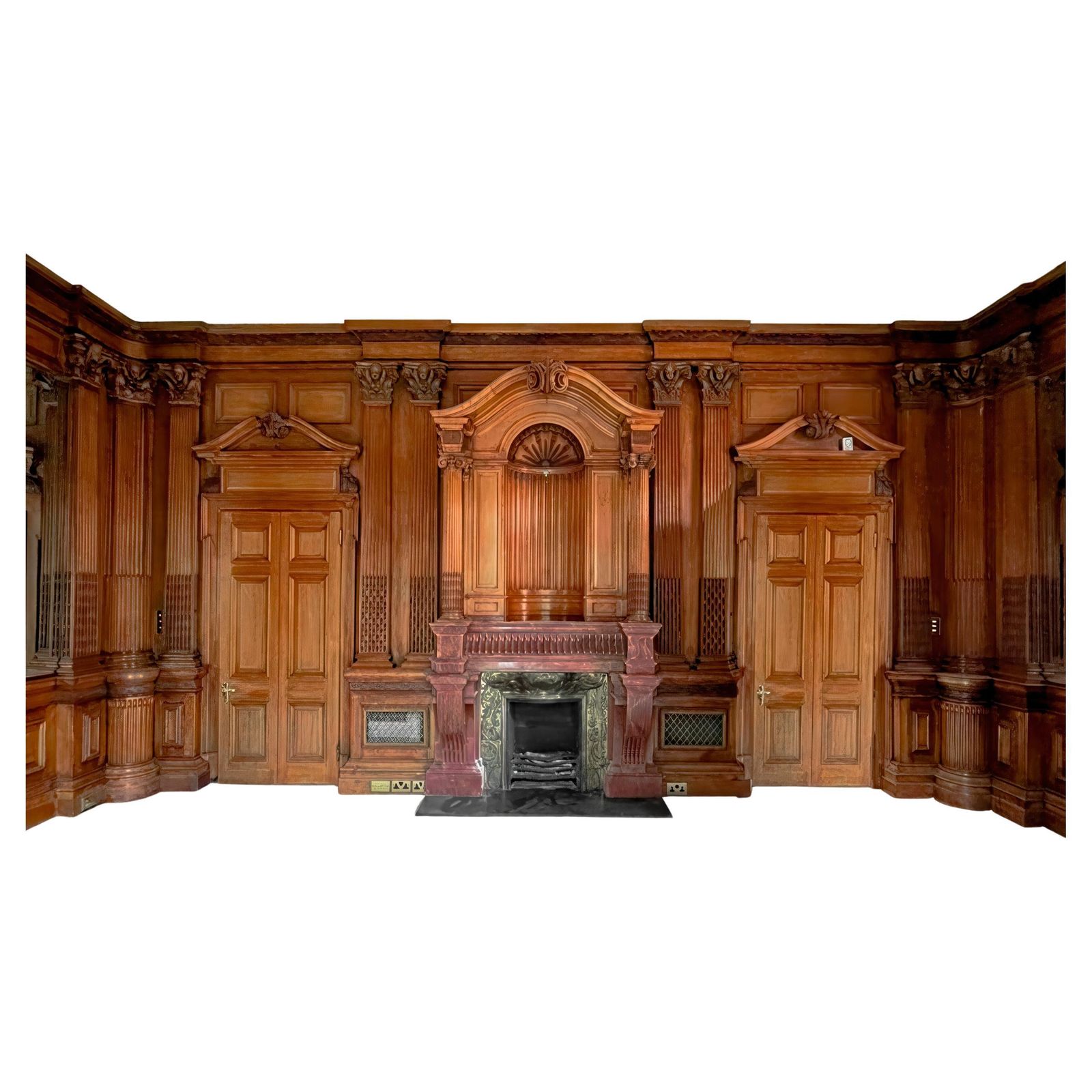
George Trollope and Sons. Exhibited at the Paris Universal Exhibition in 1878 winning a Gold Medal for Excellence.
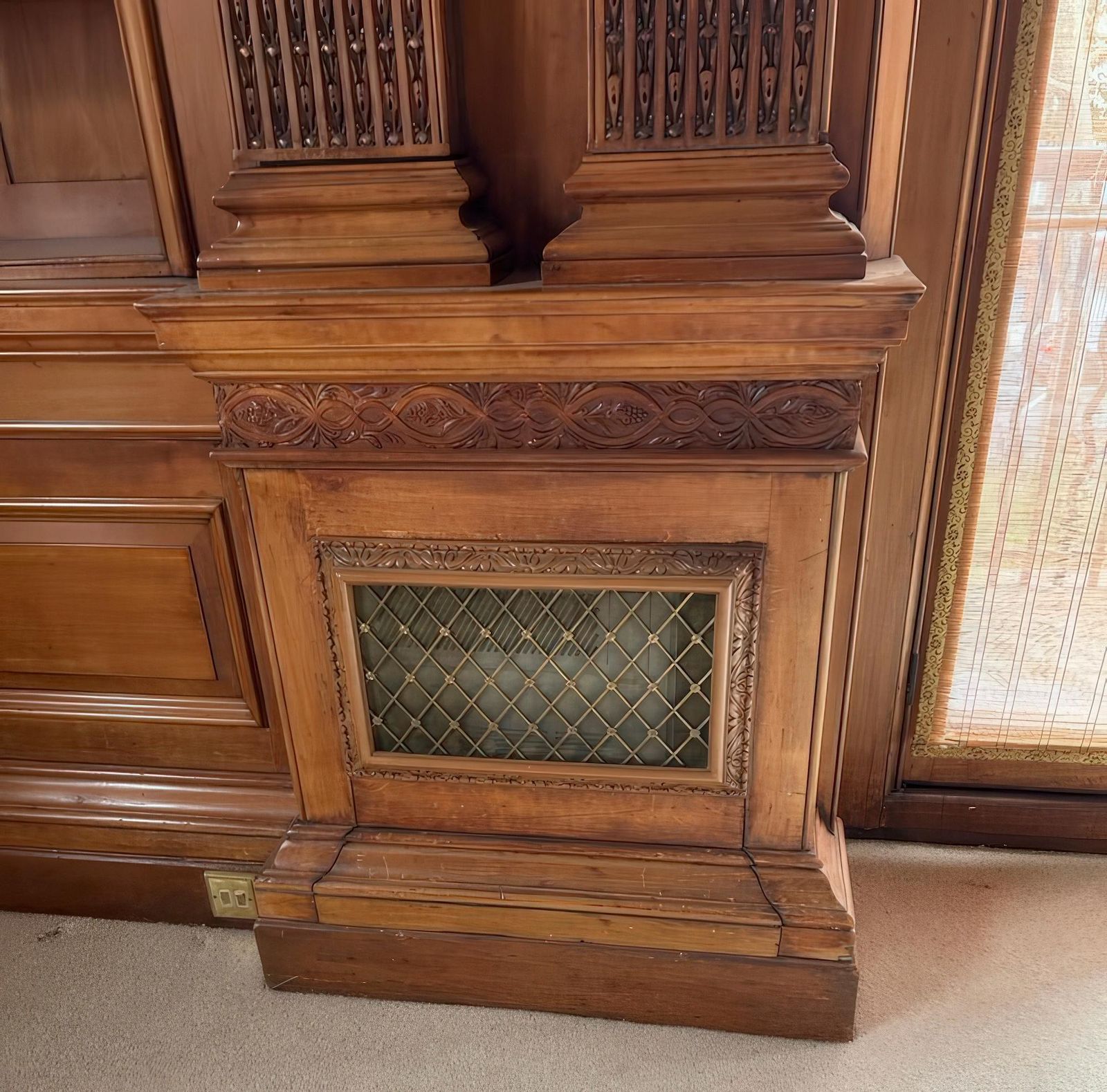
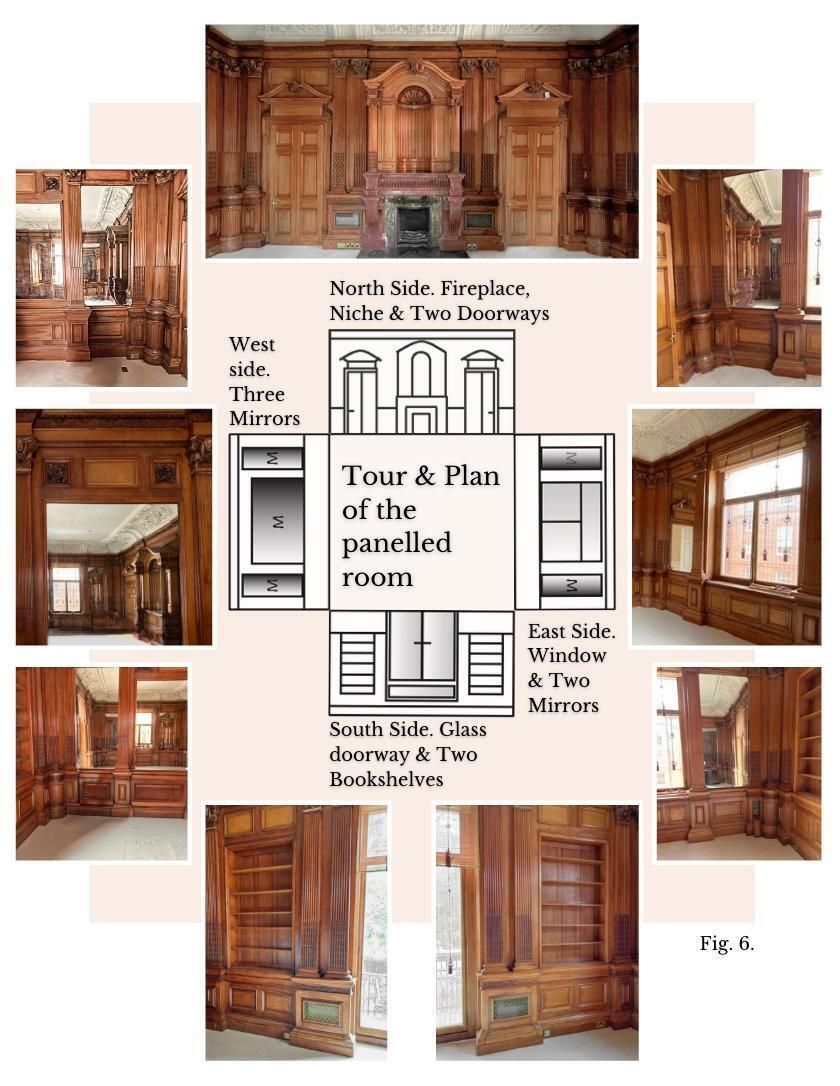
The set forms the four sides of a complete panelled room that was exhibited as a boudoir room or petit salon at the Paris Exhibition 1878 .
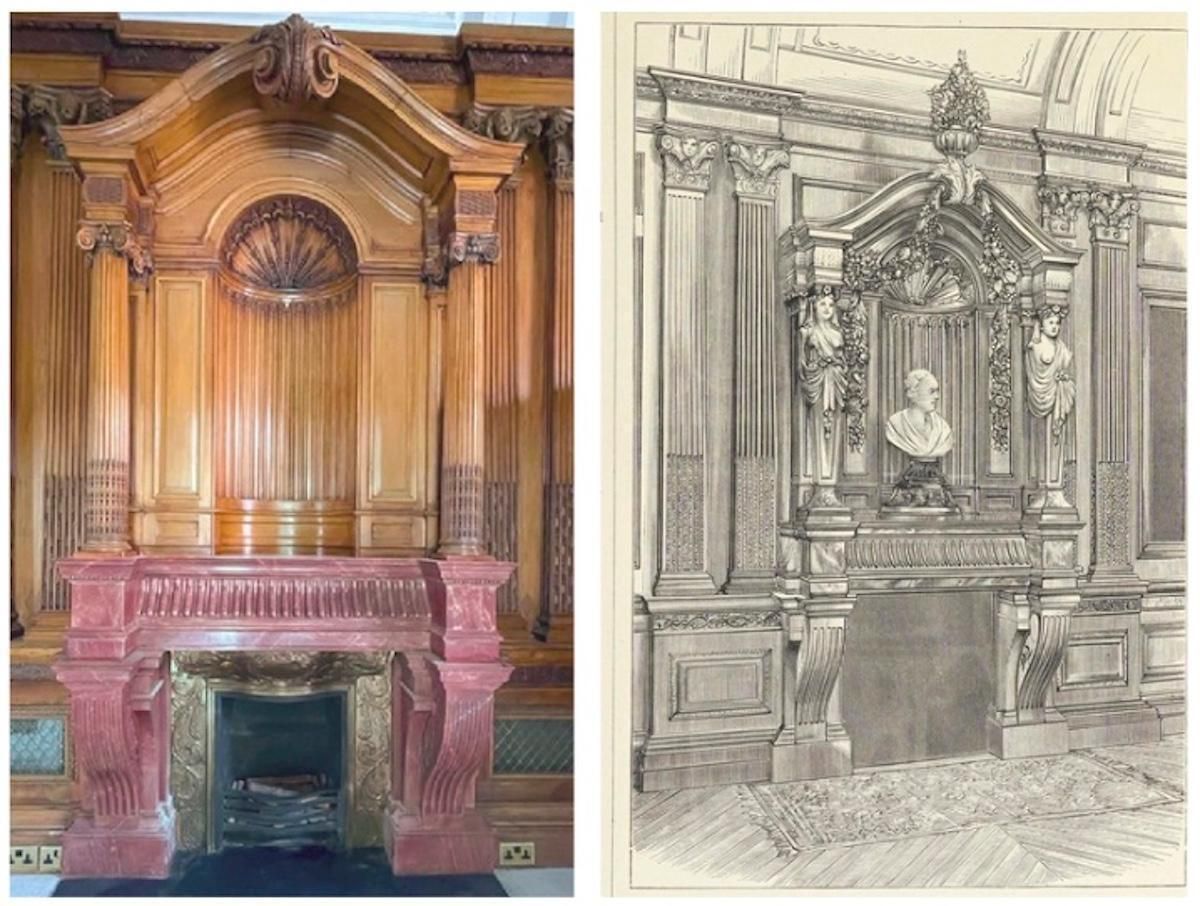
The main feature and centrepiece of this boudoir room is the Rosso Antico marble fireplace surmounted by an open display niche carved in cedar wood.
Each side of the room is composed of various panels and are as follows:
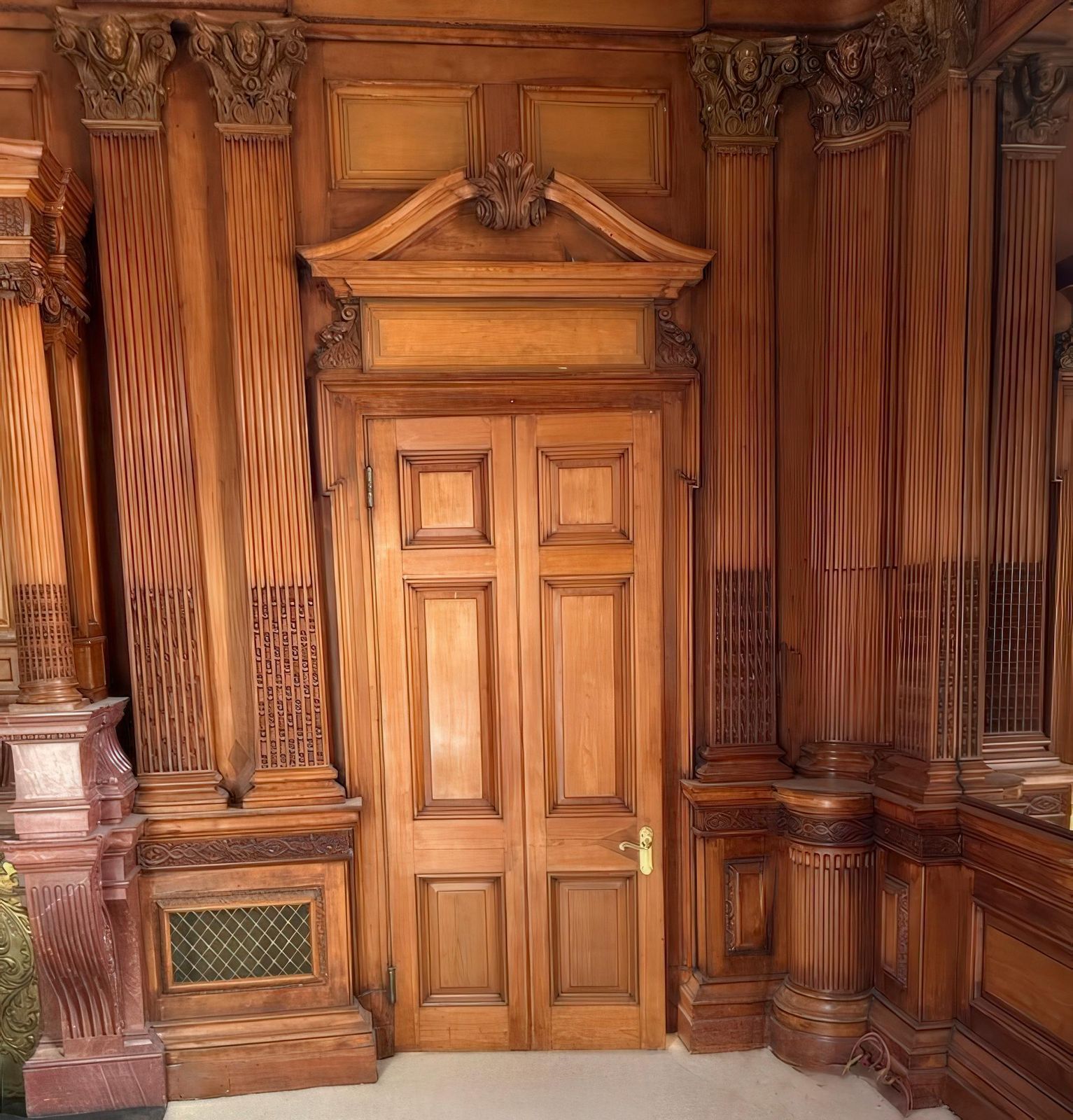
One side with a grand Rosso Antico marble fireplace flanked by two doorways.
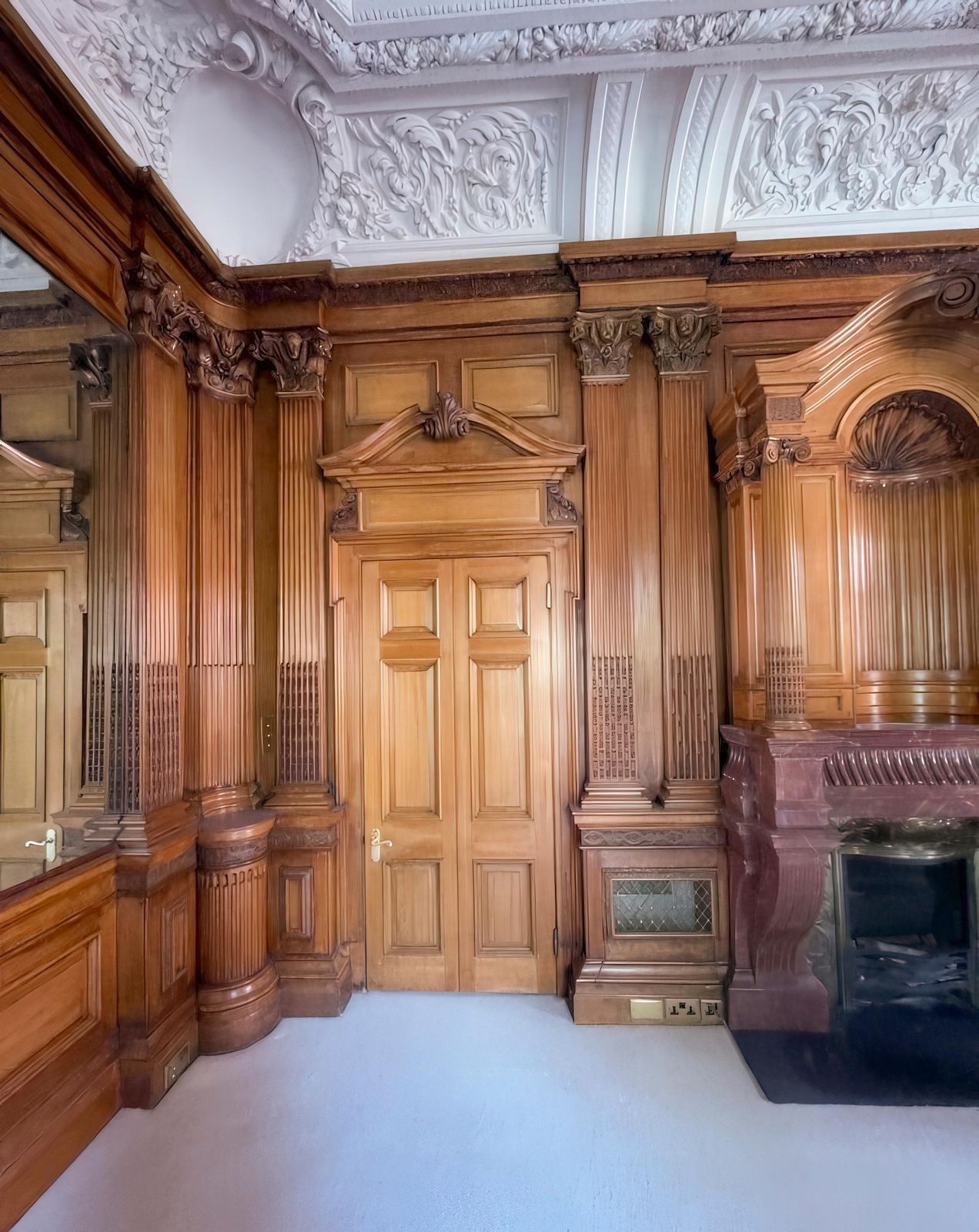
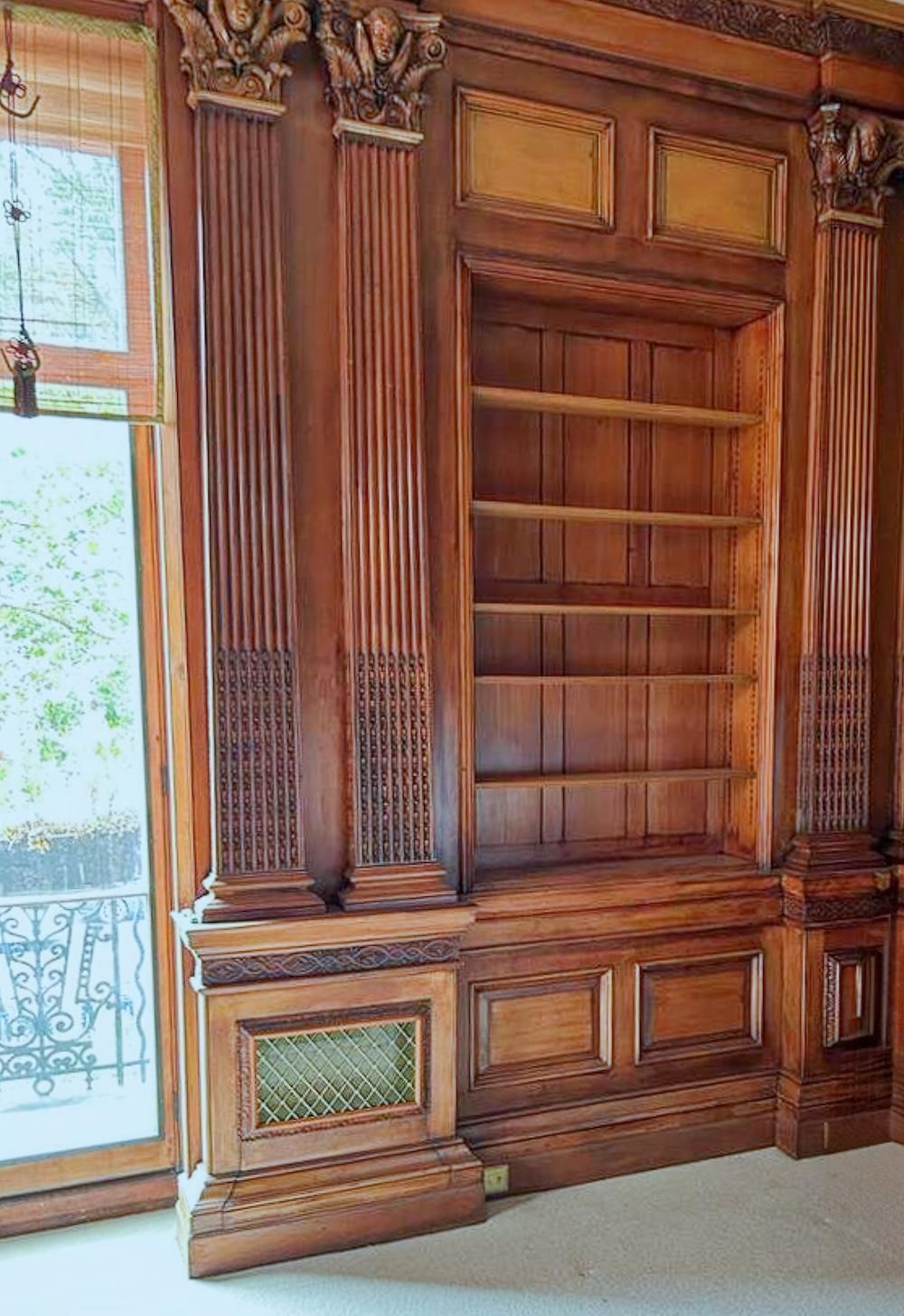
One side with French doors originally opening onto a balcony, flanked by two large bookshelves.
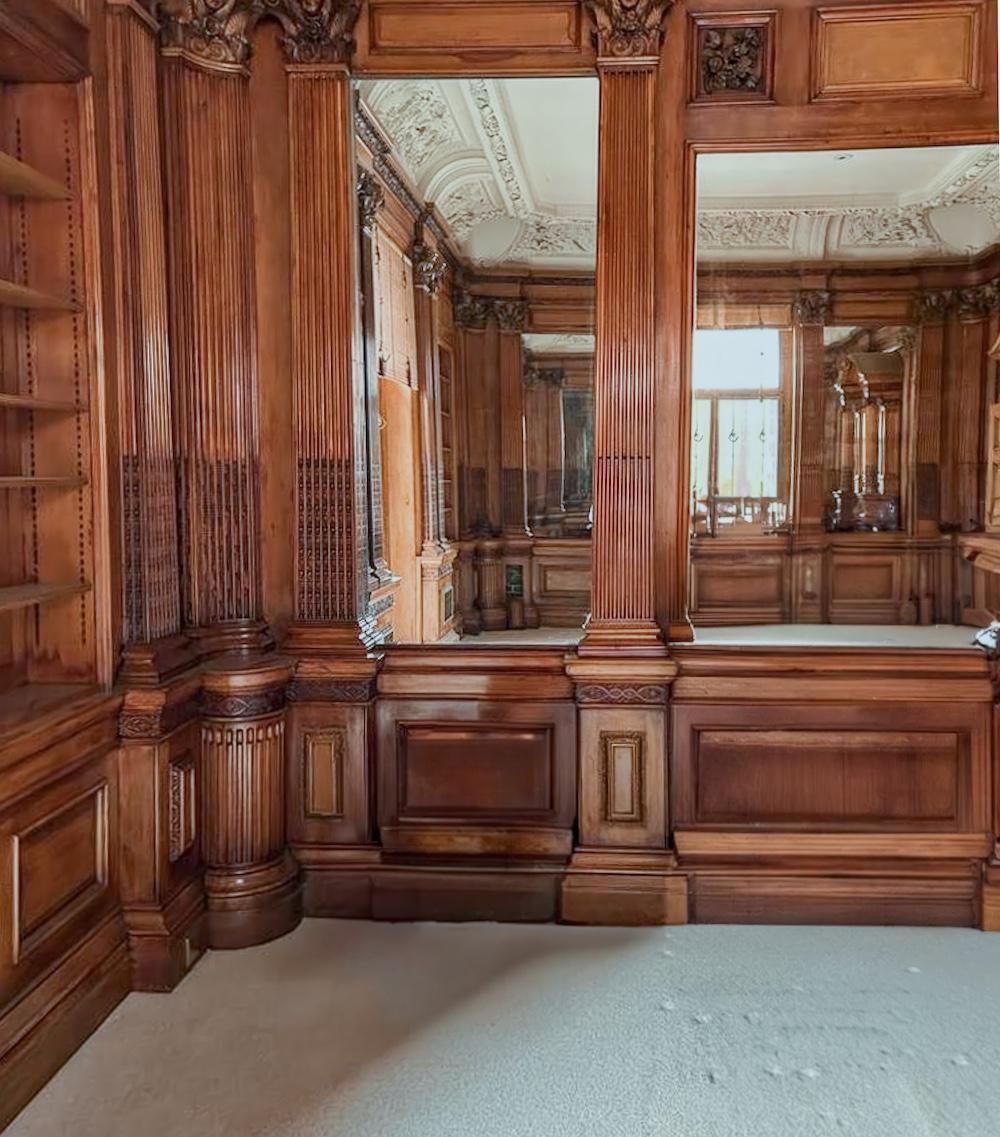
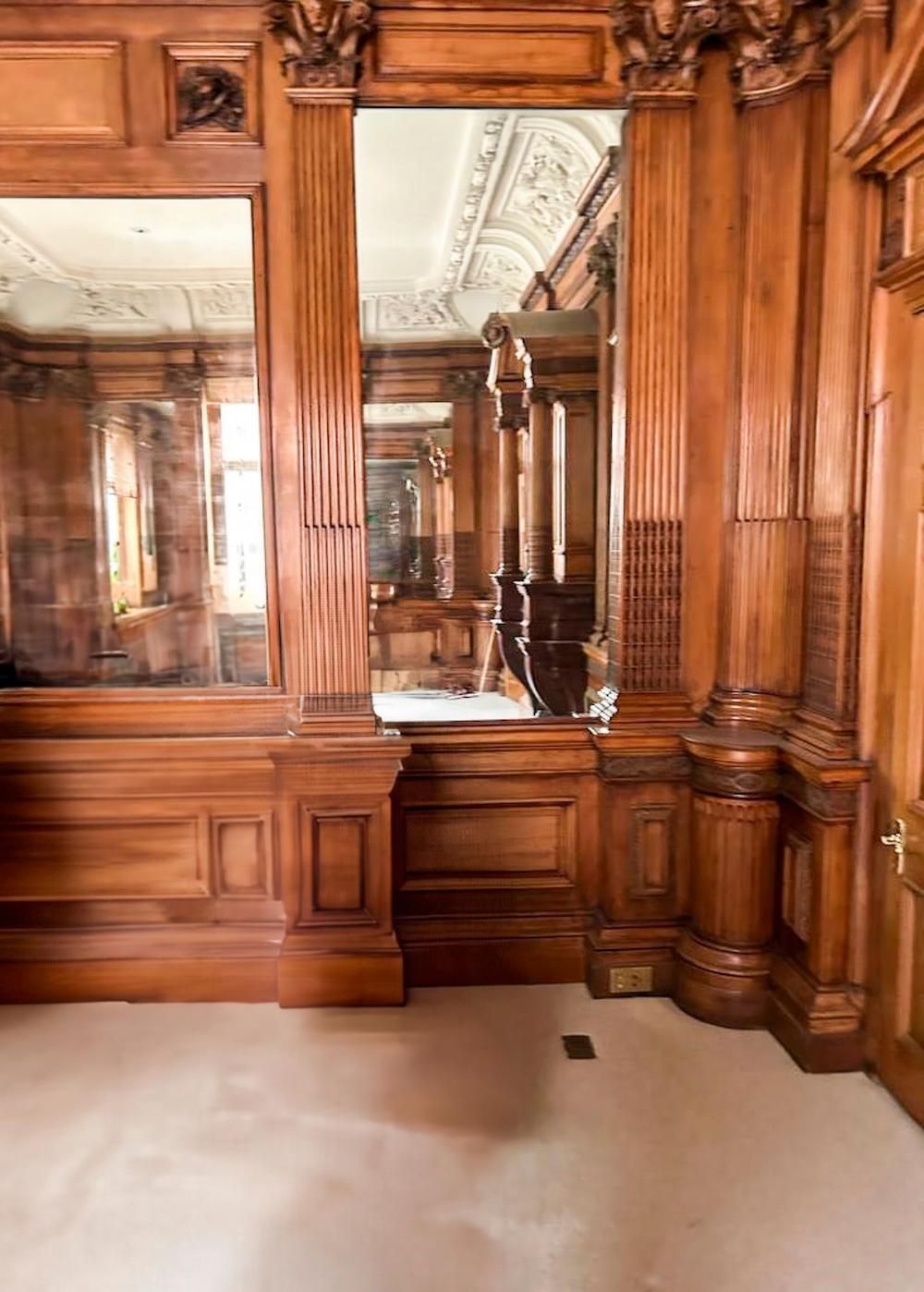
One side with a window flanked by two mirrors. The opposite side with three large mirrors.
The complete room measures:
21 ft / 6.4 m wide, 17 ft / 5.18 m deep, and 12 ft / 3.65 m high.
It could also be used in a number of different combinations to suit various room layouts. The mirrors could be replaced with windows or further bookcases.
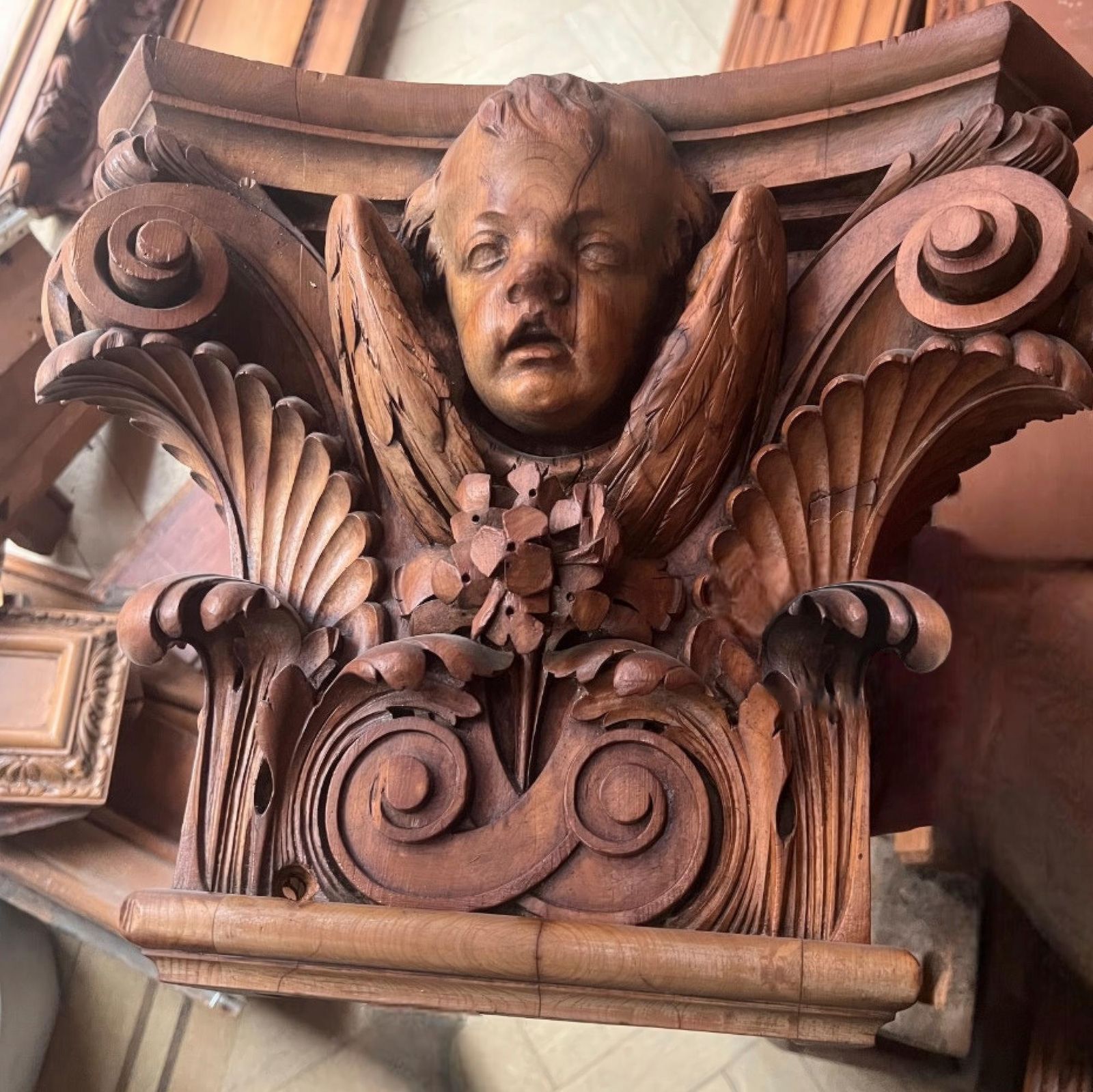
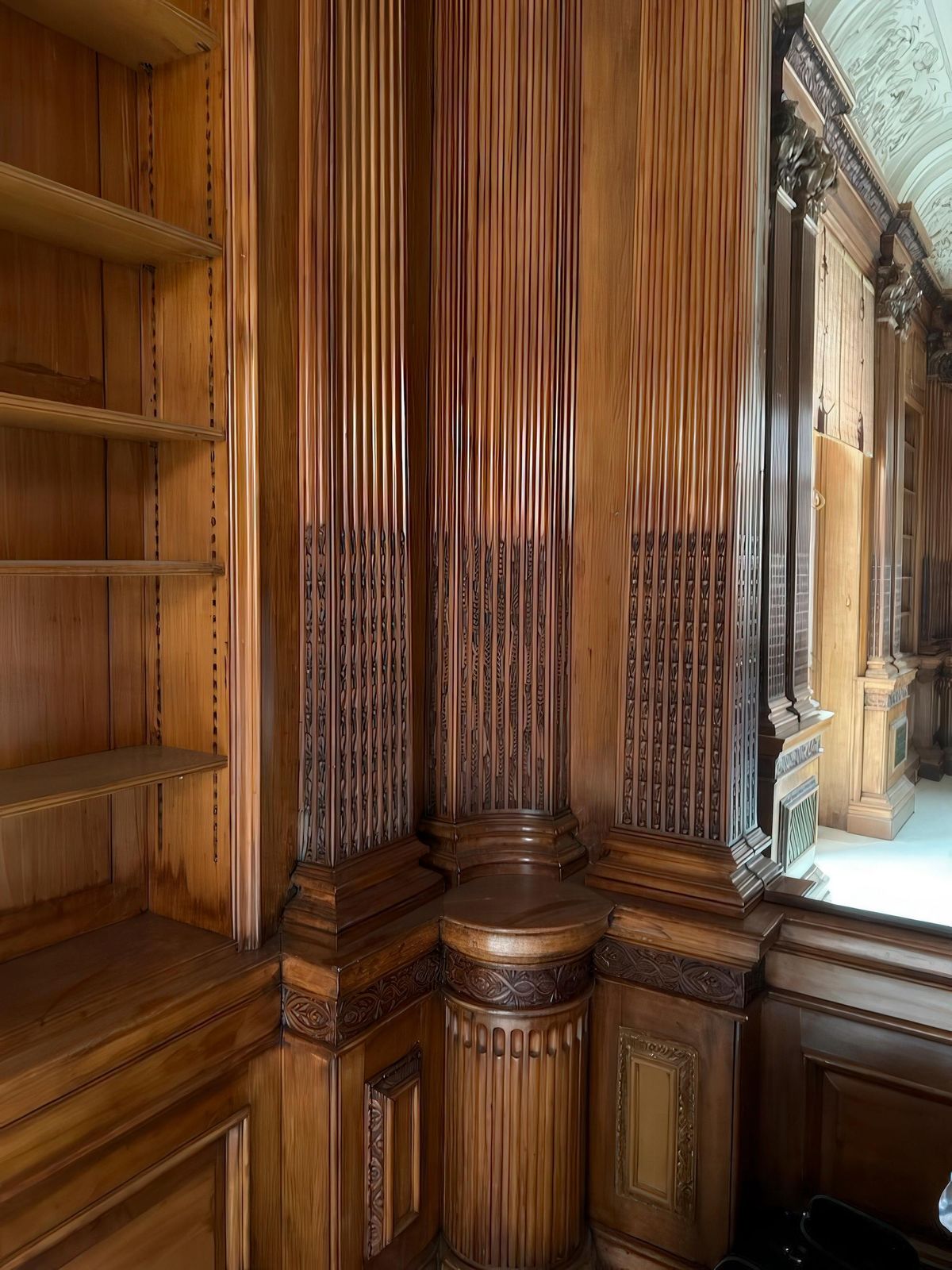
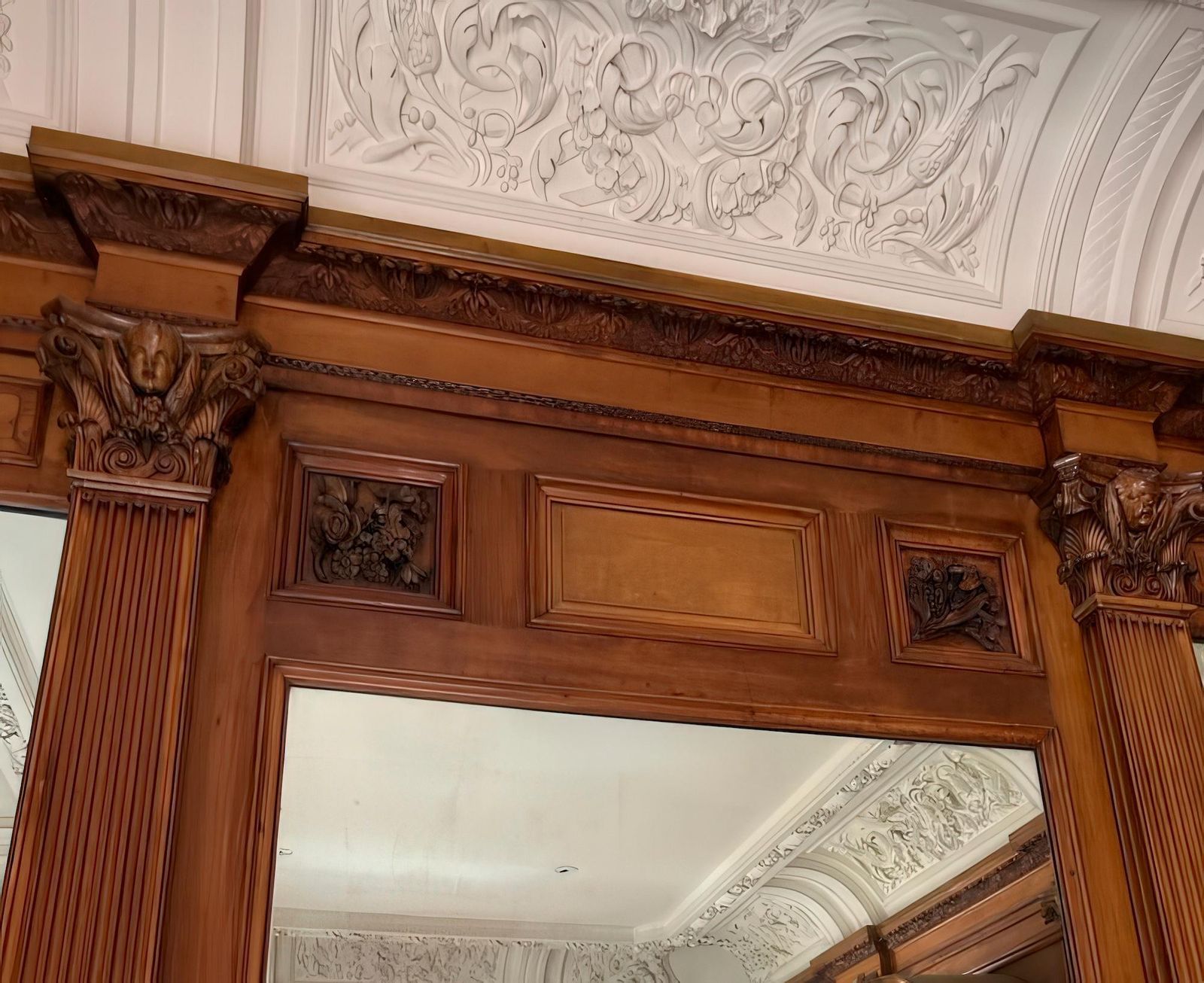
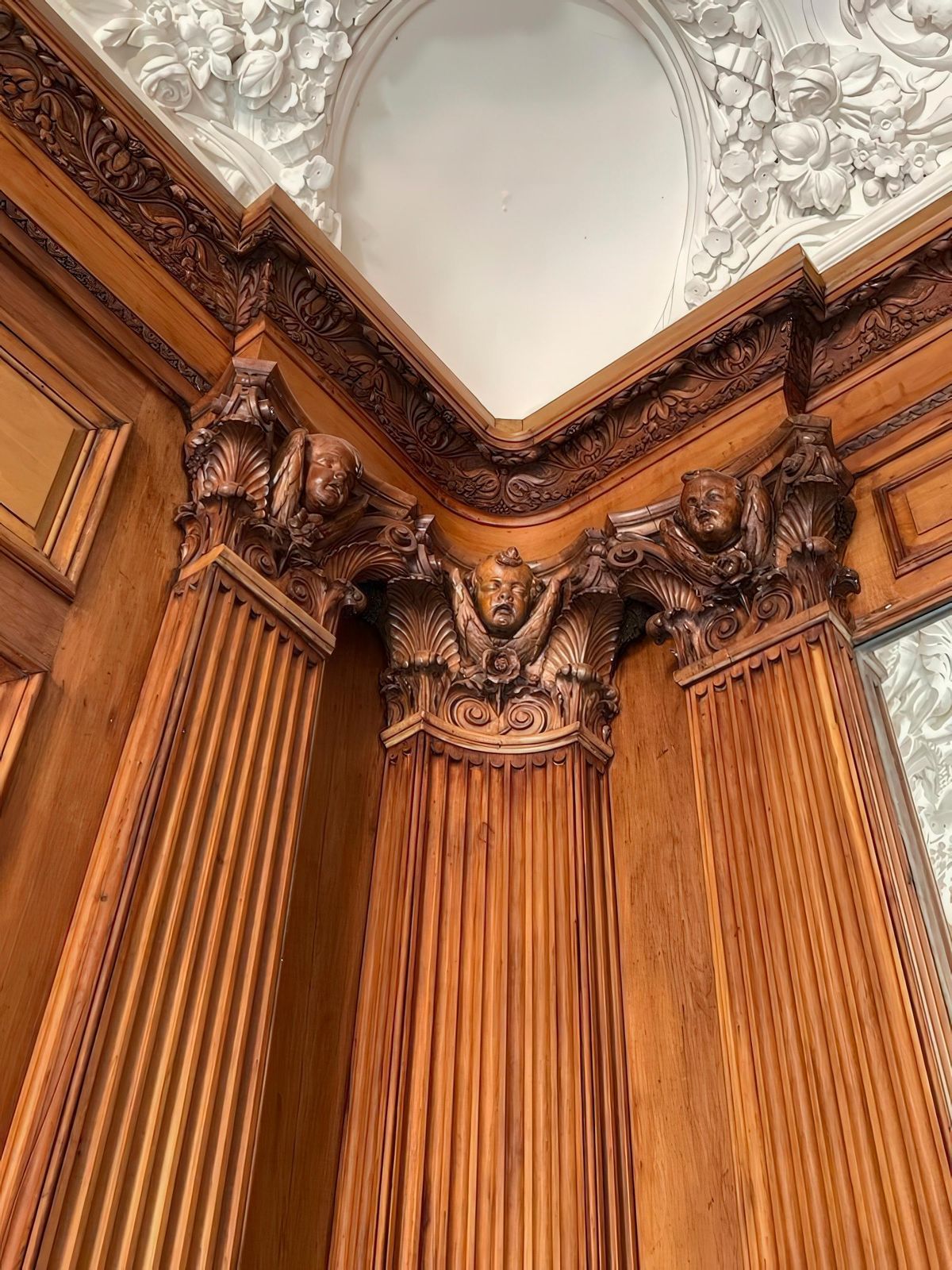
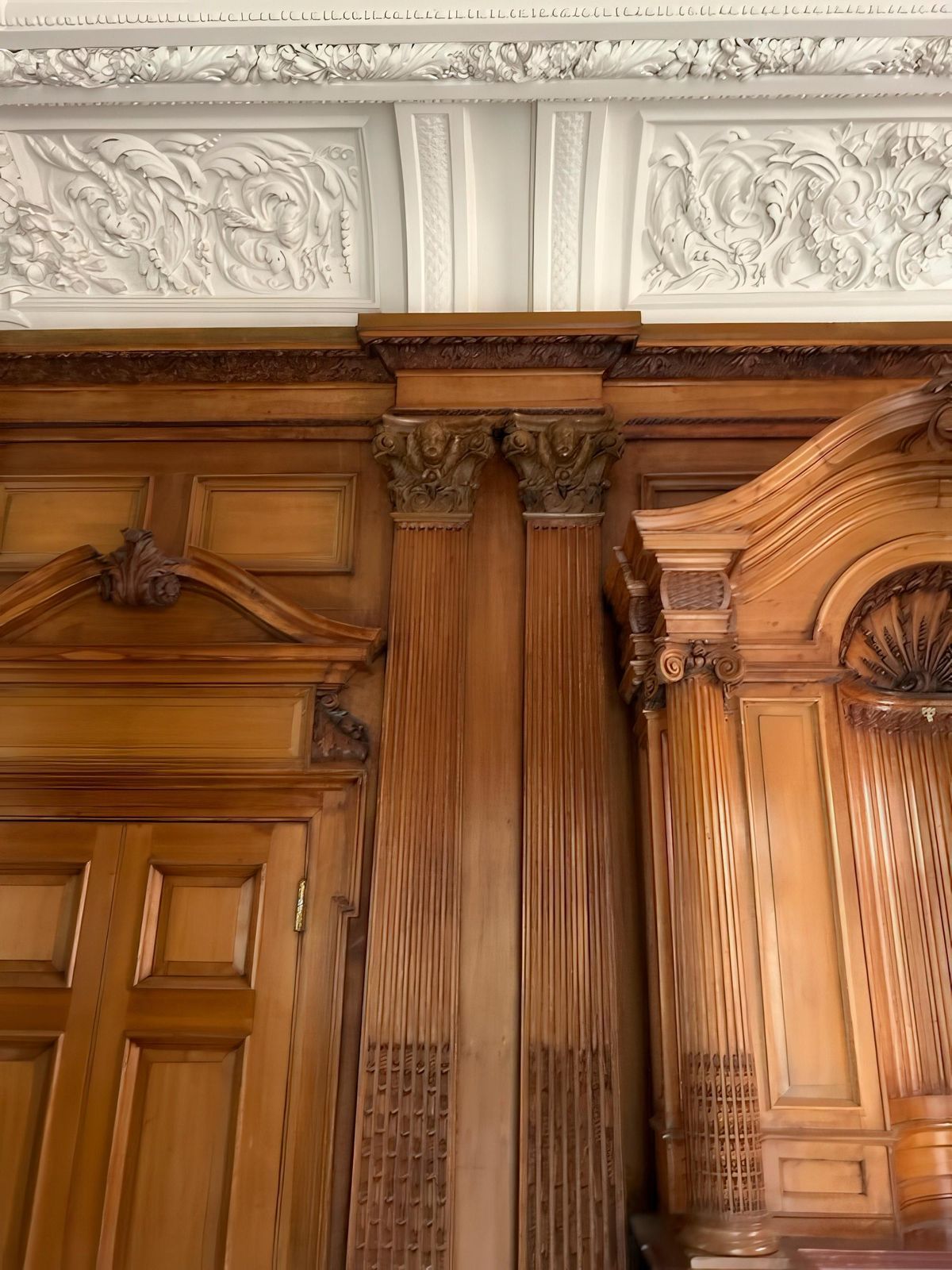
Each side is decorated with various sizes of finely carved panels and holds ornate Corinthian style columns surmounted with cherubim's on the capitals. Three cherubs are formed at the top of each corner with three columns, at the column bases there are circular carved pedestals to display statues.
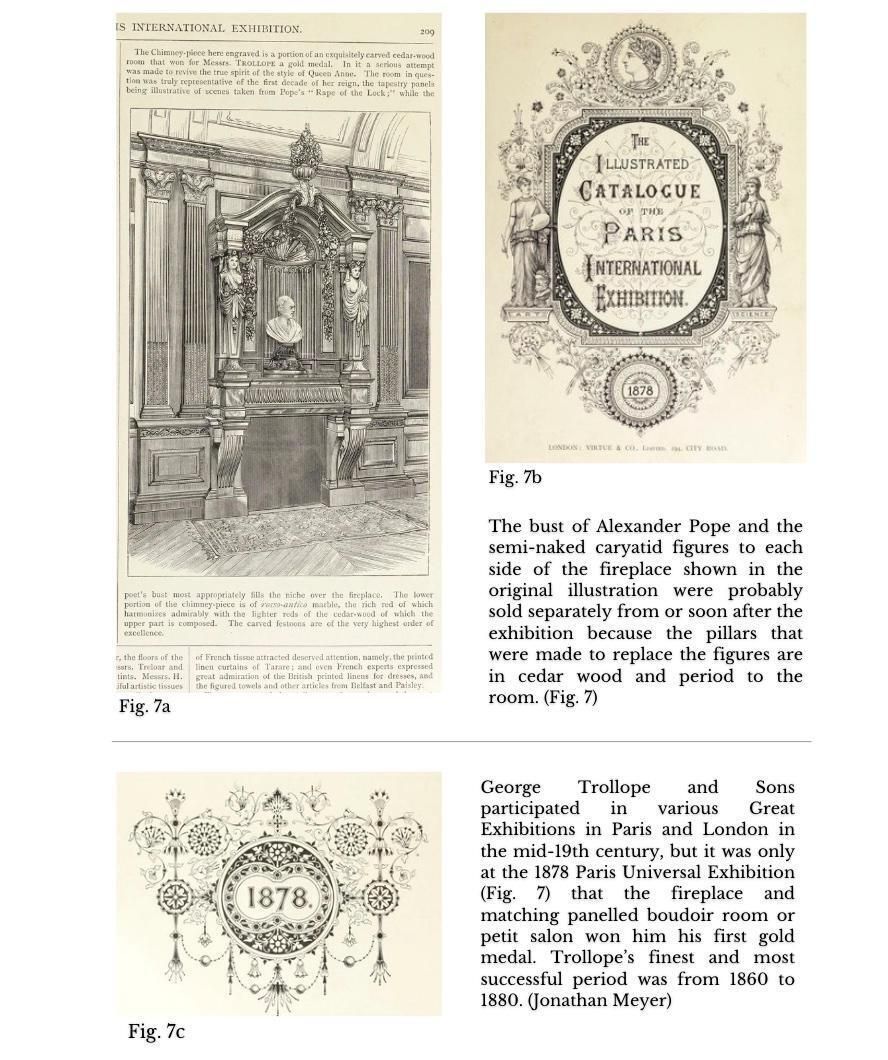
Published & illustrated in the ‘Illustrated Catalogue of the Paris International Exhibition’.
The main part of this room, the Rosso Antico marble fireplace is surmounted by a large open display niche carved in cedar wood are illustrated with a line drawing in the Paris Universal Exhibition catalogue on page 209. The whereabouts of the seminaked caryatids and the marble bust of Alexander Pope are unknown. The bust of Alexander Pope was copied from the original one in Westminster Abbey, London.
The Corinthian columns now flanking the niche above the fireplace are also in cedar wood having the identical carved fluting to the rest of the room and were made to replace the caryatid figures. Those Corinthian columns are period to the room and can only have been made shortly after it arrived back to London and before it was reassembled and fitted into the house built by George Trollope and Sons in the 1880's, and where we removed it all from.
George Trollope made clever use of Alexander Pope's early 18th-century poetical successes in Great Britain and France by using ‘The Rape of Lock’, a mock-heroic narrative poem Pope wrote in 1712 about Petre who cut off a lock of Arabella’s hair without her permission, as the theme of the boudoir room or petit salon at the 1878 Paris Exhibition.
In the original exhibition display of the room set, tapestries depicting the Rape of Lock were hung where the mirrors are now positioned.
Alexander Pope's The Rape of the Lock is a humorous indictment of the vanities and idleness of 18th-century high society. Basing his poem on an actual incident among two families of his acquaintance, Pope intended his verses to quench hot tempers and to encourage his friends to laugh at their own foolishness.
The poem is an outstanding example in the English language of the genre of mock-epic. The 'epic' was considered one of the most serious of literary forms; it had been applied, in the classical period, to the trivialities of love and war. Pope’s mock-epic is not to mock the form itself, but to mock his society in its very failure to rise to epic standards, exposing its pettiness by casting it against the grandeur of the traditional epic subjects and the bravery and fortitude of epic heroes: Pope’s mock-heroic treatment in The Rape of the Lock underlines the ridiculousness of a society in which values have lost all proportion, and the trivial is handled with the gravity and solemnity that ought to be accorded to truly important issues. The 18th-century society in this poem fails to distinguish between things that are important and things that are not. The poem mocks the men it portrays by representing them as unworthy of a heroic culture. Therefore the mock-epic follows the epic in that its main concerns are serious and moral. The point that the theme must now be satirical rather than earnest is symptomatic of how far the culture has fallen.
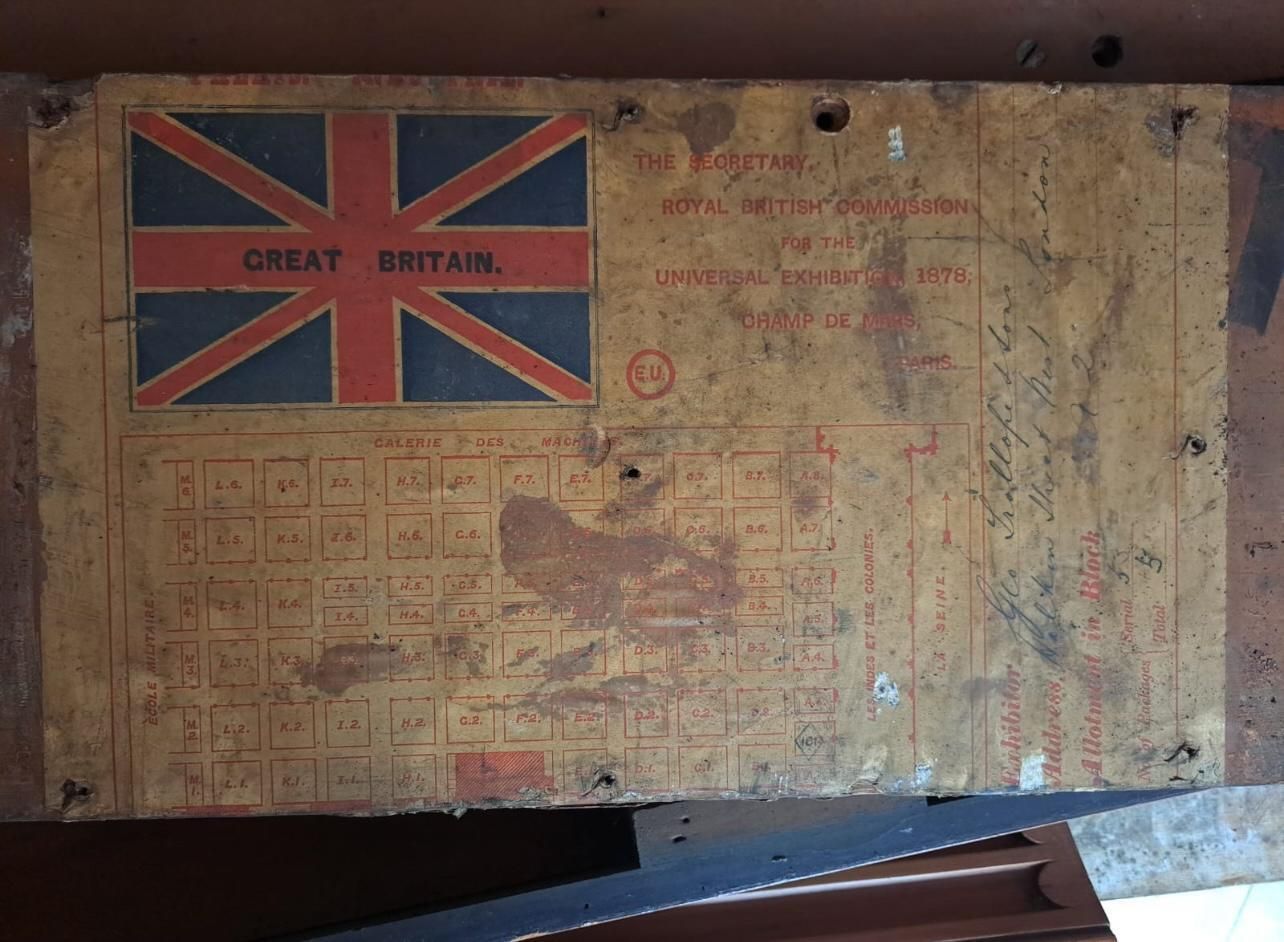
Retaining the original exhibition label
The back of the panelling still retains two original labels printed with the 'Union Jack' and printed adjacent to it, 'The Secretary Royal British Commission for the Universal Exhibition 1878 Champ de Mars Paris'.
Adjacent to that and below, printed and written in ink vertically:
Exhibitor: (and signed in ink) George Trollope & Sons.
Address: (written in ink) Halkin Street West. London.
Allotment in Block: (written in ink) a2. In the printed floor plan 'a2 square' is in the very first line to the right of the floor plan and handwritten in ink with a 'diamond shape' also written with '101' within it. This pin points where George Trollope's stand was located.
With thousands of items being displayed at the Exhibition, this label would have been the floor plan for the craftsmen, so they knew the correct place to install the boudoir room or petit salon.
The firm continued expanding house building and interior decoration side of the business and by 1849 was also trading as an estate agency, letting and controlling property for the Grosvenor Estates. A separate branch of cabinet-makers, bearing the family name, was opened at West Halkin Street, London. becoming known as 'The Museum of Decorative Arts' (looked after by George Robinson). Here Trollope and Sons also sold high-class antique furniture made by other makers. In 1851, the firm became formally known as George Trollope and Sons. West Halkin Street, London. The address was recorded in the listing for the firm in The Furniture Gazette Directory, 1876 & 1877.
Period Press Coverage & Art Critic Review.
everal newspapers also thoroughly describe George Trollope and Son's stand including the different tapestries that were hung where the mirrors are now, illustrating the poem 'The Rape of Lock', by Alexander Pope.
Marius Vachon, a French Art Critic and journalist, who wrote for the journal ‘La France’ published an extensive review of the Trollope and Sons stand in a book called Les Merveilles de l'Exposition de 1878 (The Wonders of the 1878 Exhibition).
Note: In the World Fairs translation it states door frame, Marius Vachon had originally written ‘chambranle’ in French, 'chambranle' loosely translates to a frame around something, and should read in its correct context: ‘fireplace in rosso antico’.
We have taken the extract below written by Marius Vachon in its translated form from: Les Merveilles de l'Exposition de 1878, (The Wonders of the 1878 Exhibition). This puts into perspective the importance of this fine quality room interior when he viewed it at the exhibition in 1878:
Marius Vachon: English furniture is very curious to observe; irreproachable from the point of view of execution, the furniture of our neighbours always reaches the last degree of respectability and comfort. One thing to be noticed is that for large pieces of furniture, the English upholsterer is transformed into a sort of architect; everything he makes takes on a monumental aspect.
The first object that catches the eye when one enters the furniture class is the beautiful boudoir-salon exhibited by Mr. Trollope. The boudoir (or petit salon), of carved cedar wood, is an attempt to reproduce the style which prevailed in England during the first decade of Queen Anne's reign, and all the details have been studied, but not copied, from examples of decorative work of the time. The fireplace is in "rosso antico" movement, and the ceiling is in portable plaster. The panels painted on canvas represent scenes from the heroic-comic poem "The Abduction of the Hairpin," (The Rape of Lock) written by Alexander Pope in 1712, the eighth year of Queen Anne's reign, in which the customs and mores of the time are satirized in a pleasing manner.
The apotheosis of the Loop and its sidereal transformations will form the decoration of the ceiling. In these illustrations of Pope's charming poem, the costumes and accessories have been taken from models of the time; and the bust of the poet, copied from his tomb in Westminster Abbey, occupies the niche in the centre of the mantelpiece.
M. Marius Vachon, the period writer of the above continues with:
Now we shall mention at random the magnificent dining table of Messrs. Johnston and Co., their oak mantelpiece, their boudoir table; Mr. Watt's drawing-room mantelpiece stepped in the old style and imitating the Japanese; Mr. James Shoolbred's great
The Decorative Arts Society on Trollope and Sons
The boudoir or petit salon is mentioned again in the Decorative Arts Society:
Trollope did not exhibit such highly rated objects at the 1878 Paris Exhibition as at previous exhibitions; items included a large mirror frame carved in limewood in Renaissance style and a satinwood cabinet in Adam revival style, with a similar armchair (illus. Meyer (2006), p. 242) and probably two rooms; one was a boudoir in cedar wood in Queen Anne style and the other was a boudoir decorated by the firm in the theme of Pope’s The Rape of Lock.
In the above extract, it is quite clear that the two rooms mentioned are in fact the very same room, because the fireplace and niche are illustrated in The Paris Universal Exhibition catalogue on page 209 and Marius Vachon describes the rest of the room set in the above…
Trollope and Sons exhibition pieces listed and described by Meyer in an article he wrote for: The Decorative Arts Society 1850 to present, Journal 25 in 2001., where he points out the importance of George Trollope and Sons and mentions a table by Trollope exhibited at the 1867 exhibition that sold for £40,000 in 1996. He also mentions a cabinet exhibited by Trollope at the International Exhibition of 1862 that sold at Sotheby's in 1997 for £150,000.
Interest was not as strong in the 1990's as it is today for rare exhibition pieces, high quality items were abundant back then, it was a golden era when the most beautiful works of art just kept coming onto the market. But there are exceptions as in this instance, when a unique, gold medal-winning exhibition work of art comes onto the market for the very first time.
Meyer continued researching and writing about the great exhibitions and released his book in 2006, 'The Great Exhibitions, London, New York, Paris and Philadelphia 1851- 1900, where he mentions only in passing, The Boudoir Room or Petite Salon exhibited by Trollope, he even states that an image was not reproduced and that Trollope's exhibits in 1878 were not up to the quality and class of the items Trollope exhibited in London in 1862 and Paris in 1868. This is probably because Meyer didn't know of the line drawing illustrating the Roso Antico Fireplace, Niche and Panelling reproduced in The Illustrated Catalogue of the Paris International Exhibition 1878 shown in the above which Geering recently uncovered.
John Meyer continues in the DAS journal:
Undoubtedly they (Trollope) are a firm worthy of further research as they were right at the forefront of the furniture business in London from 1860 to 1880.
Our research shows that the Petite Boudoir was awarded the gold medal for excellence in 1878 (see Journal La Liberté 23-10-1878 with the list of all medals attributed), something George Trollope and Sons did not achieve at the London 1862 and the Paris 1867 exhibitions. Jonathan Meyer joined Bonham's in 1977. He was Director at Sotheby's in charge of 19th Century Furniture from 1994 to June 2007. He was also chairman of the Fine Arts Faculty for The Royal Institute of Chartered Surveyors.
In the original description from the article in Les Merveilles de l’exposition de 1878, M. Marius Vachon states:
The first object that catches the eye when one enters the (English) furniture class is the beautiful boudoir-salon exhibited by Mr. Trollope.
Suggesting, it was in his opinion the very best on display in the English section, and being awarded the gold medal for excellence can only add weight to this.
Adjacent to the original label that was printed by The Secretary - Royal British Commission for the Universal Exhibition 1878 in stencil ‘TO BE KEPT’, i.e. ‘to be returned’. This confirms why it came back to London. We removed the Boudoir Room or Petite Salon from a Trollope house, part of a grand high-class housing estate in London which around the time of the exhibition Trollope and Sons were in the process of building, and where the room set was installed directly after it returned from the exhibition in 1878 until now.
Worthy of note is the machines that did the carving for the Boudoir Room or Petite Salon and also did all of the decorative carving (most of which was linenfold carving) for the Houses of Parliament, London.
This machine, the engraving and description of which we copy from Engineering, was specially designed by its inventor, Mr. Jordan, for assisting in the production of the vast amount of carved decorations required for the walls and ceilings of the Houses of Parliament, London, and it was so employed during the entire progress of the work. The late Sir Charles Barry was so well satisfied with it, that he frequently declared it would have been impossible to have accomplished the work without it. The Department of Woods and Forests employed five of the machines at the Government Works, Thames Bank, for several years; and the machines have now passed into the hands of Messrs. George Trollope and Son, and are still used in the same building.
They also exhibited the new technique of xylatechnography and sgraffito, methods of impressing coloured design into soft wood and engraving veneer to reveal the base wood.
The newspaper, La Liberte October, 23rd 1878 listing the medal winners of the Paris 1878 exhibition. Third column, ''GROUPE III MOBILIER ET ACCESSOIRES'', (GROUP III FURNITURE AND ACCESSORIES). Medailles d'or. (Gold Medals) where G Trollope et fils (G Trollope and Sons) are listed
George Trollope & Sons
George Trollope & Sons were registered under this name in 1843 and are recorded in West Halkin Street, Belgrave Square, London by 1864.
They undertook large scale refurbishments of residential property and in this way supplied furniture and decorations made by them to only the wealthiest of clients.
The firm was highly considered by the 1860s and exhibited at several International Exhibitions. They became very successful during the second half of the nineteenth century building the highest quality houses of the period and producing a wide range of goods and decorations to noble families and well connected clients
In 1830 J & G Trollope became paper hanger to King George IV and in that year submitted a bill, headed by the Royal Arms, to John Arkwright of Hampton Court, Leominster.
Her Majesty's Theatre completed in 1869
St Philip's Church, Battersea completed in 1870
Furnishing for Fairlawns, Tonbridge for Edward Cazalet - 14 Nov 1874 & 13 Feb 1875 Cadogan Estates from 1876 to 1889 - The most expensive and exclusive estate in London to date
Interior fittings for Knoyle House, Wiltshire, for Alfred Seymour - 7 February 1880
George Trollope & Sons exhibited architectural decorative panels at the Arts & Crafts Exhibition Society, London, 1889 and 1890.
The Institute of Chartered Surveyors was completed in 1892
Claridge's completed in 1897
The Baltic Exchange building was completed in 1903 although it was demolished in 1998. The site, together with that of the Chamber of Shipping at 30–32 St Mary Axe, was used for the building of 30 St Mary Axe commonly referred to as "The Gherkin".
George Trollope & Sons - Clientele
The Golden Milestone, published 1 Jan 1910 by Trollope & Sons, Artists in Decoration since A.D. 1778, at West Halkin Street Galleries, Belgrave Square.
Colour illustrations show various room styles and the text promotes the firm's ability to provide either a complete design service or simply the provision of individual elements (furniture, carpets and curtains, decorations, light fittings etc.) To give prospective customers reassurance about the quality of the firm's work, the publication has a four page list of clients, these were:
Mrs. B.E. Agar, Lord Airedale, the Earl of Albemarle, the Marquess of Anglesey, Viscount Astor, Sir Otto Beit, Sir Archibald Birkmyre, the Duke of Buccleuch, the Earl of Cadogan, C.H. Combe, Sir William Corry, Viscount Cowdray of Midhurst, the Countess of Craven, Lord Crawshaw, Lord Dalmeny, Lord D'Abernon, E.R. Debenham, Lord Devonport, Greville Douglas, Antony J. Drexel, J. Lionel Dugdale, the Countess of Dundonald, F. Eckstein, Sir J.R. Ellerman, Lord Elphinstone, Lord Faringdon, Dennis Farrer, Sir E. Johnson-Ferguson, A.W. Gilmour, Lord Glenconner, Lady Esme Gordon, Mrs Ronald Greville, R.L. Gunther, Sir Eric Hambro, H.C. Hambro, R.O. Hambro, Cuthbert Heath, Hon. A.P. Henderson, Hon. E.B. Butler-Henderson, Lord Hillingdon, Sir George Holford, Sir G. Thompson-Hutchinson, the Earl of Iveagh, S.B. Joel, E.S. Kadoorie, the Earl of Kenmare, Sir Alexander D. Kleinwort, H.G. Kleinwort, F.A. Konig, Lord Kylsant, the Earl of Lonsdale, Lady Ludlow, Lady Lyle, the Mackintosh of Mackintosh, the Duchess of Marlborough, Hugh Morrison, Hon. H.D. McLaren, the Duke of Newcastle, the Duke of Northumberland, Hon. Clive Pearson, Hon. Harold Pearson, Sir John Denison-Pender, Sir Lionel Phillips, Sir William Plender, Countess of Portarlington, the Duke of Portland, Earl of Reading, Lord Revelstoke, Duke of Richmond and Gordon, Viscountess Ridley, the Earl of Rosebery, James de Rothschild, the Earl of Scarborough, Viscountess St. Cyres, the Duke of Sutherland, Sir George Touche, Sir John Ward, Lady Margaret Waterlow, the Duke of Westminster, Lord Wolverton, Sir Alfred F. Yarrow. Carlton Club, Guards Club, Junior United Service Club, Junior Carlton Club, Royal Air Force Club, Royal Automobile Club and Union Club.
Literature:
The Illustrated Catalog of the Paris International Exhibition, 1878
Worldfair info website
The Furniture History Society
Vintage Machinery
Official Catalog of the exhibition (in French)
Les merveilles de l'Exposition de 1878
La Liberté - 23-10-1878 Gold Medals
Condition report:
Wear consistent with age and use. Condition report: The complete original panelled room and the Rosso Antico marble fireplace were all removed successfully and are in wonderful original condition.
Wear Condition
Average
Cancellations
We offer free cancellations and full refund for orders cancelled before dispatching. View full policy.
Returns
We have a 14-day return guarantee for orders from individual sellers, within the UK and European Union. View full policy.
Additional Delivery Info from Seller
Estimated delivery time
Less than one week
Free collection available
No
Made to Last
The average lifespan of a Vinterior piece is 100 years, while modern flat-pack typically takes just 3 years to reach landfill. When you choose pre-loved, you can shop with confidence in quality, craftsmanship and longevity. With our top-rated customer service team and price match guarantee, there's no better way to shop pre-loved.

Shopping at Vinterior


Similar Fireplaces
Similar Fireplaces
Add to a wishlist
Create Wishlist
Completethe room
Good design is all in the layering. Whether you're adding impact or refining the details, now’s the time to find what’s missing.
Reviews
4.67

Based on 3 reviews


Wear conditions
Excellent
Shows little to no signs of wear and tear.
Good
May show slight traces of use in keeping with age. Most vintage and antique items fit into this condition.
Average
Likely to show signs of some light scratching and ageing but still remains in a fair condition.
Apparent Wear and Tear
Visible signs of previous use including scratches, chips or stains.
Please refer to condition report, images or make a seller enquiry for additional information.
Cancellations and Returns
Last updated: 12/02/2026
Clear, predictable protection for every pre-loved purchase.
Simple £75 flat return fee for UK-to-UK mainland furniture when you change your mind.
Applies to furniture with a final selling price of up to £5,000 (excluding delivery and service fees) and delivered from a UK mainland seller to mainland UK addresses. Excludes Northern Ireland, Channel Islands, Scottish Highlands & Islands, Isle of Wight and Isles of Scilly.
Buying vintage should feel inspiring, not uncertain.
Every order on Vinterior is backed by straightforward returns, free cancellations, and extra peace of mind for UK furniture purchases.
1. Free cancellations
Changed your mind before dispatch?
You can cancel any order before it's shipped for a full refund, including delivery.
To cancel an order, click Create cancellation on the order page.
Once an item has been dispatched, delivery costs are not refundable.
Bespoke, personalised or made-to-order pieces cannot be cancelled.
2. Returning an item
You have 14 days from delivery to request a return.
There are two return types:
A. The item isn't as described (free return)
If your piece arrives and it doesn't match the listing in any material way (incorrect description, undisclosed damage, inaccurate measurements, misleading photos), you are fully protected:
- Free return
- The seller or Vinterior arranges pickup
- Full refund, including outbound delivery costs once the seller receives the item
This applies to all purchases.
B. You changed your mind
UK-to-UK furniture deliveries:
To make UK furniture returns predictable and stress-free, we offer a simple flat return fee of £75.
- Applies to furniture delivered from a UK mainland seller to a mainland UK address. Excludes Northern Ireland, Channel Islands, Scottish Highlands & Islands, Isle of Wight and Isles of Scilly.
- Pickup arranged for you
- One clear fee, no surprises
We coordinate the return with either the seller's chosen courier or our trusted delivery partner.
All other items
Most smaller items are straightforward to return.
You can still return your item within 14 days.
- For smaller or parcel-sized items, you can choose to post the item back yourself using a tracked service, or the seller can suggest a preferred courier.
- For larger or more fragile pieces, the seller may recommend the safest return method.
- Return delivery costs vary depending on size and courier.
The seller will confirm the best option based on the item.
3. If your item arrives damaged
Damage on arrival is uncommon, especially for UK furniture deliveries.
But if something does go wrong, you're fully protected.
- Let us know as soon as possible (ideally within 72 hours of delivery) so we can resolve things quickly
- Share photos so we understand what happened
- We’ll help arrange a return and refund if needed
You’re always protected when something goes wrong in transit.
Your statutory rights apply for up to 30 days from delivery.
4. What can't be returned
Some items cannot be returned:
- Bespoke, personalised, or made-to-order pieces
- Items altered after delivery
5. How to start a return
- Log in to your Vinterior account
- Open your order
- Click Create a return
- Add notes + photos if relevant
We'll guide you through the rest.
6. What happens next
- We review your request, confirm the return and advise on next steps
- Pickup or return method is arranged
- The item is returned to the seller
- We issue your refund once the seller confirms the item's condition
Returns are completed smoothly once the pickup is arranged.
7. Refunds
Once the seller receives the piece back in the same condition it was sent, we'll issue your refund to your original payment method.
Once a refund is issued, it may take up to 5–10 working days for the funds to appear back on your original payment method, depending on your bank or card provider.
If the item is returned with new damage that wasn't present at delivery, the refund may be adjusted following review.
Need help?
If you have questions about a return or your order, our support team is here to help. Email us at [email protected] or find other ways to contact us here.
What your service fee covers
-
 14-day return guarantee
-
Flat-fee return shipping on UK furniture
-
Seller vetting
-
Dedicated customer support
| Order Value (£) | Fee (£) |
|---|---|
| 0 — 49.99 | 2.75 |
| 50 — 99.99 | 5.50 |
| 100 — 199.99 | 11.00 |
| 200 — 399.99 | 21.00 |
| 400 — 599.99 | 30.00 |
| 600 — 799.99 | 40.00 |
| 800 — 999.99 | 50.00 |
| 1,000 — 1,499.99 | 55.00 |
| 1,500 — 1,999.99 | 60.00 |
| 2,000 — 4,999.99 | 82.50 |
| 5,000+ | 110.00 |
Added at checkout, based on your basket total.
