


Antique French Gilt Bronze Clock With Portrait Plaque Of Molière C.1860

 London, United Kingdom

Hassle-free returns
-
 Easy returns (14 days)
-
Free return if the item isn't as described
-
Buyer protection
Damage is rare, and you're fully protected if it happens.
Dimensions
Wear Condition
Excellent
Material
Porcelain
Style
Antique, Italian Antiques
Product Details
Description
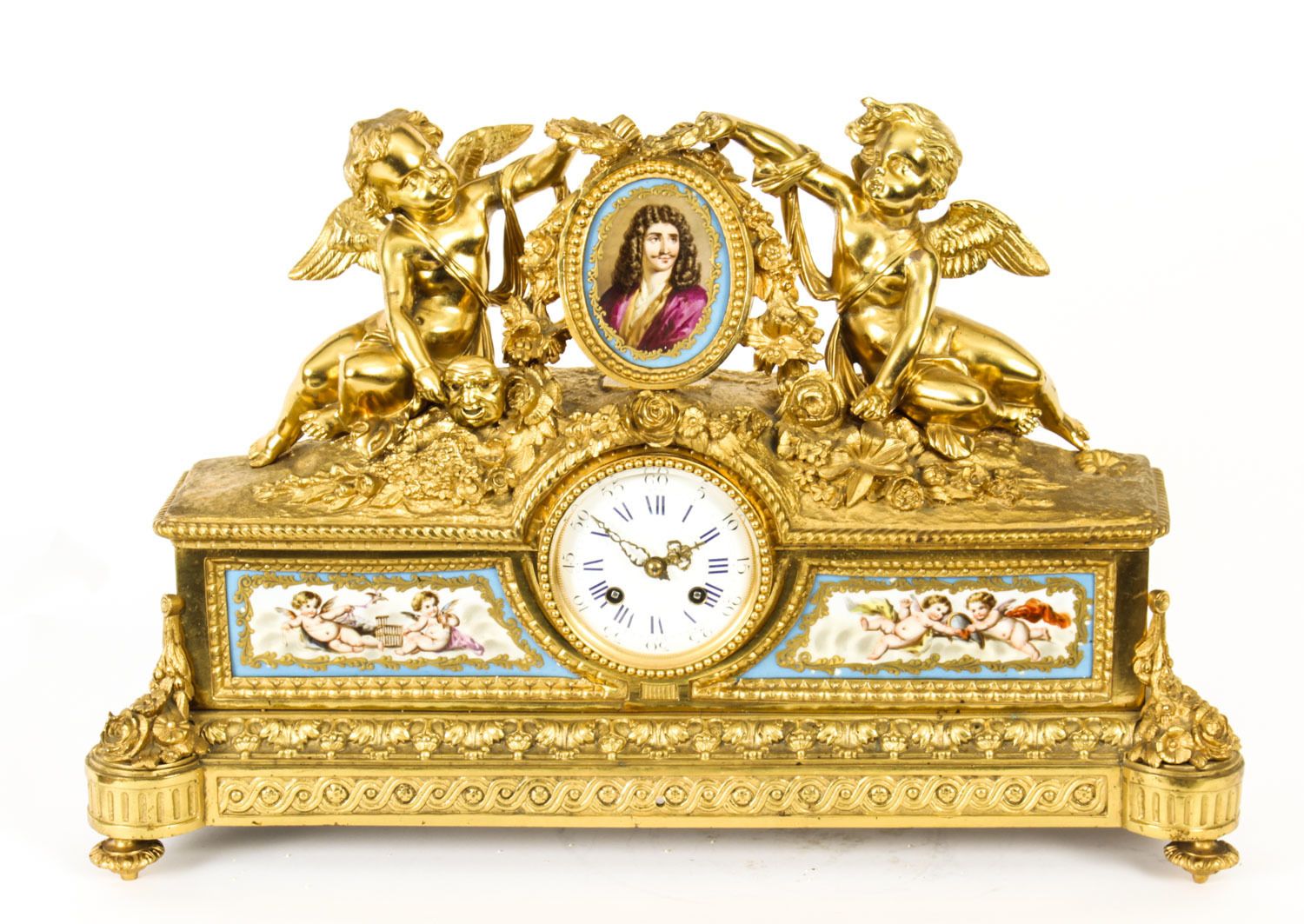
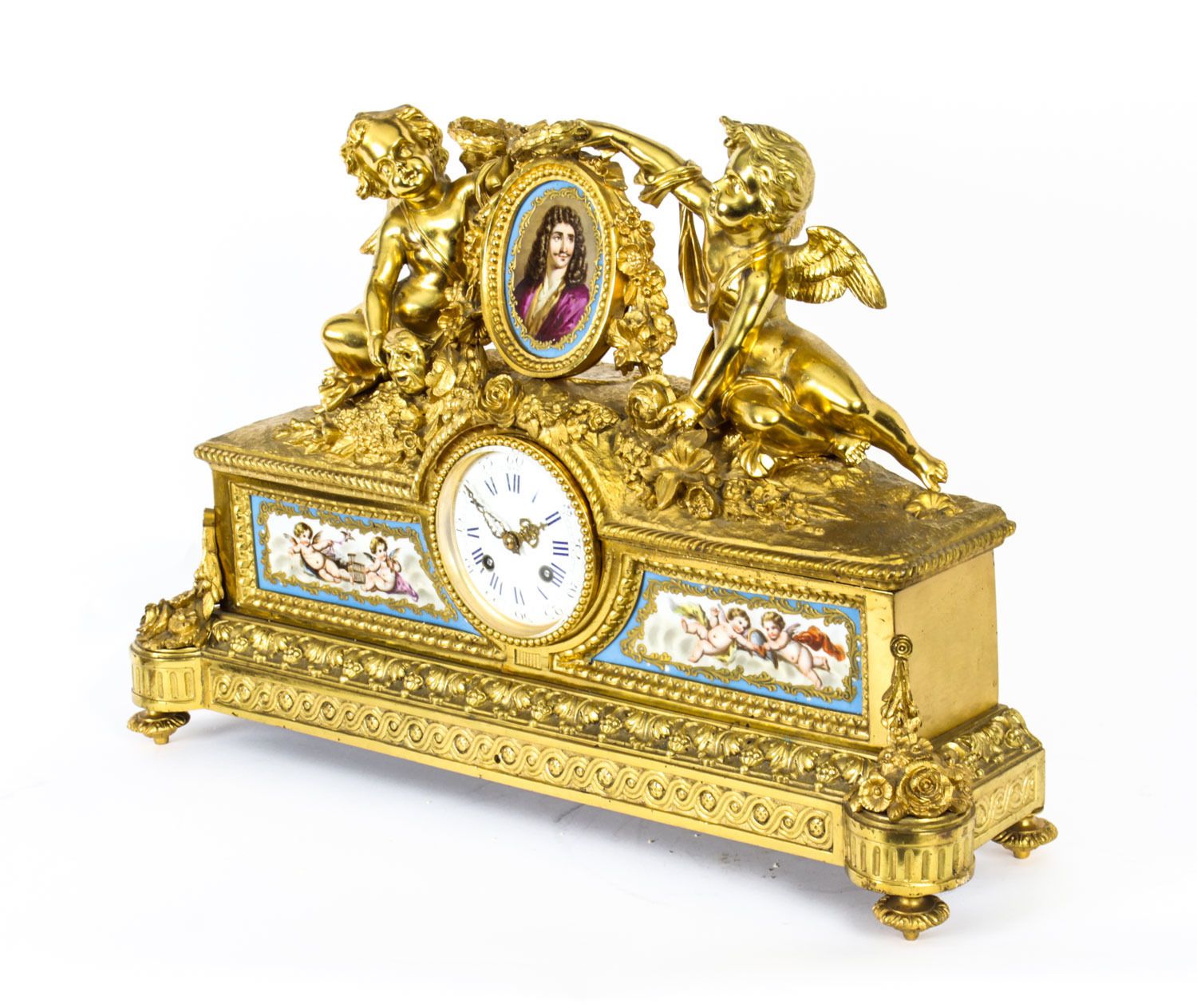
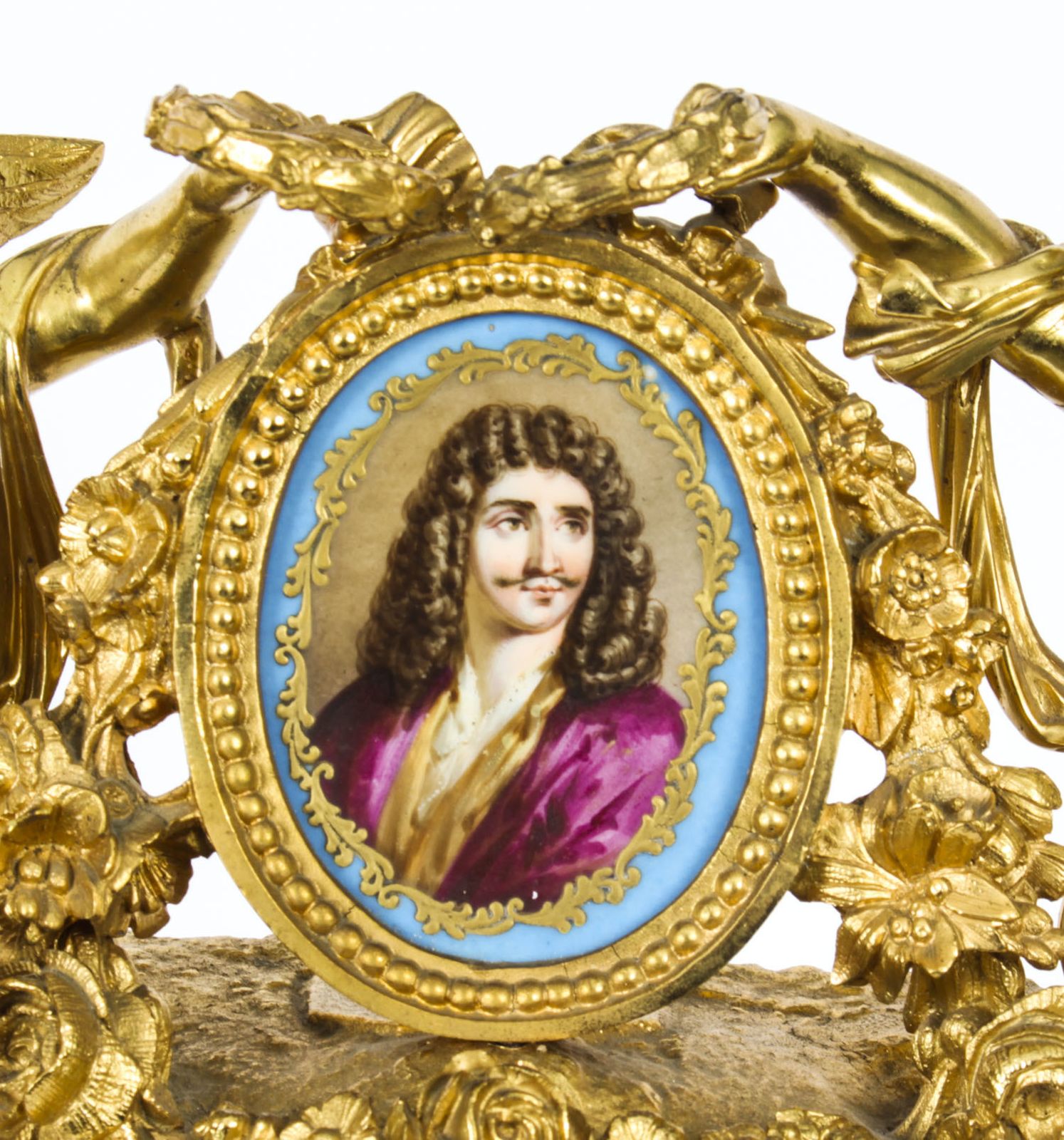
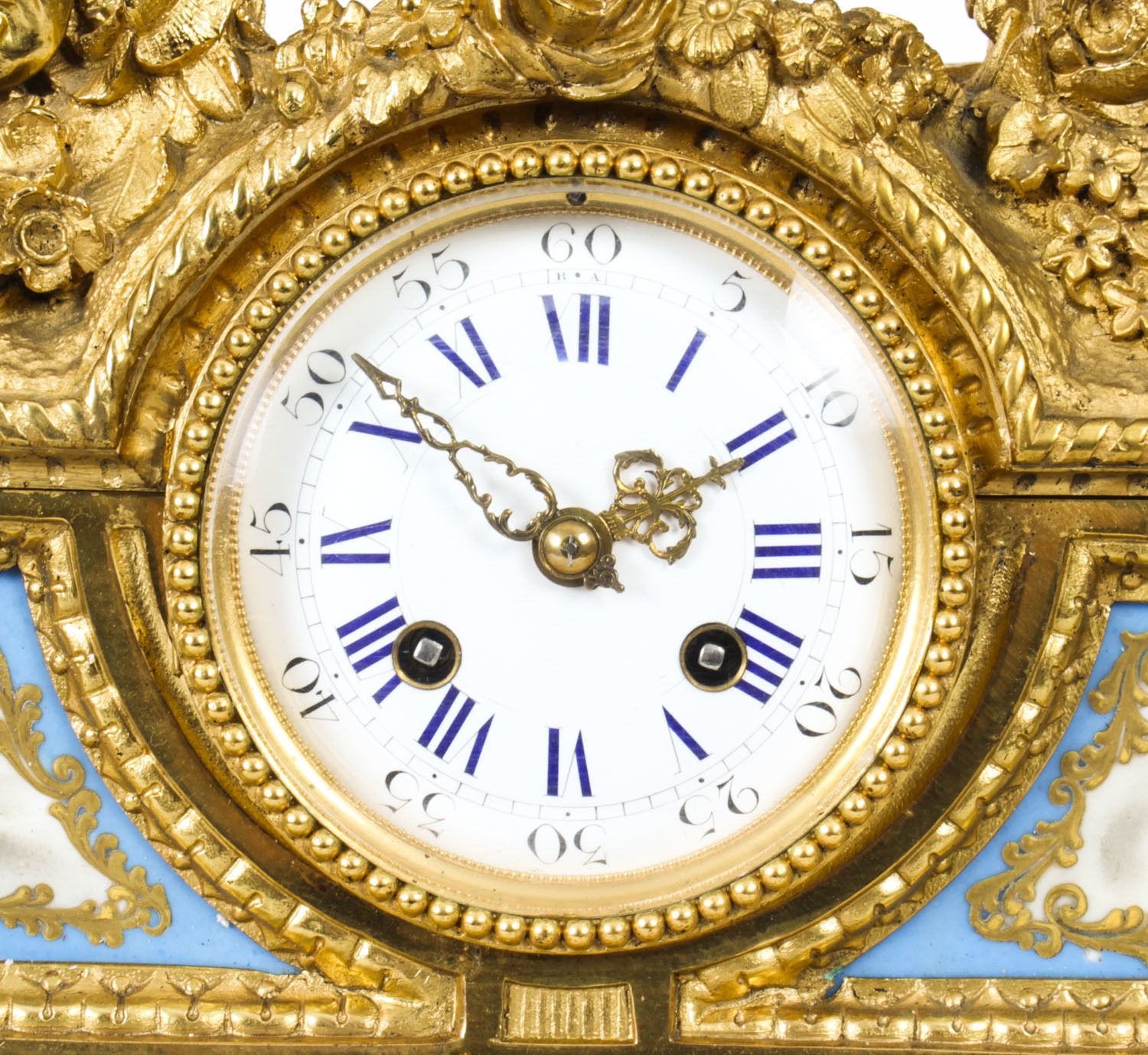
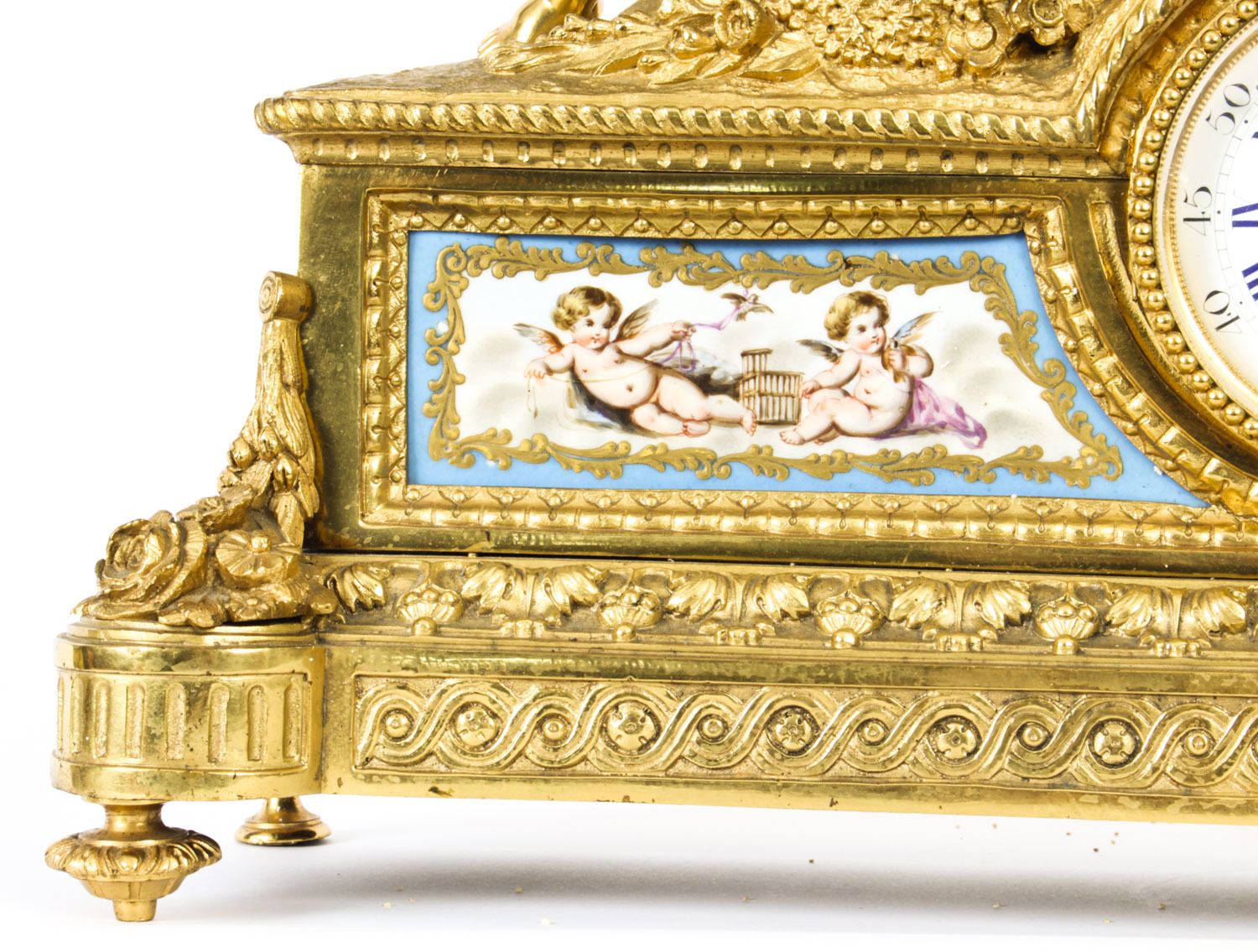
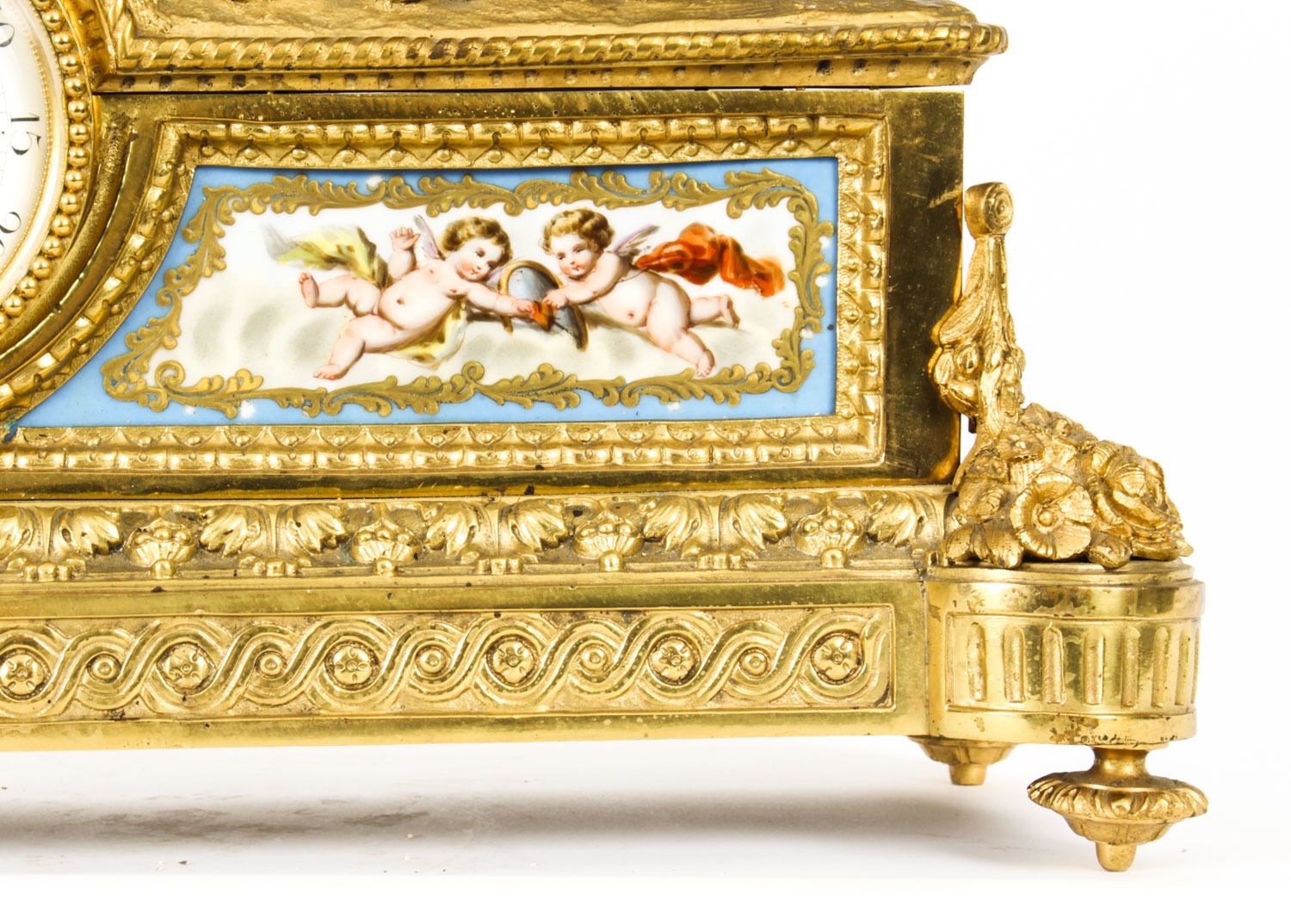
This is a superb antique French gilt bronze mantel clock with Bleu Celeste porcelain panels in the Sevres manner, circa 1860 in date.
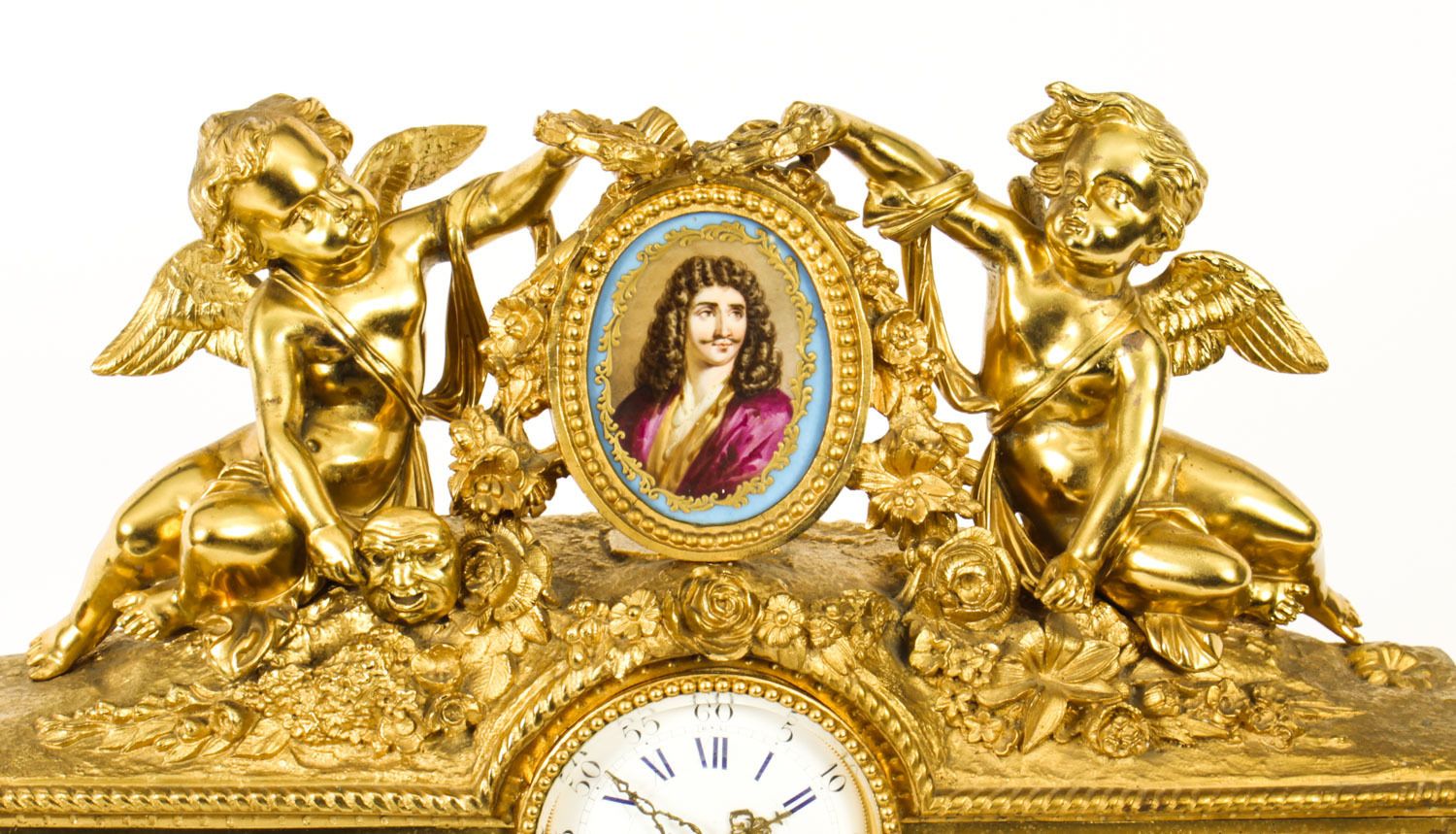
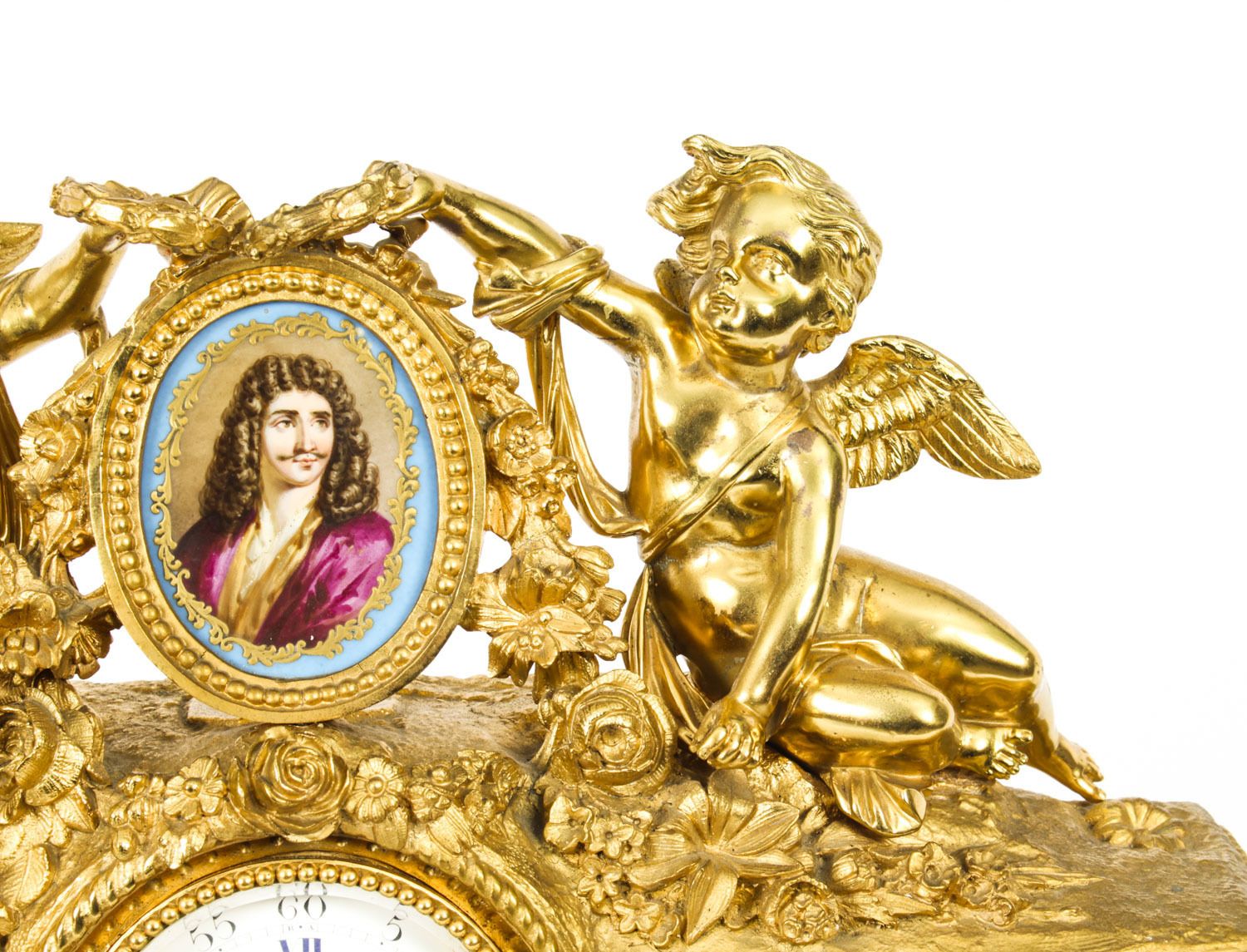
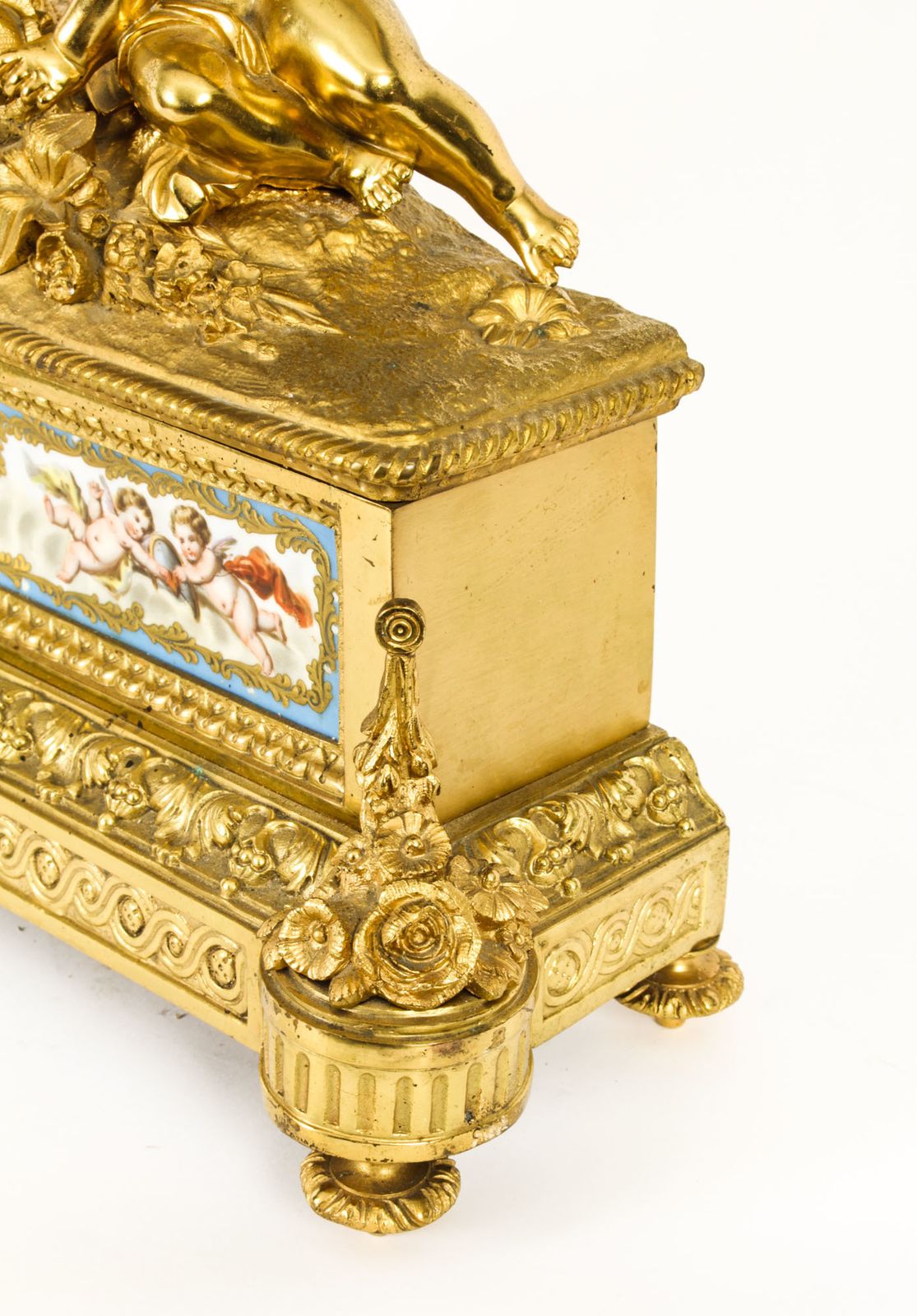
The case crowned with two cherubs holding laurels one holding a mask emblematic of theatre, flanking an oval Bleu Celeste porcelain panel of the playwright Molière .
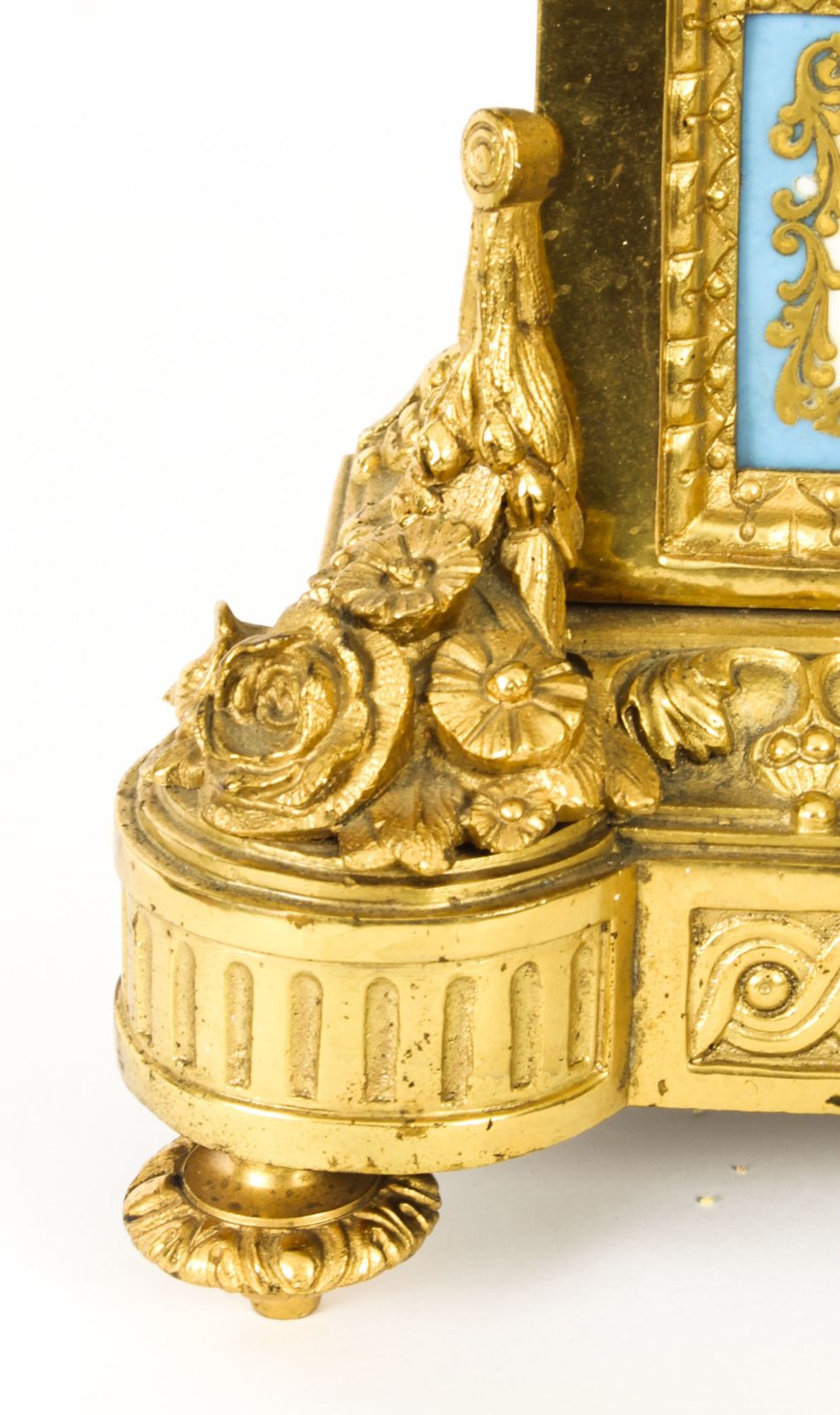
The base decorated with ormolu flowers is raised on turned feet and inset with Sevres plaques decorated with cherubs.
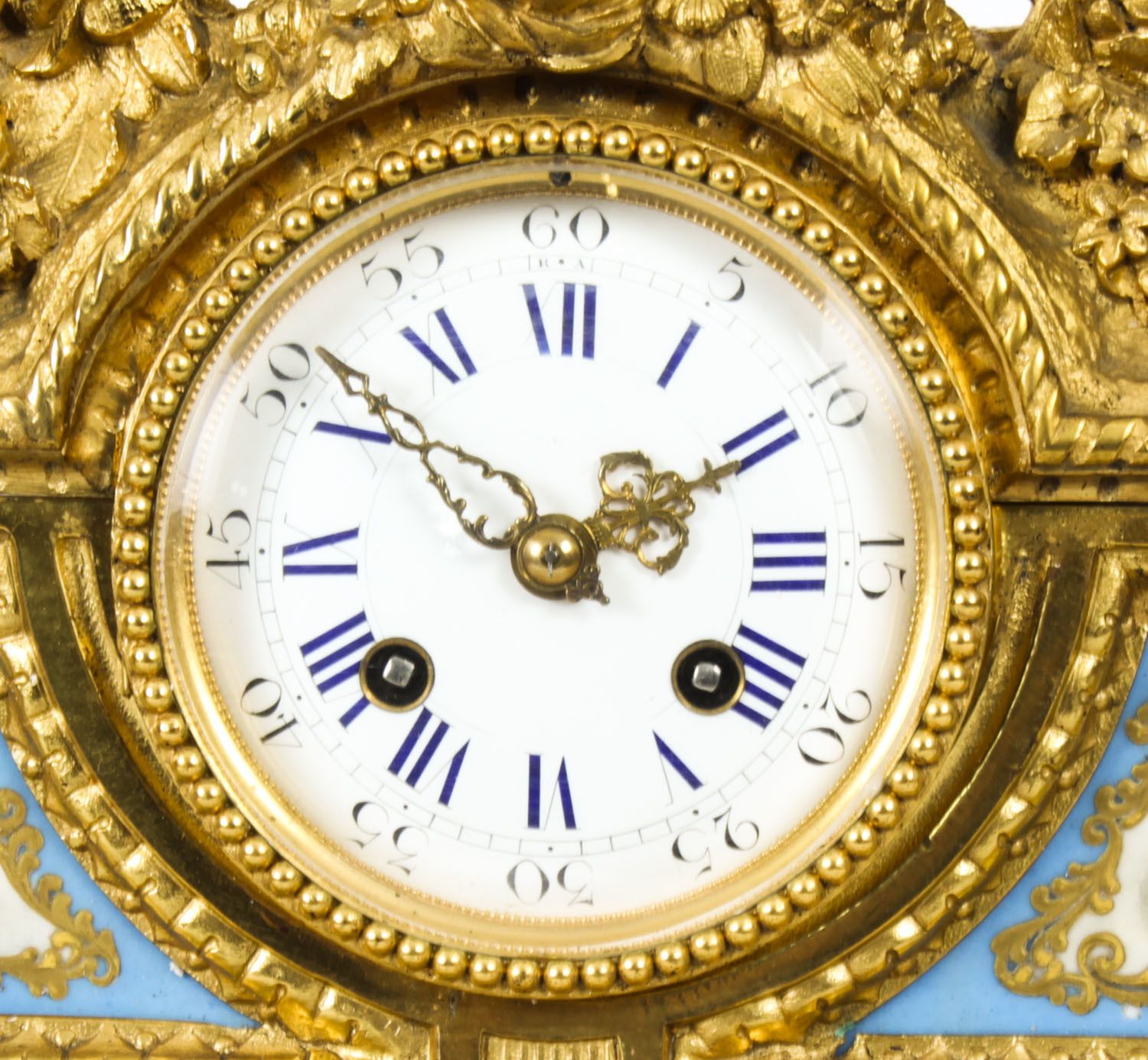
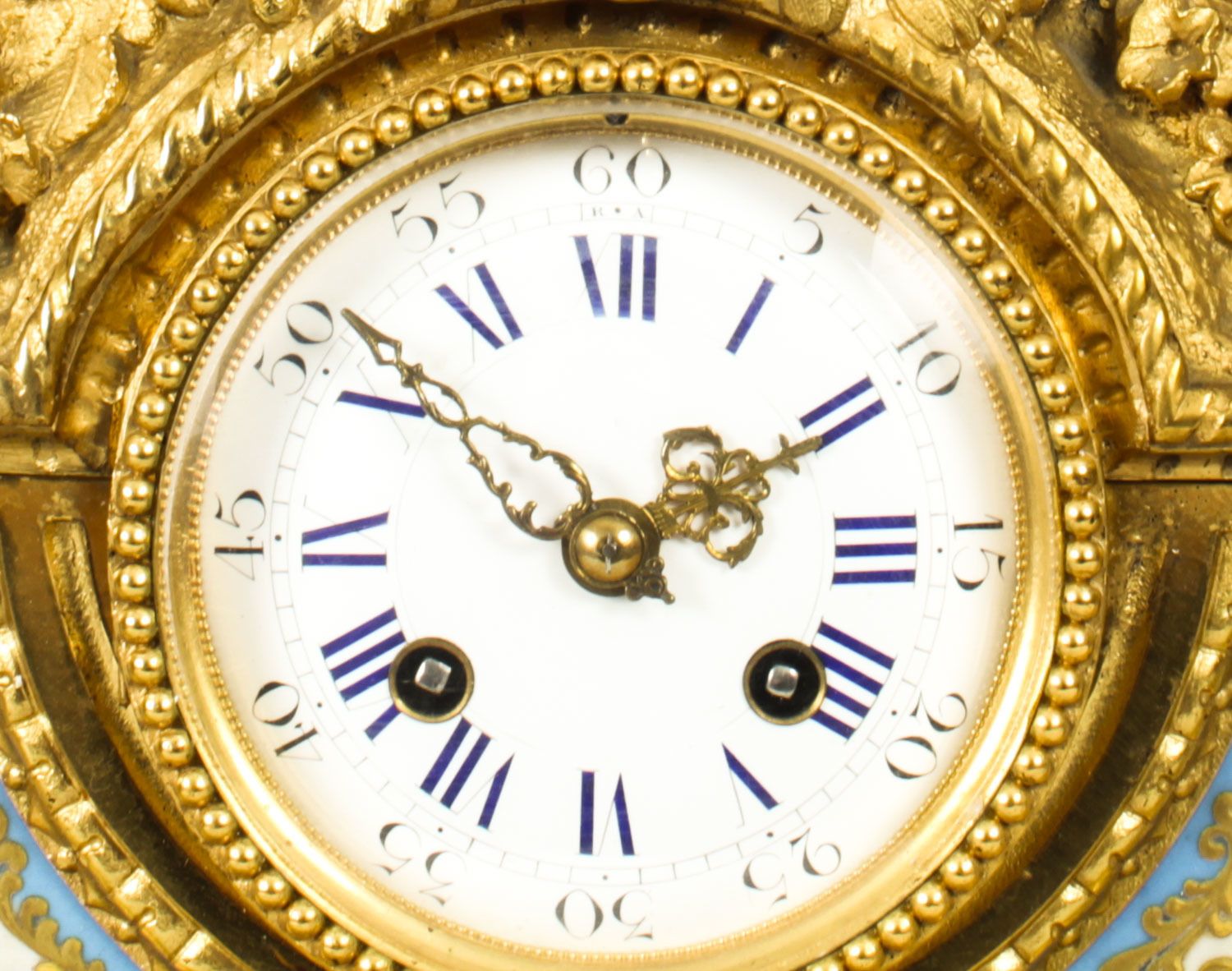
The circular dial has Roman and Arabic numerals and the clock has an 8 day striking movement complete with count wheel strike and bell, stamped with Miroy Freres to back and is complete with original key bell and pendulum
This incredible clock is a must have for any collector of ornamental and decorative pieces.
Condition:
The clock is in excellent working condition the movement having been cleaned and serviced, the ormolu case having been polished, please see photos for confirmation.
Dimensions in cm:
Height 34 x Width 52 x Depth 14
Dimensions in inches:
Height 1 foot, 1 inch x Width 1 foot, 8 inches x Depth 5 inches
Ormolu - Gilt Bronze (from French 'or moulu', signifying ground or pounded gold) is an 18th-century English term for applying finely ground, high-carat gold in a mercury amalgam to an object of bronze.The mercury is driven off in a kiln leaving behind a gold-coloured veneer known as 'gilt bronze'.
The manufacture of true ormolu employs a process known as mercury-gilding or fire-gilding, in which a solution of nitrate of mercury is applied to a piece of copper, brass, or bronze, followed by the application of an amalgam of gold and mercury. The item was then exposed to extreme heat until the mercury burned off and the gold remained, adhered to the metal object.
After around 1830 because legislation had outlawed the use of mercury other techniques were used instead. Electroplating is the most common modern technique. Ormolu techniques are essentially the same as those used on silver, to produce silver-gilt..
Molière
Jean-Baptiste Poquelin, known by his stage name French: 15 January 1622 – 17 February 1673), was a French playwright and actor who is considered to be one of the greatest masters of comedy in Western literature. Among Molière's best known works are The Misanthrope, The School for Wives, Tartuffe, The Miser, The Imaginary Invalid, and The Bourgeois Gentleman.
Born into a prosperous family and having studied at the Collège de Clermont (now Lycée Louis-le-Grand), Molière was well suited to begin a life in the theatre. Thirteen years as an itinerant actor helped him polish his comic abilities while he began writing, combining Commedia dell'arte elements with the more refined French comedy.
Through the patronage of aristocrats including Philippe I, Duke of Orléans—the brother of Louis XIV—Molière procured a command performance before the King at the Louvre. Performing a classic play by Pierre Corneille and a farce of his own, The Doctor in Love, Molière was granted the use of salle du Petit-Bourbon near the Louvre, a spacious room appointed for theatrical performances. Later, Molière was granted the use of the theatre in the Palais-Royal. In both locations he found success among Parisians with plays such as The Affected Ladies, The School for Husbands and The School for Wives. This royal favour brought a royal pension to his troupe and the title Troupe du Roi ("The King's Troupe"). Molière continued as the official author of court entertainments.
Though he received the adulation of the court and Parisians, Molière's satires attracted criticism from moralists and the Catholic Church. Tartuffe and its attack on perceived religious hypocrisy roundly received condemnations from the Church, while Don Juan was banned from performance. Molière's hard work in so many theatrical capacities took its toll on his health and, by 1667, he was forced to take a break from the stage. In 1673, during a production of his final play, The Imaginary Invalid, Molière, who suffered from pulmonary tuberculosis, was seized by a coughing fit and a haemorrhage while playing the hypochondriac Argan. He finished the performance but collapsed again and died a few hours later.
Molière was born in Paris, the son of Jean Poquelin and Marie Cressé, the daughter of a prosperous bourgeois family. He lost his mother when he was ten and he did not seem to have been particularly close to his father. After his mother's death, he lived with his father above the Pavillon des Singes on the rue Saint-Honoré, an affluent area of Paris. It is like that his education commenced with studies in a Parisian elementary school; this was followed with his enrollment in the prestigious Jesuit Collège de Clermont, where he completed his studies in a strict academic environment and got a first taste of life on the stage.
In 1631, Jean Poquelin purchased from the court of Louis XIII the posts of "valet de chambre ordinaire et tapissier du Roi" ("valet of the King's chamber and keeper of carpets and upholstery"). His son assumed the same posts in 1641. The title required only three months' work and an initial cost of 1,200 livres; the title paid 300 livres a year and provided a number of lucrative contracts. Poquelin also studied as a provincial lawyer sometime around 1642, probably in Orléans, but it is not documented that he ever qualified. So far he had followed his father's plans, which had served him well; he had mingled with nobility at the Collège de Clermont and seemed destined for a career in office.
In June 1643, when Molière was 21, he decided to abandon his social class and pursue a career on the stage. Taking leave of his father, he joined the actress Madeleine Béjart, with whom he had crossed paths before, and founded the Illustre Thé tre with 630 livres. They were later joined by Madeleine's brother and sister.
Illustration after Pierre Brissart for the printed text of 'L'Étourdi, ou le Contretemps
The new theatre troupe went bankrupt in 1645. Molière had become head of the troupe, due in part, perhaps, to his acting prowess and his legal training. However, the troupe had acquired large debts, mostly for the rent of the theatre (a court for jeu de paume), for which they owed 2000 livres. Historians differ as to whether his father or the lover of a member of his troupe paid his debts; either way, after a 24-hour stint in prison he returned to the acting circuit. It was at this time that he began to use the pseudonym Molière, possibly inspired by a small village of the same name in the Midi near Le Vigan. It was also likely that he changed his name to spare his father the shame of having an actor in the family (actors, although no longer vilified by the state under Louis XIV, were still not allowed to be buried in sacred ground).
After his imprisonment, he and Madeleine began a theatrical circuit of the provinces with a new theatre troupe; this life was to last about twelve years, during which he initially played in the company of Charles Dufresne, and subsequently created a company of his own, which had sufficient success and obtained the patronage of Philippe I, Duke of Orléans. Few plays survive from this period. The most noteworthy are L'Étourdi, ou le Contretemps (The Bungler) and Le Docteur Amoureux (The Doctor in Love); with these two plays, Molière moved away from the heavy influence of the Italian improvisational Commedia dell'arte, and displayed his talent for mockery. In the course of his travels he met Armand, Prince of Conti, the governor of Languedoc, who became his patron, and named his company after him. This friendship later ended when Conti, having contracted syphilis from a courtesan, turned towards religion and joined Molière's enemies in the Parti des Dévots and the Compagnie de Saint Sacrement.
In Lyon, Mademoiselle Du Parc, known as Marquise, joined the company. Marquise was courted, in vain, by Pierre Corneille and later became the lover of Jean Racine. Racine offered Molière his tragedy Théagène et Chariclée (one of the first works he wrote after he had abandoned his theology studies), but Molière would not perform it, though he encouraged Racine to pursue his artistic career. It is said that soon thereafter Molière became angry with Racine when he was told that he had secretly presented his tragedy to the company of the Hôtel de Bourgogne as well.
Molière was forced to reach Paris in stages, staying outside for a few weeks in order to promote himself with society gentlemen and allow his reputation to feed in to Paris. Molière reached Paris in 1658 and performed in front of the King at the Louvre (then for rent as a theatre) in Corneille's tragedy Nicomède and in the farce Le Docteur Amoureux with some success. He was awarded the title of Troupe de Monsieur (Monsieur being the honorific for the king's brother Philippe I, Duke of Orléans). With the help of Monsieur, his company was allowed to share the theatre in the large hall of the Petit-Bourbon with the famous Italian Commedia dell'arte company of Tiberio Fiorillo, famous for his character of Scaramouche. (The two companies performed in the theatre on different nights.) The premiere of Molière's Les Précieuses Ridicules (The Affected Young Ladies) took place at the Petit-Bourbon on 18 November 1659.
Les Précieuses Ridicules was the first of Molière's many attempts to satirize certain societal mannerisms and affectations then common in France. It is widely accepted that the plot was based on Samuel Chappuzeau's Le Cercle des Femmes of 1656. He primarily mocks the Académie Française, a group created by Richelieu under a royal patent to establish the rules of the fledgling French theater. The Académie preached unity of time, action, and styles of verse. Molière is often associated with the claim that comedy castigat ridendo mores or "criticises customs through humour" (a phrase in fact coined by his contemporary Jean de Santeuil and sometimes mistaken for a classical Latin proverb).
Despite his own preference for tragedy, which he had tried to further with the Illustre Thé tre, Molière became famous for his farces, which were generally in one act and performed after the tragedy. Some of these farces were only partly written, and were played in the style of Commedia dell'arte with improvisation over a canovaccio (a vague plot outline). He also wrote two comedies in verse, but these were less successful and are generally considered less significant. Later in life Molière concentrated on writing musical comedies, in which the drama is interrupted by songs and/or dances.
Les Précieuses Ridicules won Molière the attention and the criticism of many, but it was not a popular success. He then asked Fiorillo to teach him the techniques of Commedia dell'arte. His 1660 play Sganarelle, ou Le Cocu imaginaire (The Imaginary Cuckold) seems to be a tribute both to Commedia dell'arte and to his teacher. Its theme of marital relationships dramatizes Molière's pessimistic views on the falsity inherent in human relationships. This view is also evident in his later works, and was a source of inspiration for many later authors, including (in a different field and with different effect) Luigi Pirandello. It describes a kind of round dance where two couples believe that each of their partners has been betrayed by the other's and is the first in Molière's 'Jealousy series' which includes Dom Garcie de Navarre, L'École des maris and L'École des femmes.
First volume of a 1739 translation into English of all of Molière's plays, printed by John Watts.
In 1660 the Petit-Bourbon was demolished to make way for the eastern expansion of the Louvre, but Molière's company was allowed to move into the abandoned theatre in the east wing of the Palais-Royal. After a period of refurbishment they opened there on 20 January 1661. In order to please his patron, Monsieur, who was so enthralled with entertainment and art that he was soon excluded from state affairs, Molière wrote and played Dom Garcie de Navarre ou Le Prince jaloux (The Jealous Prince, 4 February 1661), a heroic comedy derived from a work of Cicognini's. Two other comedies of the same year were the successful L'École des maris (The School for Husbands) and Les F cheux, subtitled Comédie faite pour les divertissements du Roi (a comedy for the King's amusements) because it was performed during a series of parties that Nicolas Fouquet gave in honor of the sovereign. These entertainments led Jean-Baptiste Colbert to demand the arrest of Fouquet for wasting public money, and he was condemned to life imprisonment.
On 20 February 1662 Molière married Armande Béjart, whom he believed to be the sister of Madeleine. (She may instead have been her illegitimate daughter with the Duke of Modena.) The same year he premiered L'École des femmes (The School for Wives), subsequently regarded as a masterpiece. It poked fun at the limited education that was given to daughters of rich families, and reflected Molière's own marriage. Both this work and his marriage attracted much criticism. The play sparked the protest called the "Quarrel of L'École des femmes". On the artistic side he responded
Wear Condition
Excellent
Cancellations
We offer free cancellations and full refund for orders cancelled before dispatching. View full policy.
Returns
We have a 14-day return guarantee for orders from individual sellers, within the UK and European Union. View full policy.
Additional Delivery Info from Seller
Free delivery in London.
Estimated delivery time
Less than one week
Free collection available
Yes
Made to Last
The average lifespan of a Vinterior piece is 100 years, while modern flat-pack typically takes just 3 years to reach landfill. When you choose pre-loved, you can shop with confidence in quality, craftsmanship and longevity. With our top-rated customer service team and price match guarantee, there's no better way to shop pre-loved.


Shopping at Vinterior


Similar Clocks
Similar Clocks
Add to a wishlist
Create Wishlist
Completethe room
Good design is all in the layering. Whether you're adding impact or refining the details, now’s the time to find what’s missing.
Reviews
5.0

Based on 13 reviews





Wear conditions
Excellent
Shows little to no signs of wear and tear.
Good
May show slight traces of use in keeping with age. Most vintage and antique items fit into this condition.
Average
Likely to show signs of some light scratching and ageing but still remains in a fair condition.
Apparent Wear and Tear
Visible signs of previous use including scratches, chips or stains.
Please refer to condition report, images or make a seller enquiry for additional information.
Cancellations and Returns
Last updated: 12/02/2026
Clear, predictable protection for every pre-loved purchase.
Simple £75 flat return fee for UK-to-UK mainland furniture when you change your mind.
Applies to furniture with a final selling price of up to £5,000 (excluding delivery and service fees) and delivered from a UK mainland seller to mainland UK addresses. Excludes Northern Ireland, Channel Islands, Scottish Highlands & Islands, Isle of Wight and Isles of Scilly.
Buying vintage should feel inspiring, not uncertain.
Every order on Vinterior is backed by straightforward returns, free cancellations, and extra peace of mind for UK furniture purchases.
1. Free cancellations
Changed your mind before dispatch?
You can cancel any order before it's shipped for a full refund, including delivery.
To cancel an order, click Create cancellation on the order page.
Once an item has been dispatched, delivery costs are not refundable.
Bespoke, personalised or made-to-order pieces cannot be cancelled.
2. Returning an item
You have 14 days from delivery to request a return.
There are two return types:
A. The item isn't as described (free return)
If your piece arrives and it doesn't match the listing in any material way (incorrect description, undisclosed damage, inaccurate measurements, misleading photos), you are fully protected:
- Free return
- The seller or Vinterior arranges pickup
- Full refund, including outbound delivery costs once the seller receives the item
This applies to all purchases.
B. You changed your mind
UK-to-UK furniture deliveries:
To make UK furniture returns predictable and stress-free, we offer a simple flat return fee of £75.
- Applies to furniture delivered from a UK mainland seller to a mainland UK address. Excludes Northern Ireland, Channel Islands, Scottish Highlands & Islands, Isle of Wight and Isles of Scilly.
- Pickup arranged for you
- One clear fee, no surprises
We coordinate the return with either the seller's chosen courier or our trusted delivery partner.
All other items
Most smaller items are straightforward to return.
You can still return your item within 14 days.
- For smaller or parcel-sized items, you can choose to post the item back yourself using a tracked service, or the seller can suggest a preferred courier.
- For larger or more fragile pieces, the seller may recommend the safest return method.
- Return delivery costs vary depending on size and courier.
The seller will confirm the best option based on the item.
3. If your item arrives damaged
Damage on arrival is uncommon, especially for UK furniture deliveries.
But if something does go wrong, you're fully protected.
- Let us know as soon as possible (ideally within 72 hours of delivery) so we can resolve things quickly
- Share photos so we understand what happened
- We’ll help arrange a return and refund if needed
You’re always protected when something goes wrong in transit.
Your statutory rights apply for up to 30 days from delivery.
4. What can't be returned
Some items cannot be returned:
- Bespoke, personalised, or made-to-order pieces
- Items altered after delivery
5. How to start a return
- Log in to your Vinterior account
- Open your order
- Click Create a return
- Add notes + photos if relevant
We'll guide you through the rest.
6. What happens next
- We review your request, confirm the return and advise on next steps
- Pickup or return method is arranged
- The item is returned to the seller
- We issue your refund once the seller confirms the item's condition
Returns are completed smoothly once the pickup is arranged.
7. Refunds
Once the seller receives the piece back in the same condition it was sent, we'll issue your refund to your original payment method.
Once a refund is issued, it may take up to 5–10 working days for the funds to appear back on your original payment method, depending on your bank or card provider.
If the item is returned with new damage that wasn't present at delivery, the refund may be adjusted following review.
Need help?
If you have questions about a return or your order, our support team is here to help. Email us at [email protected] or find other ways to contact us here.
What your service fee covers
-
 14-day return guarantee
-
Flat-fee return shipping on UK furniture
-
Seller vetting
-
Dedicated customer support
| Order Value (£) | Fee (£) |
|---|---|
| 0 — 49.99 | 2.75 |
| 50 — 99.99 | 5.50 |
| 100 — 199.99 | 11.00 |
| 200 — 399.99 | 21.00 |
| 400 — 599.99 | 30.00 |
| 600 — 799.99 | 40.00 |
| 800 — 999.99 | 50.00 |
| 1,000 — 1,499.99 | 55.00 |
| 1,500 — 1,999.99 | 60.00 |
| 2,000 — 4,999.99 | 82.50 |
| 5,000+ | 110.00 |
Added at checkout, based on your basket total.
