


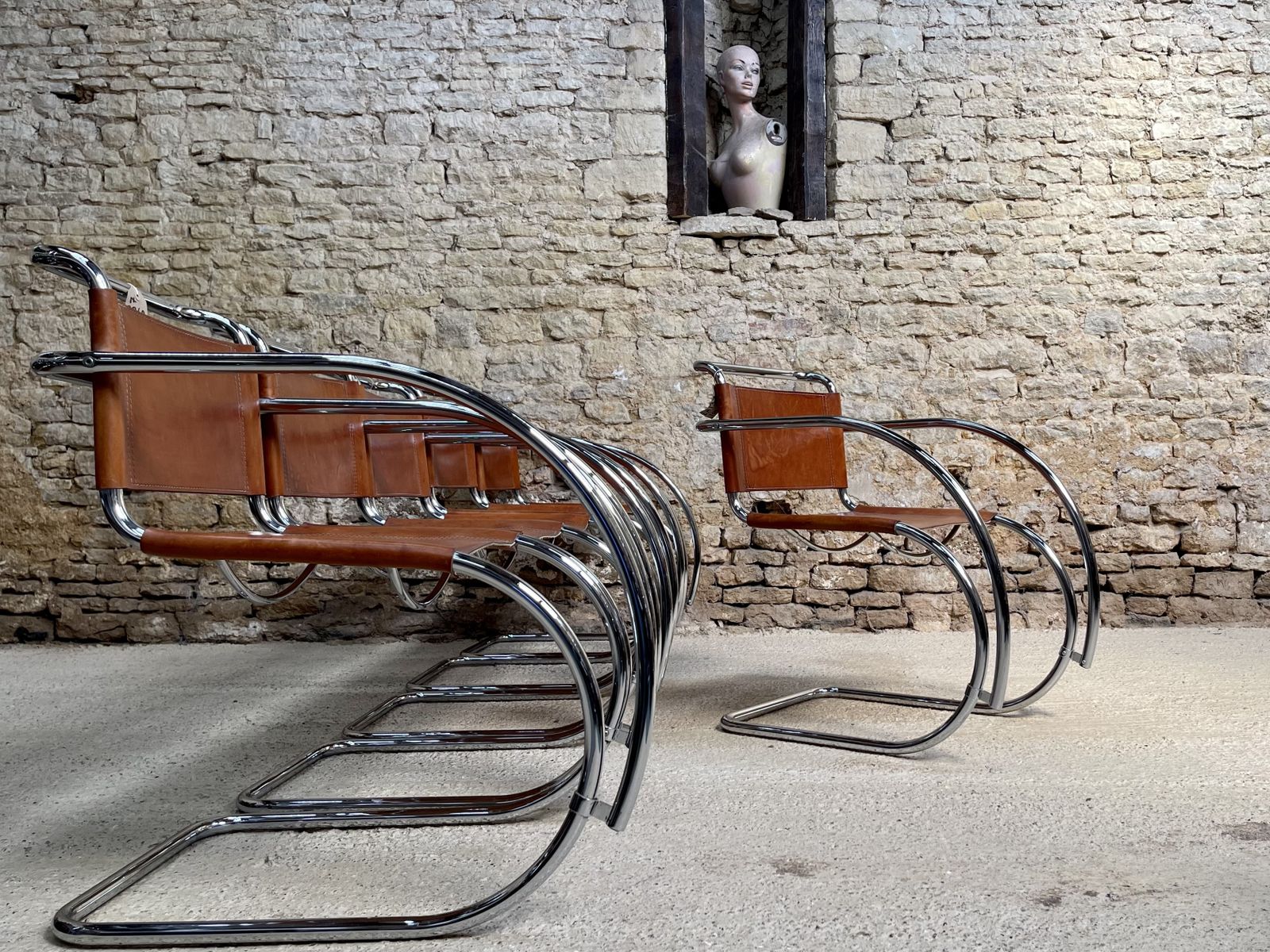
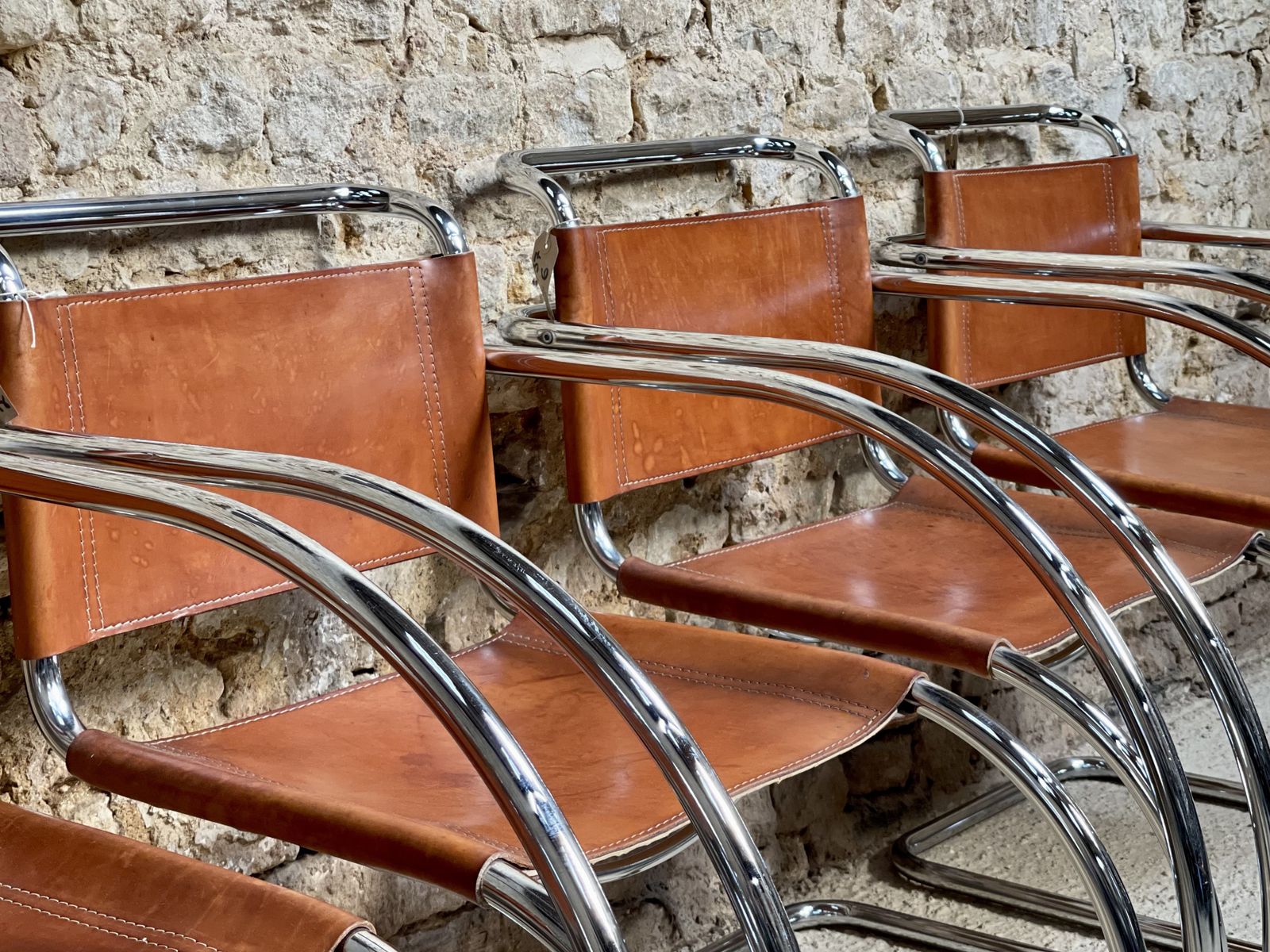
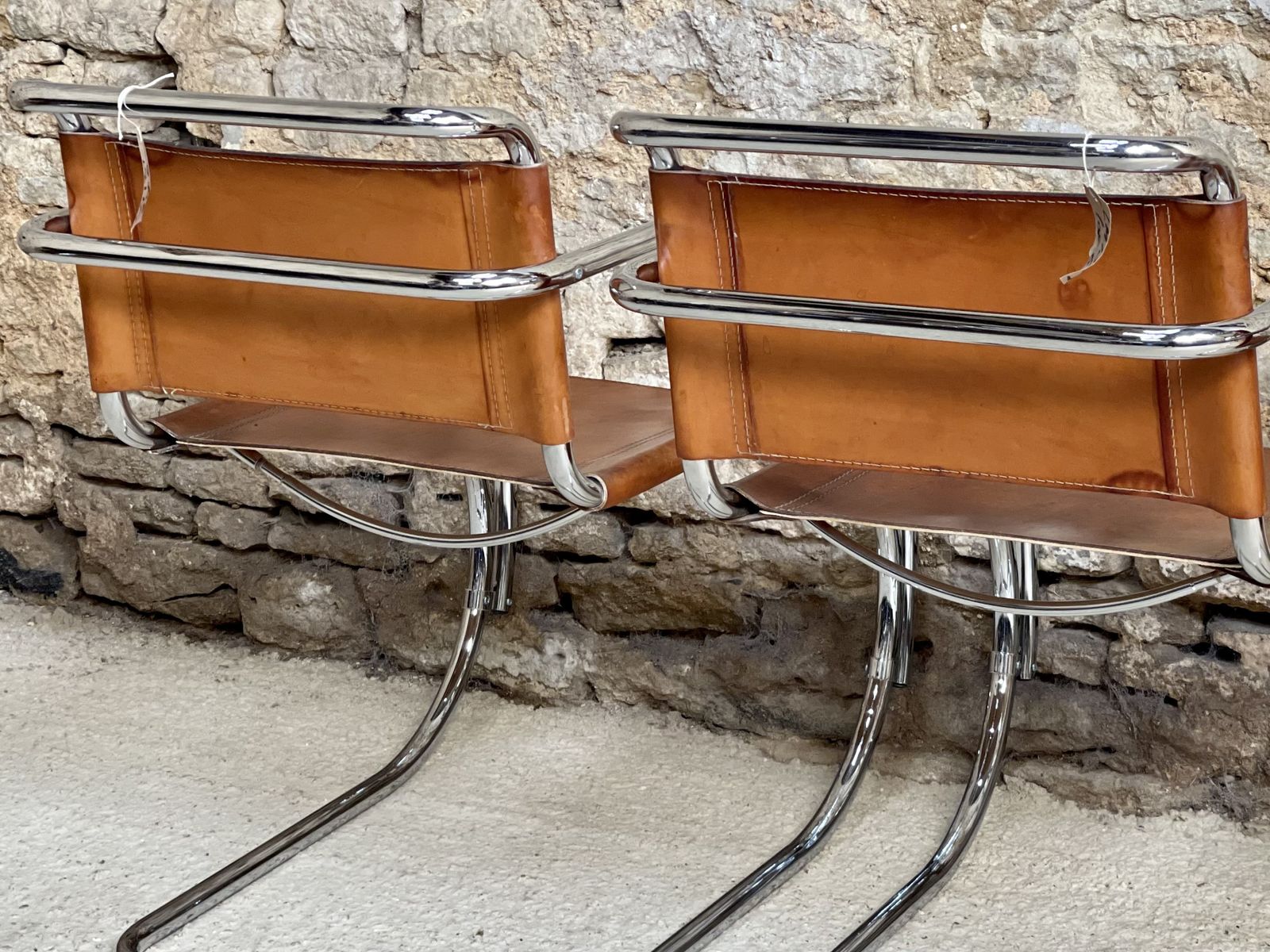
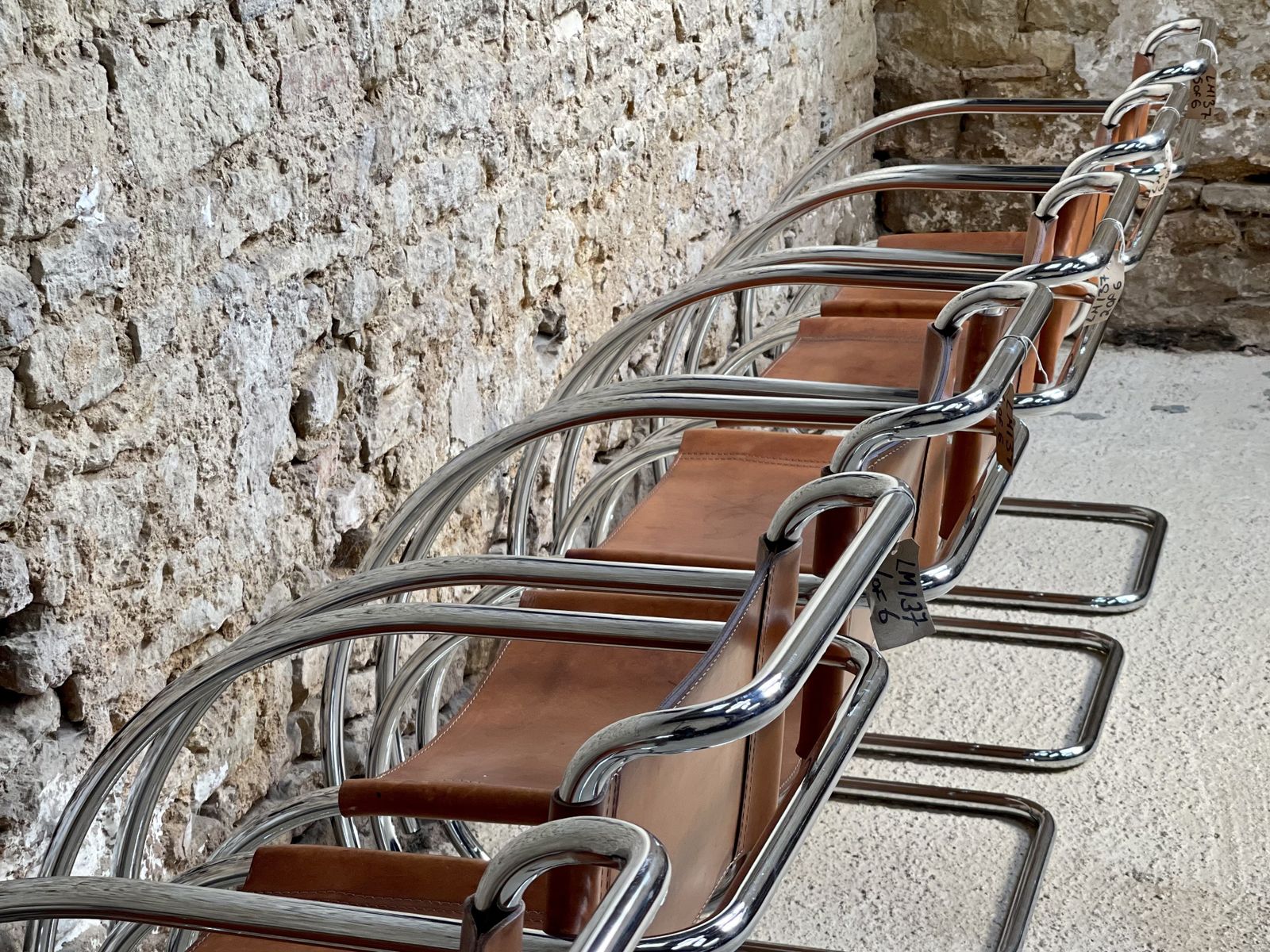
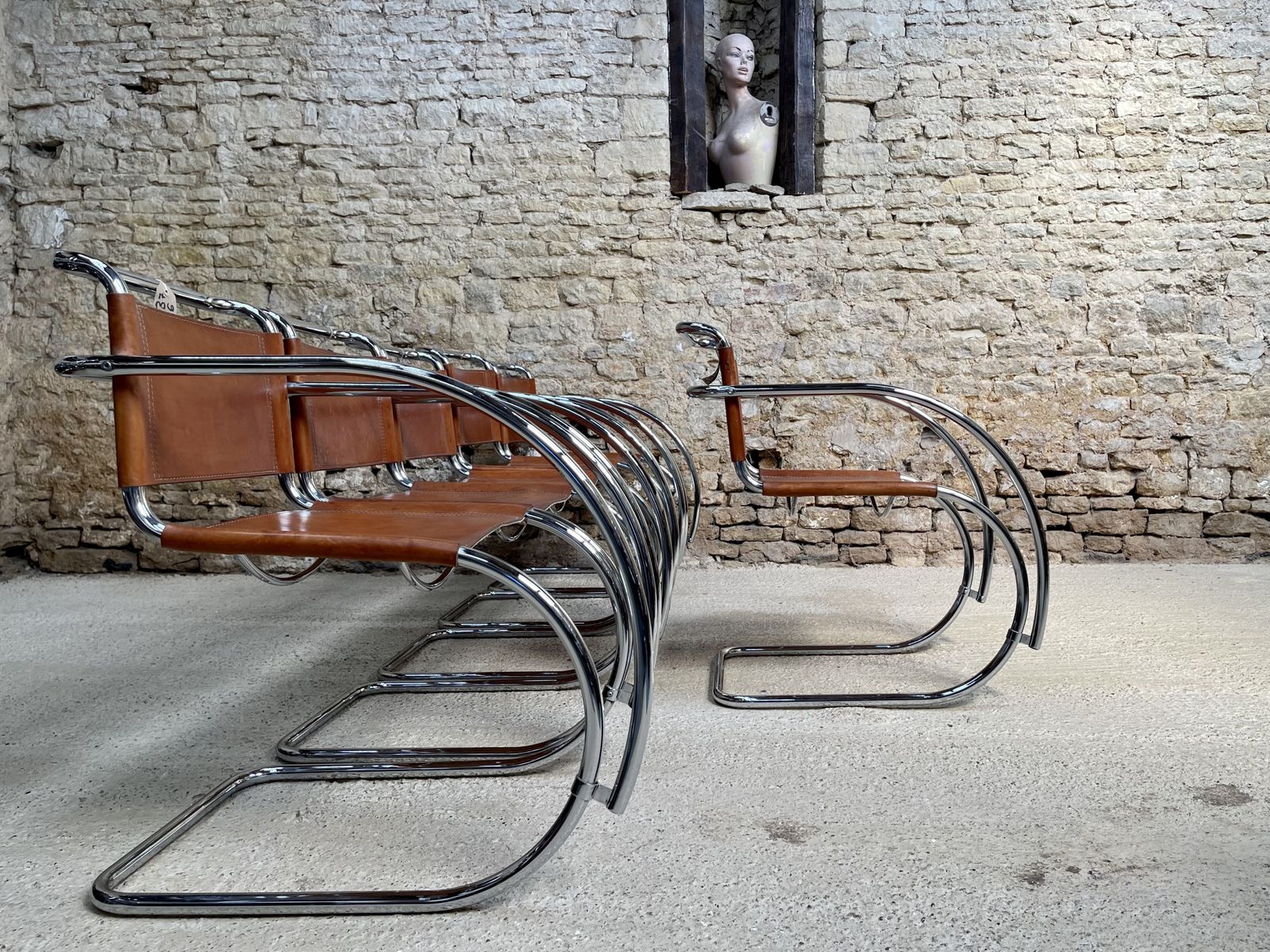
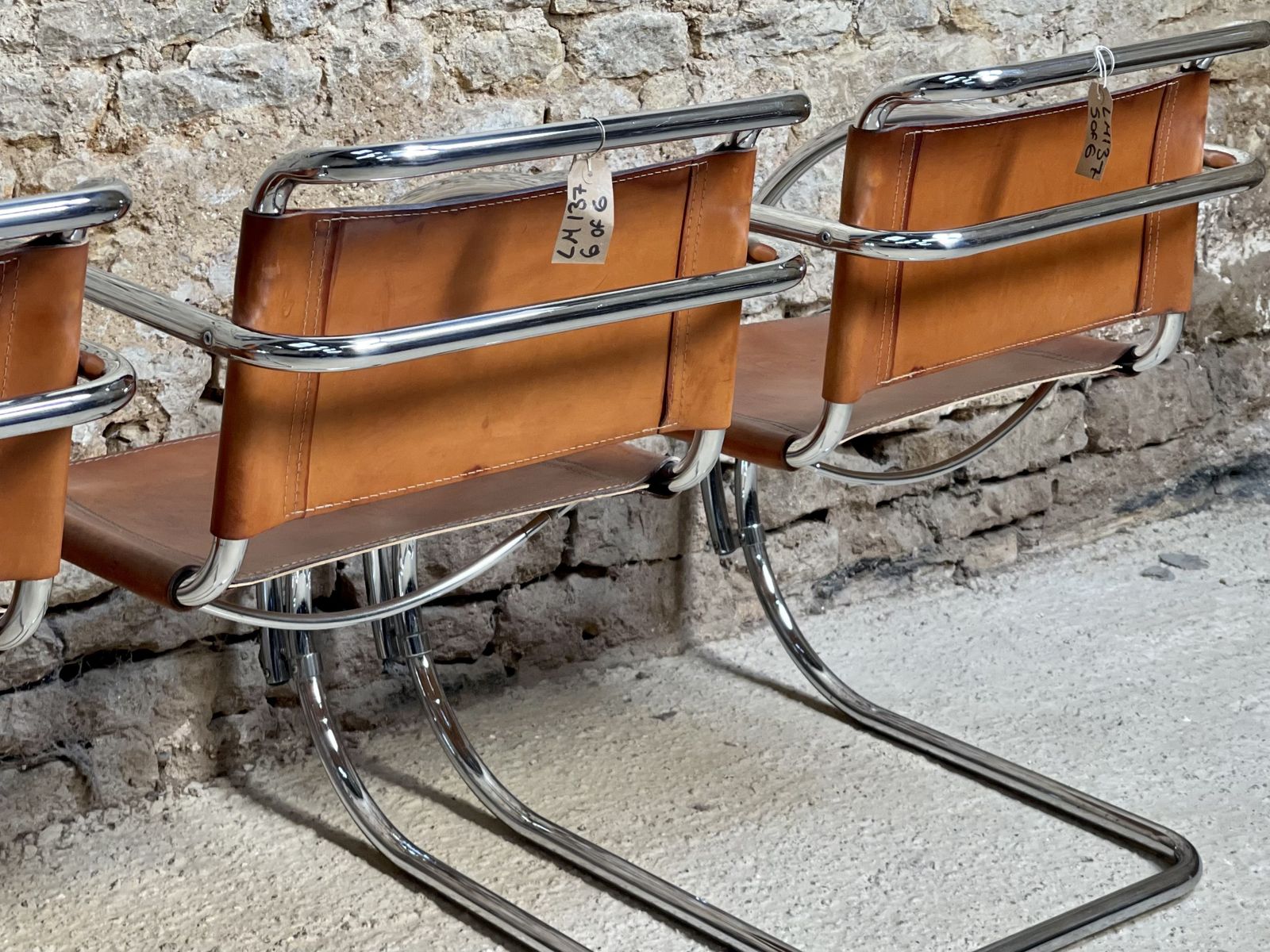
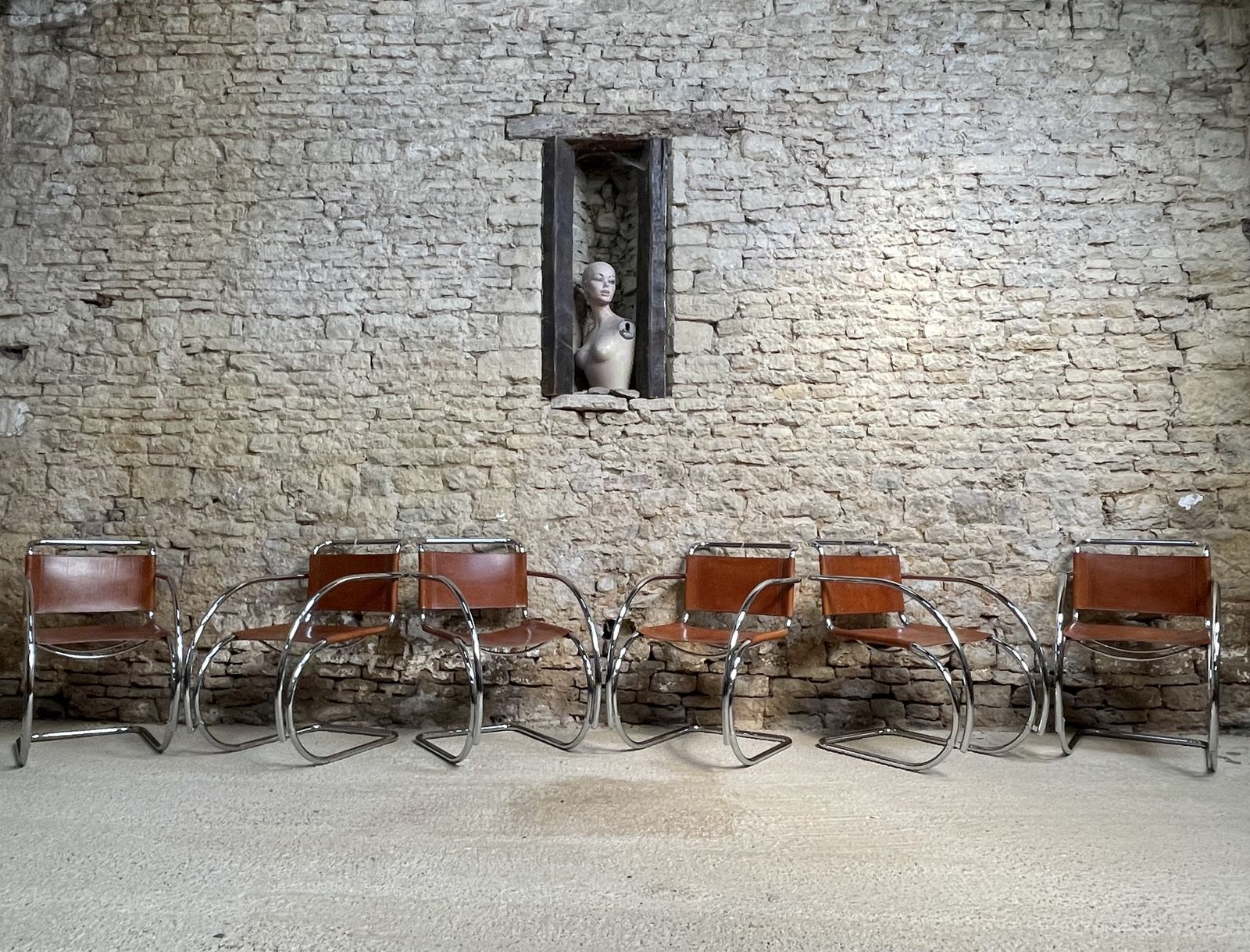
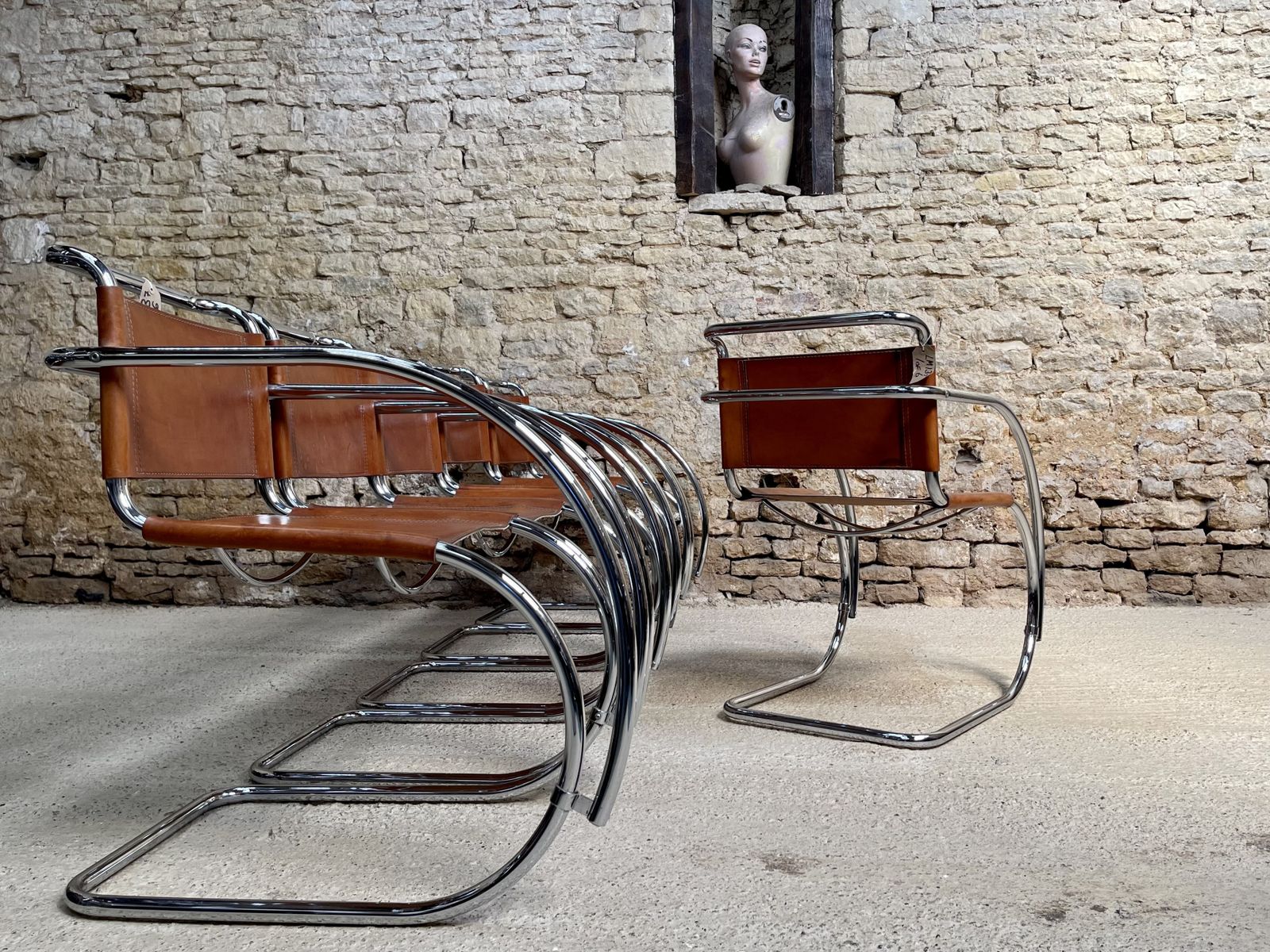
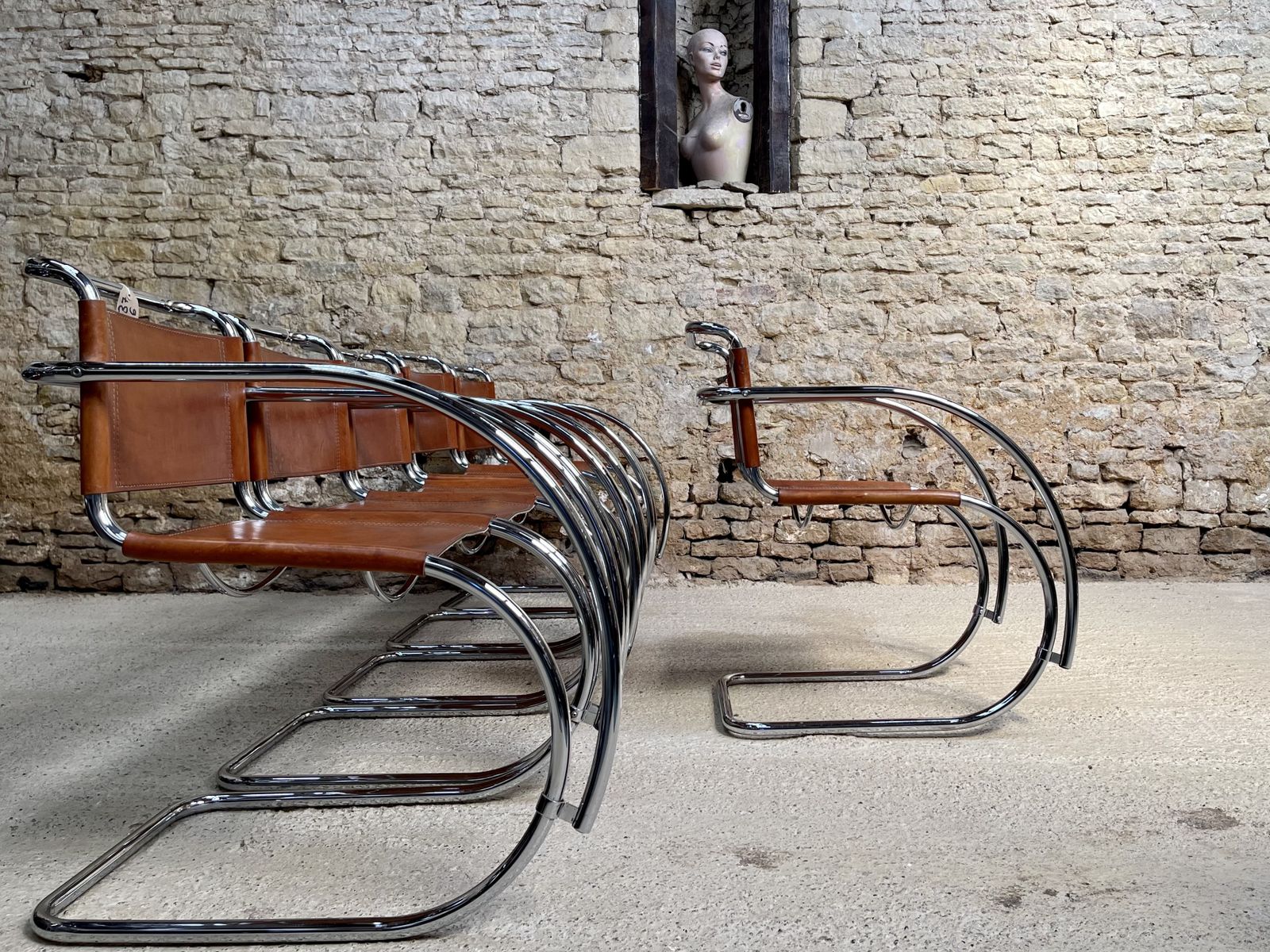
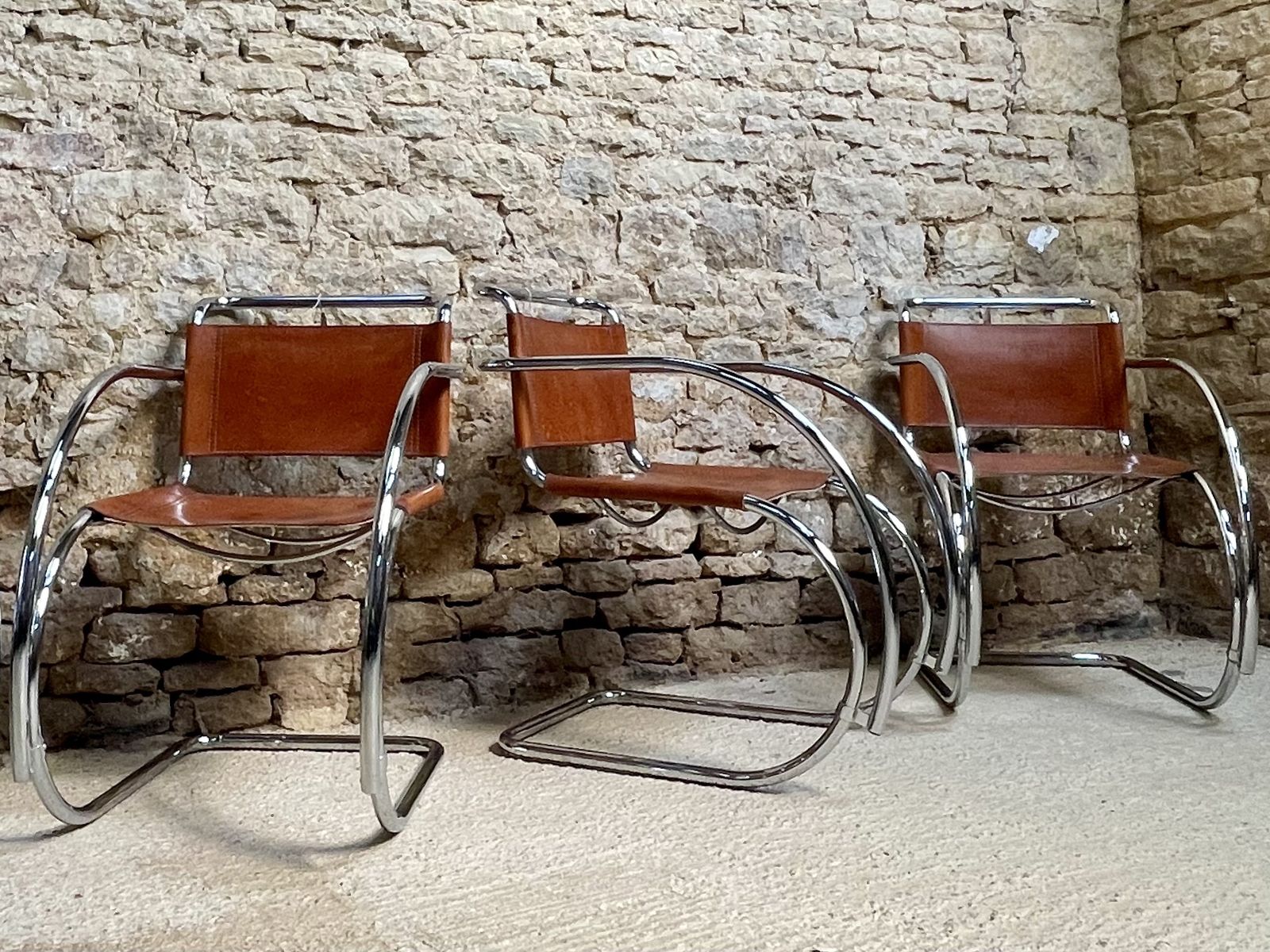
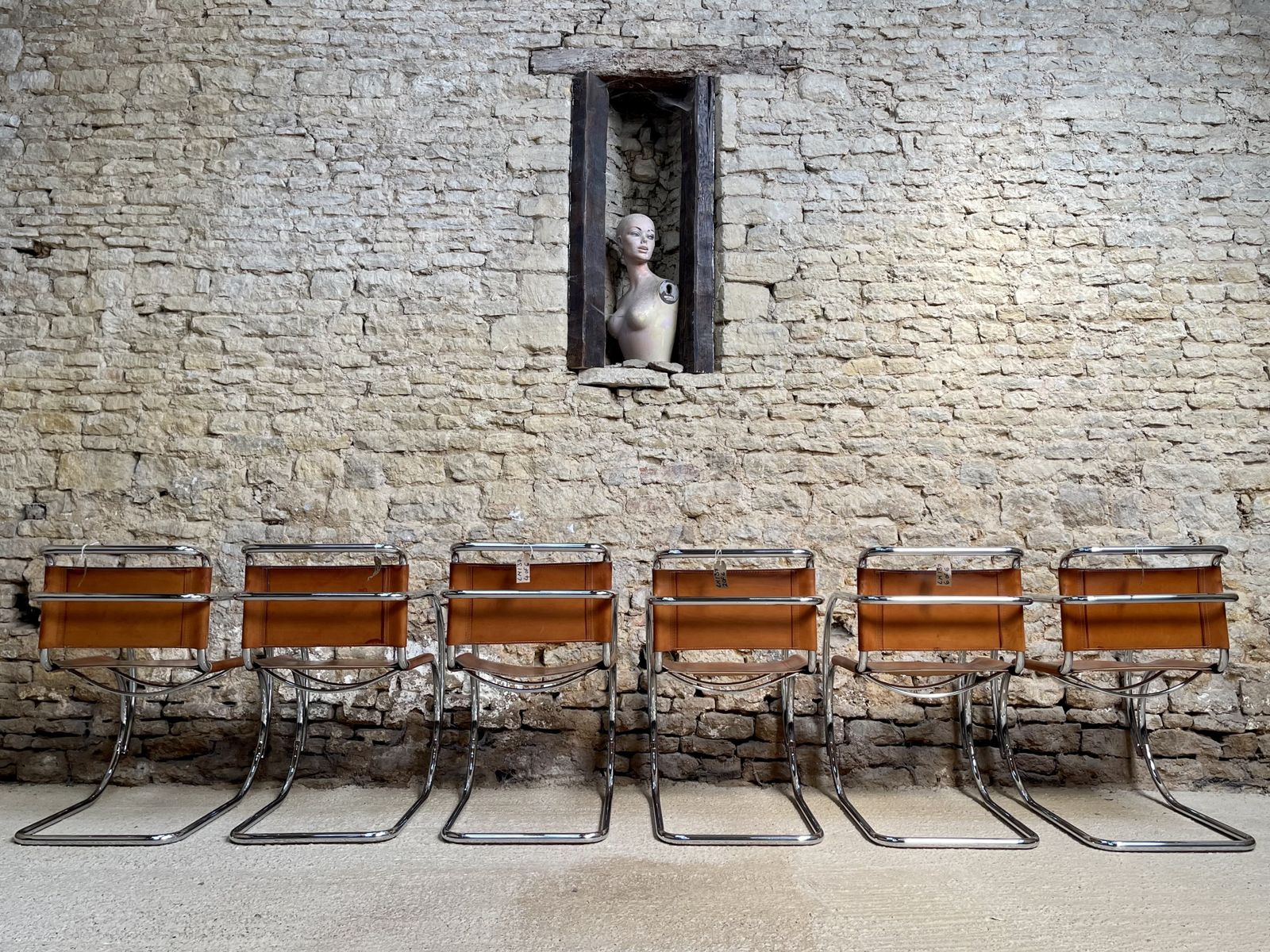
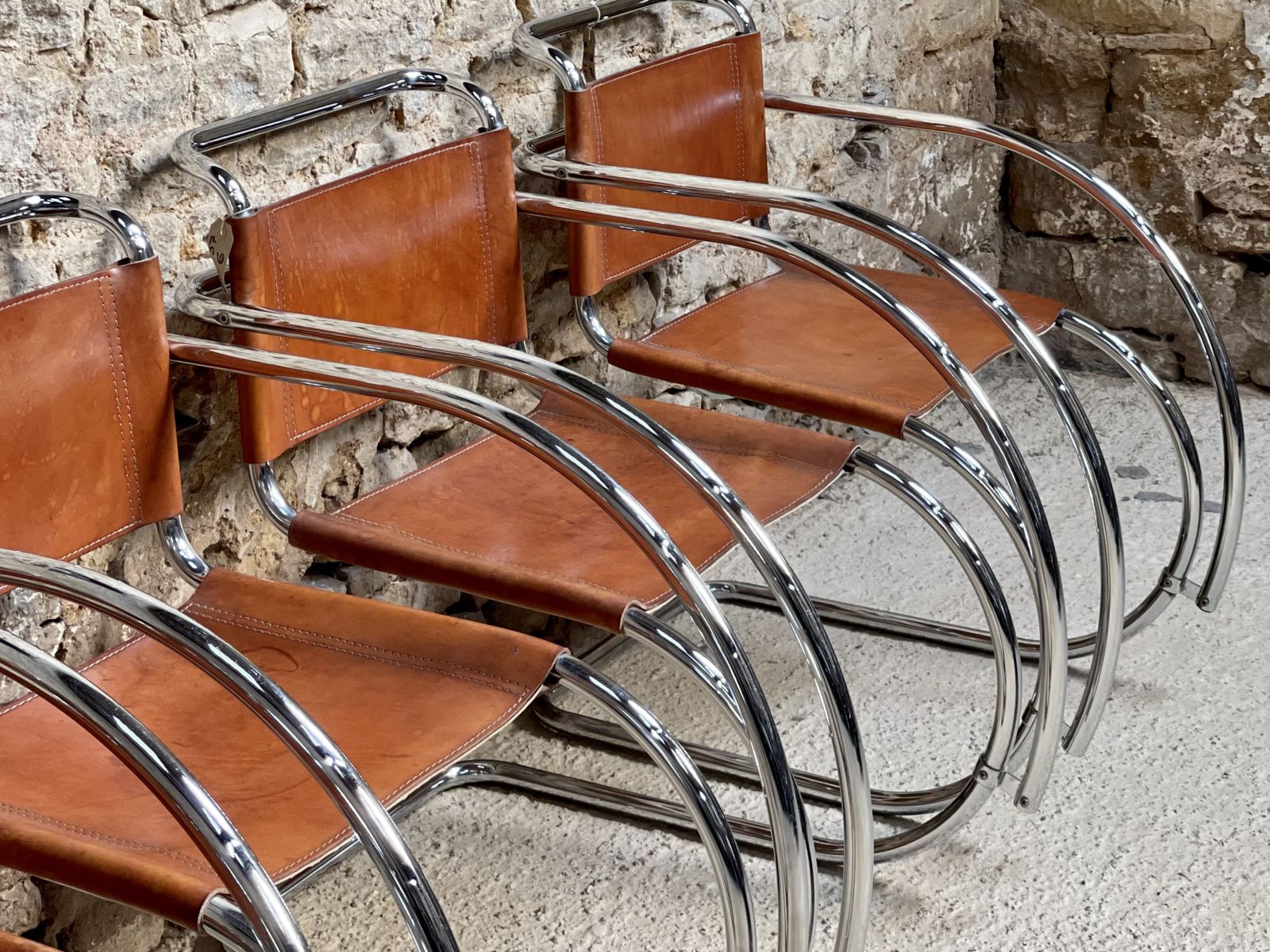
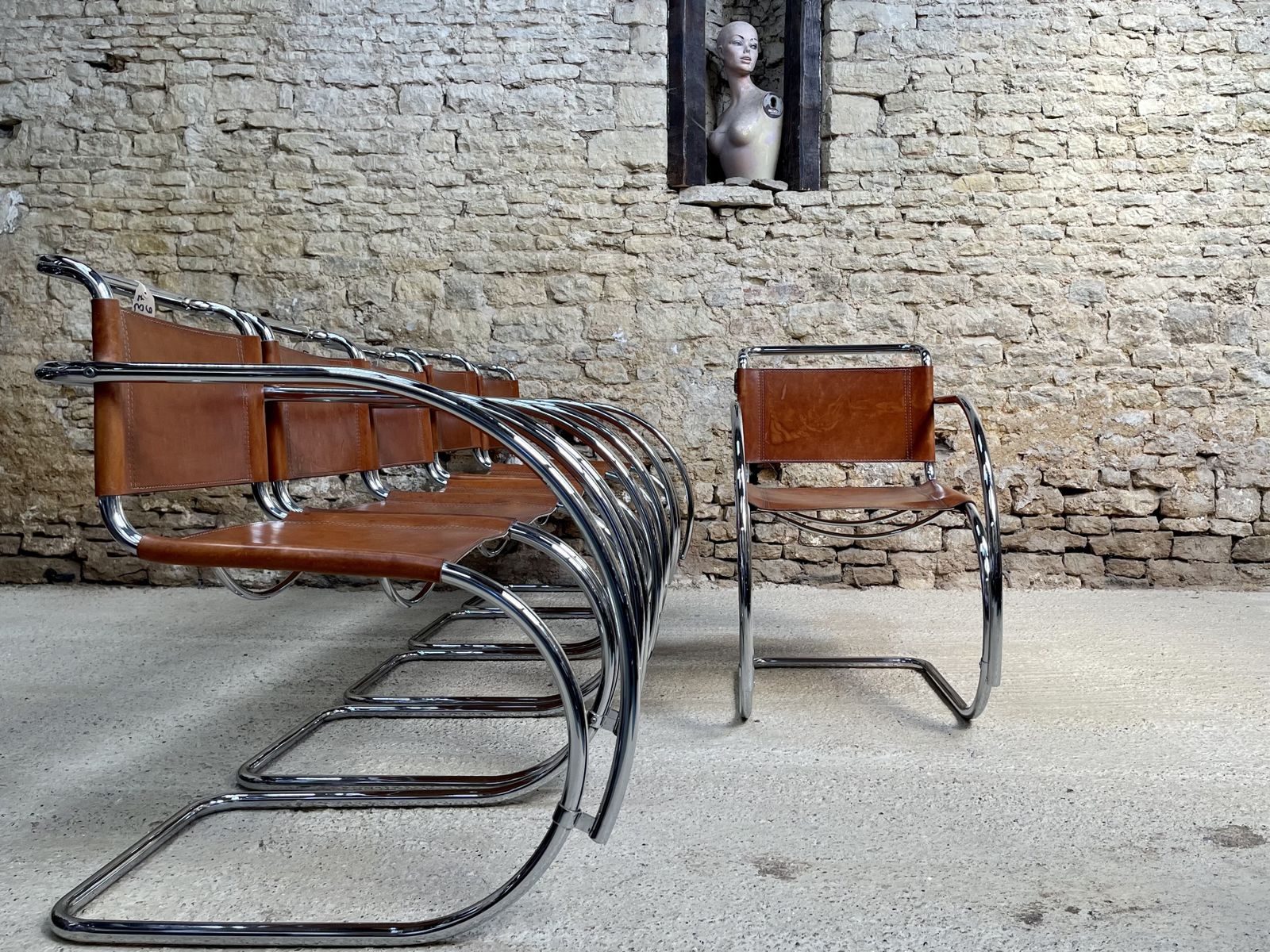
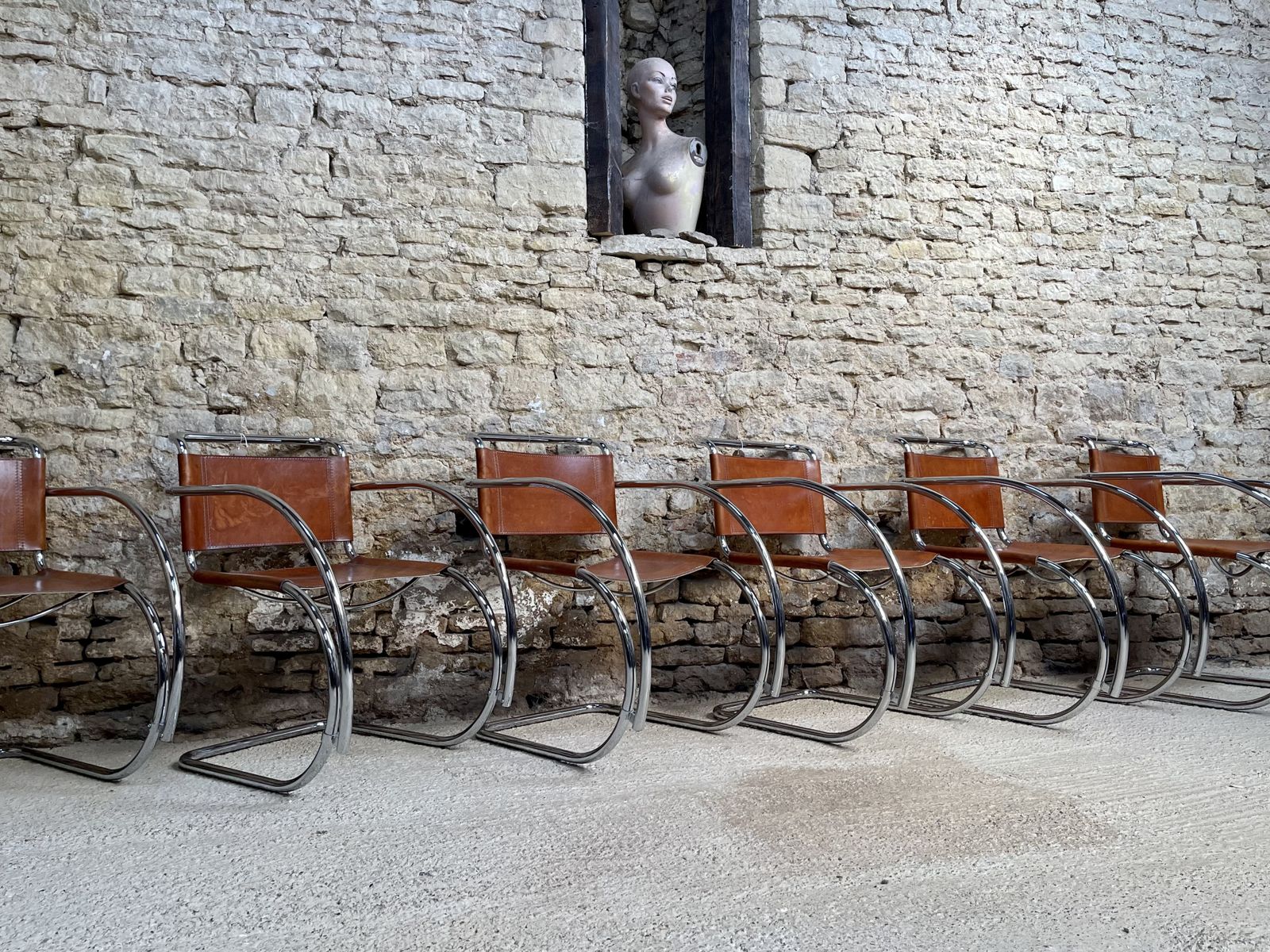
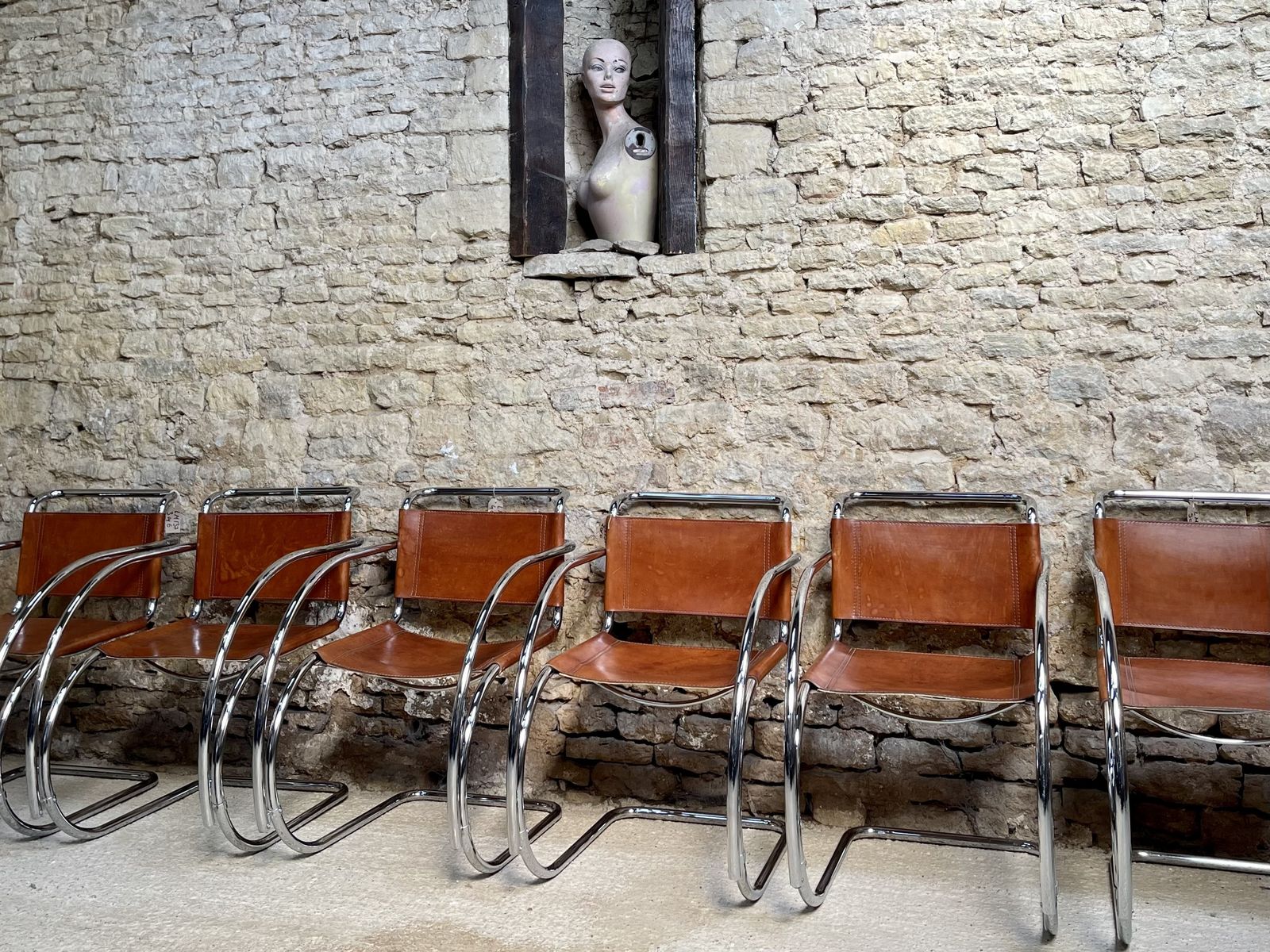
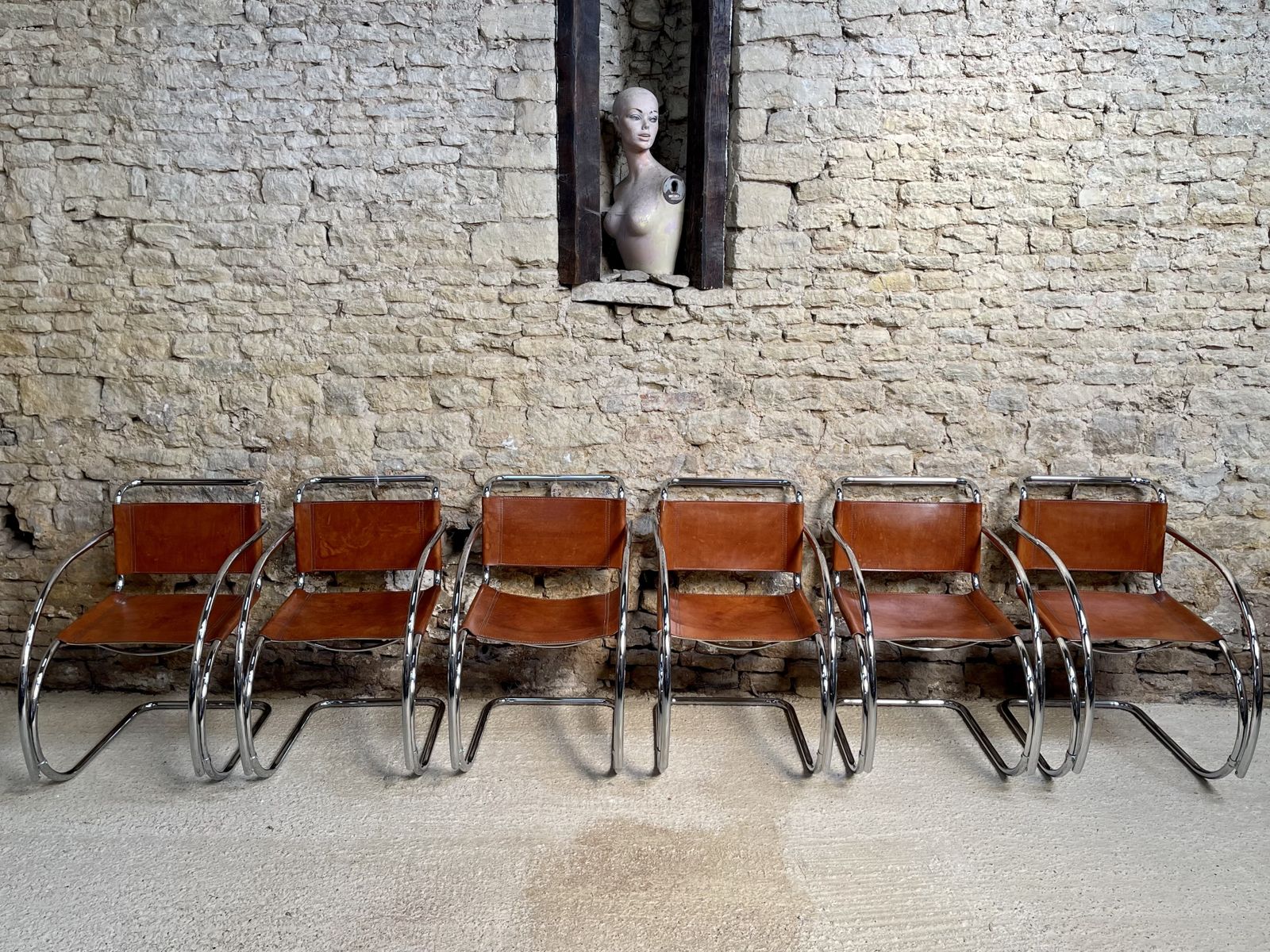
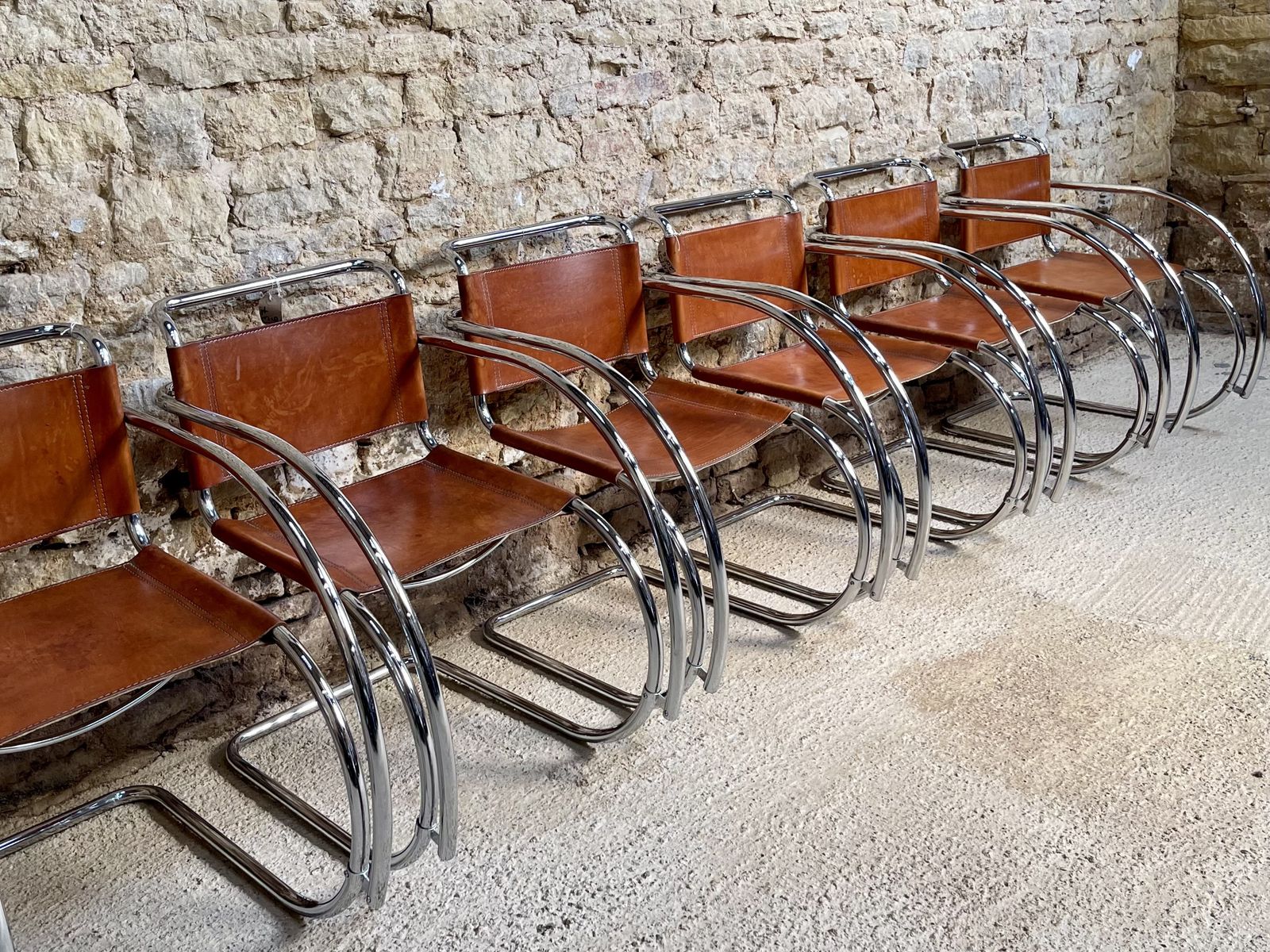
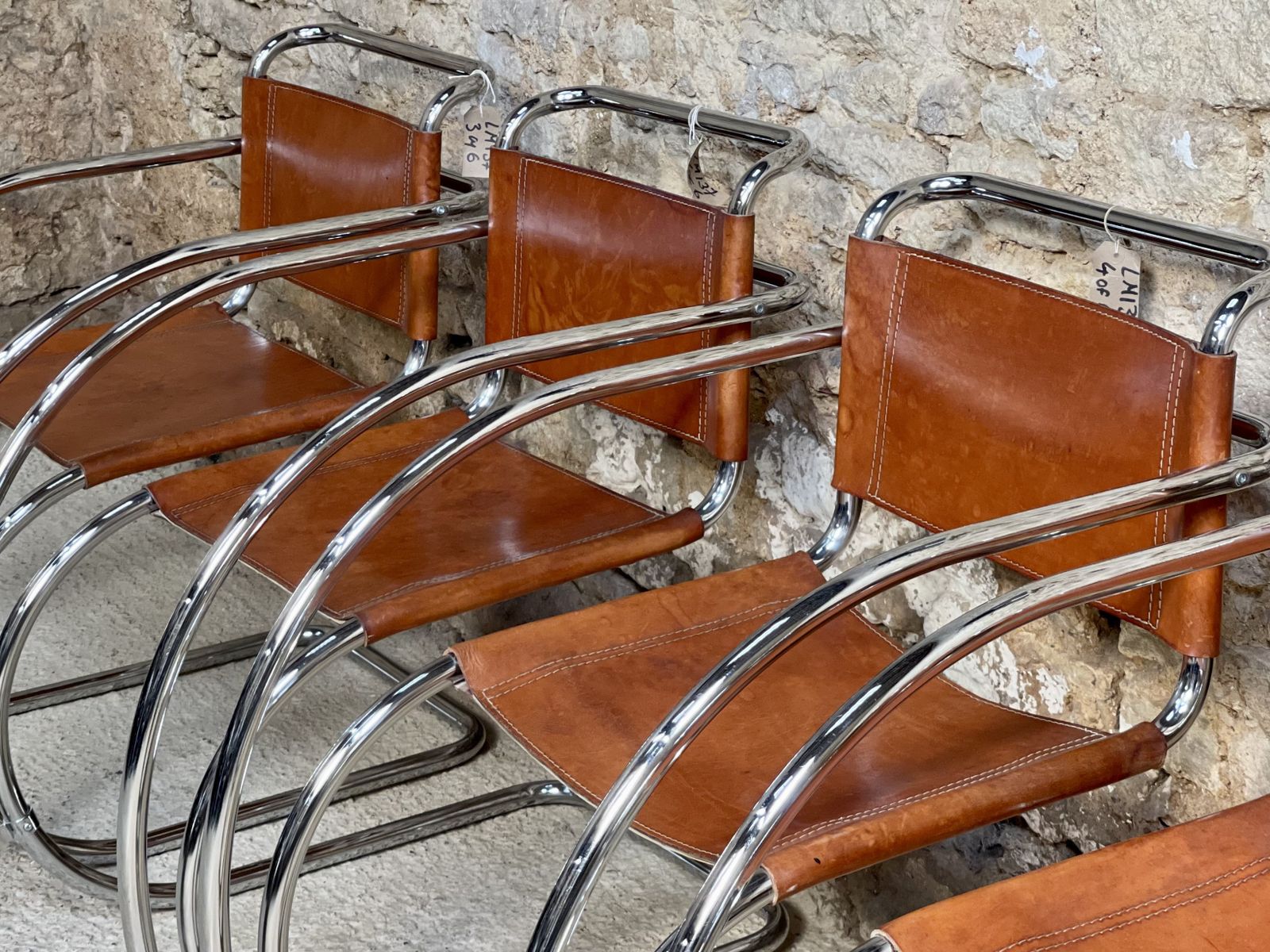
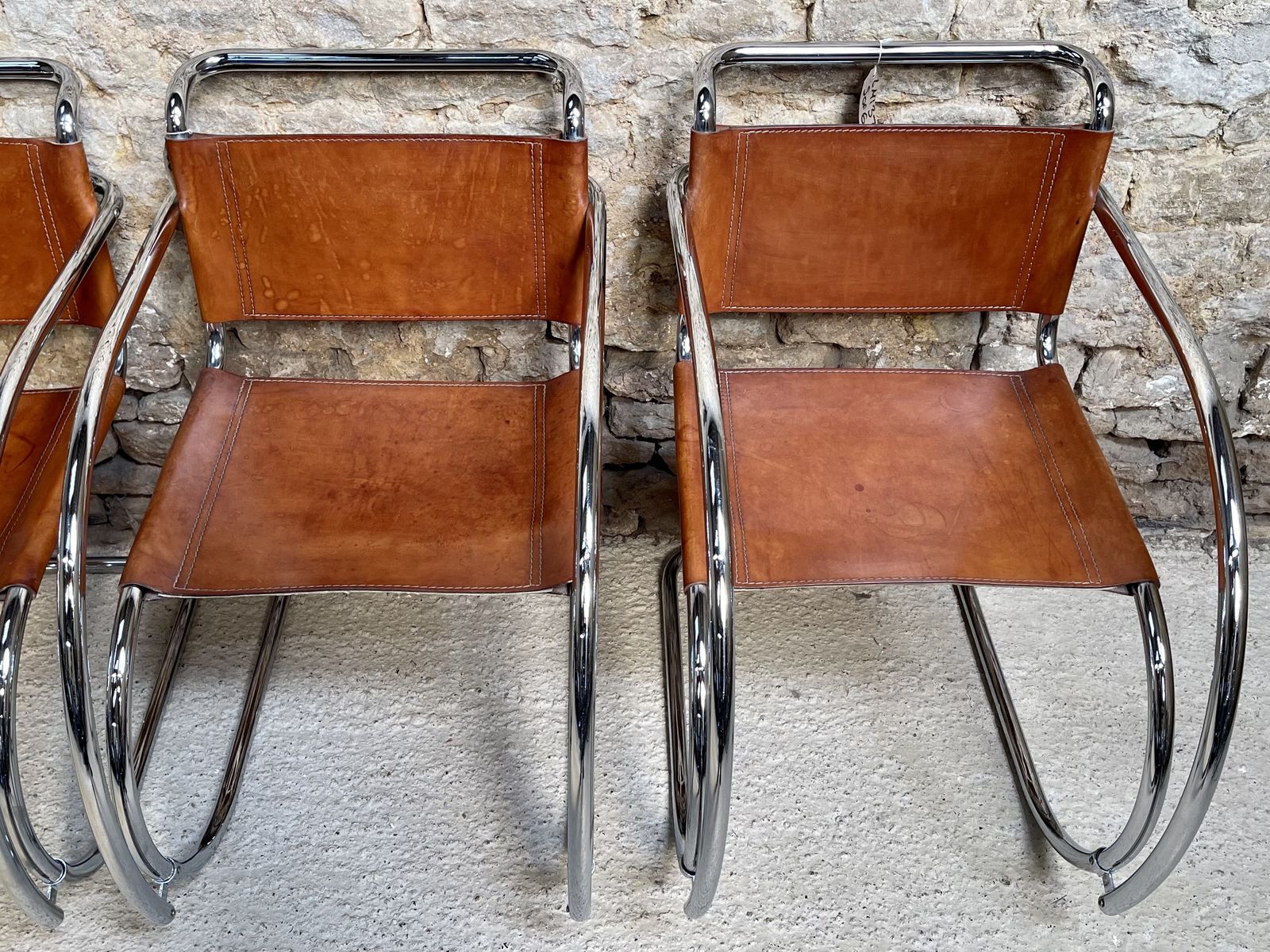
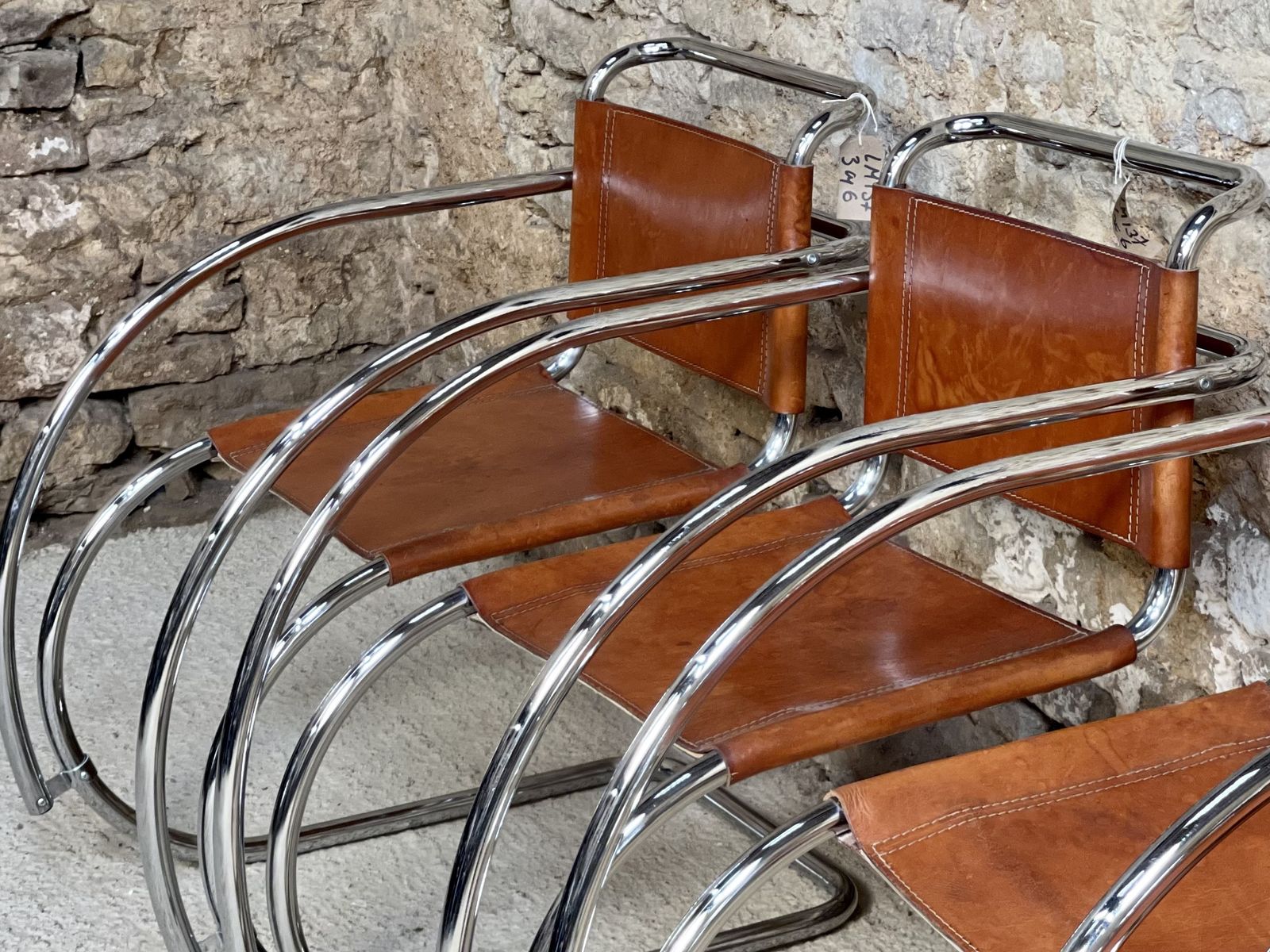
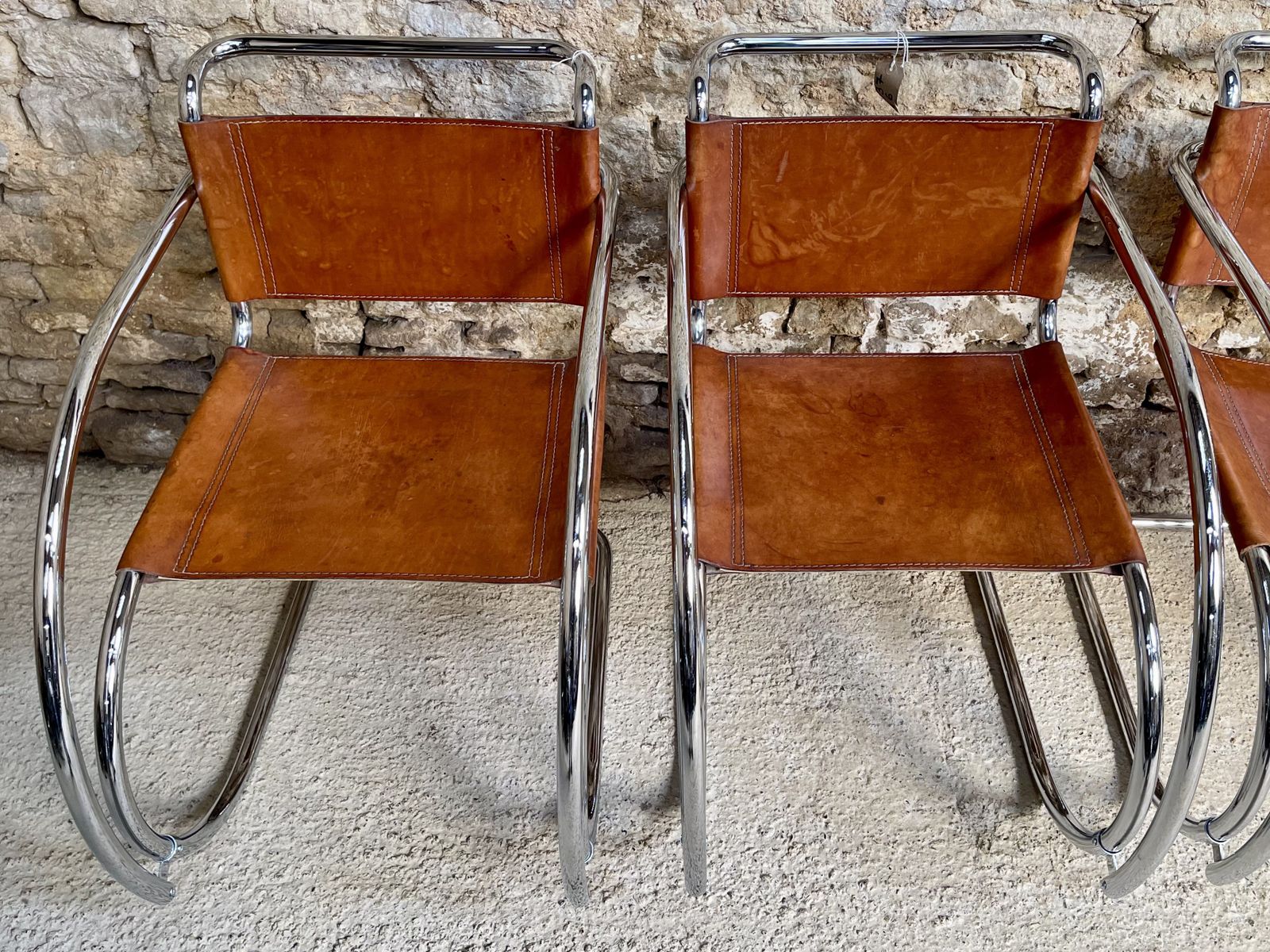
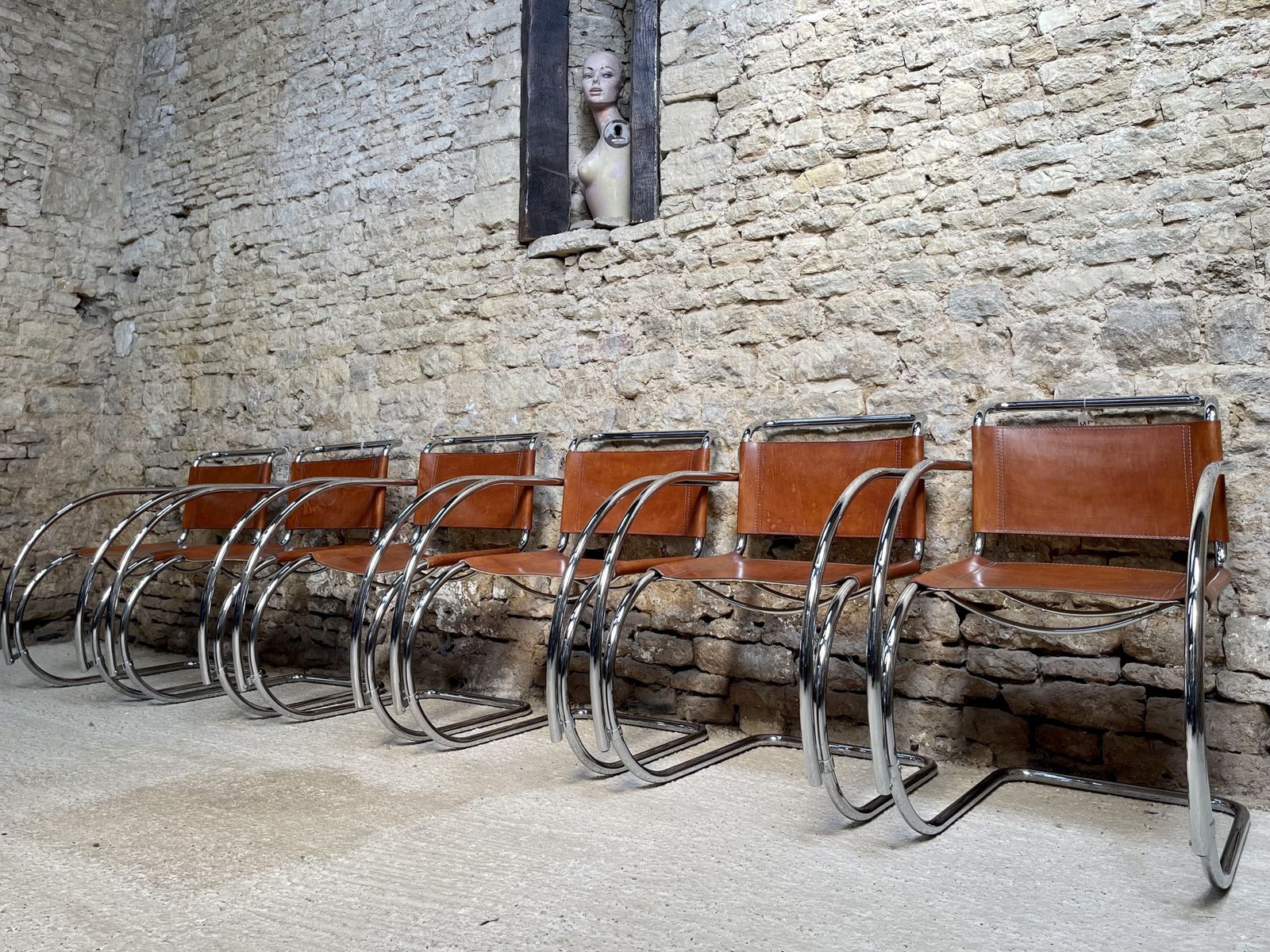
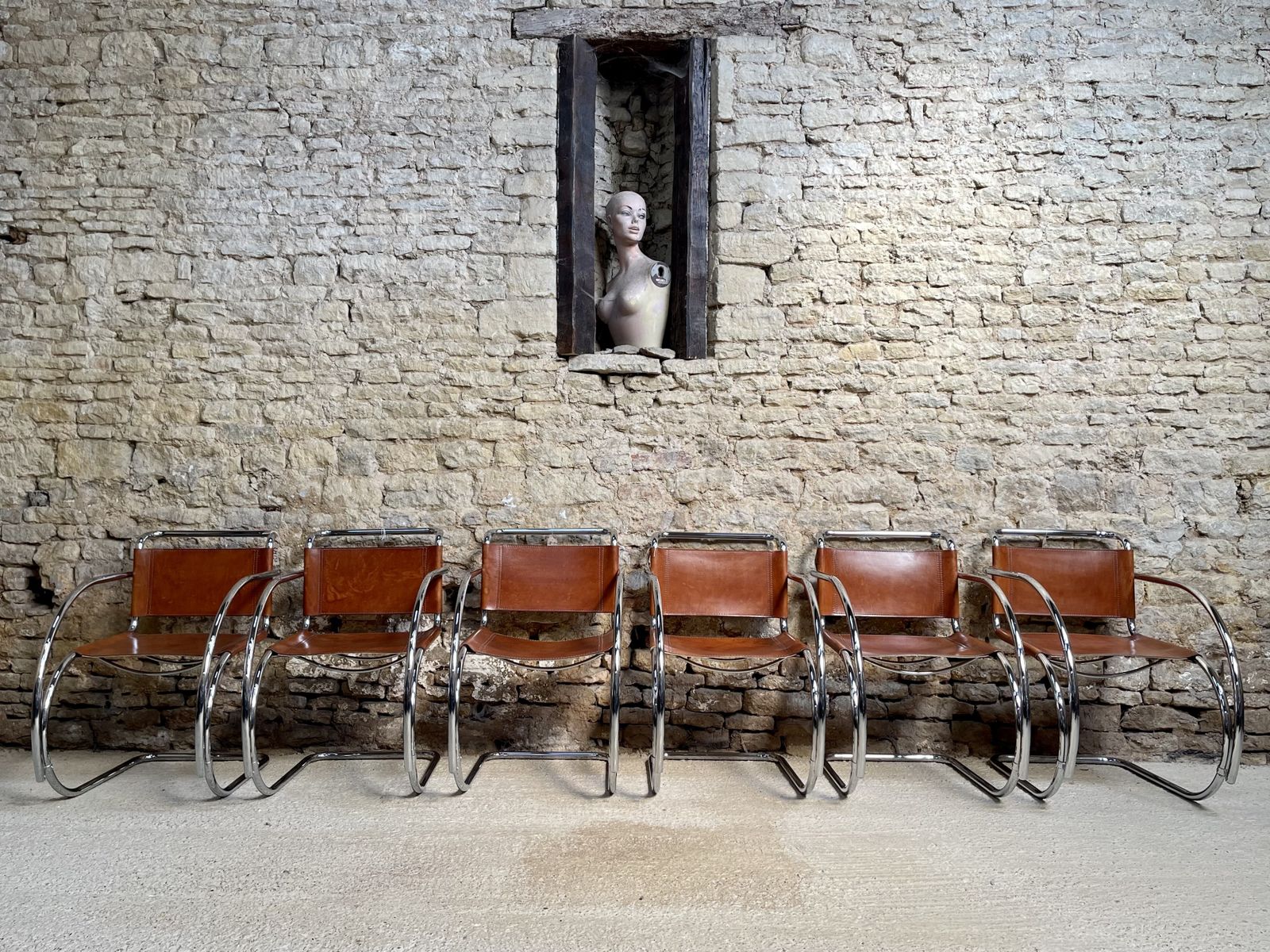
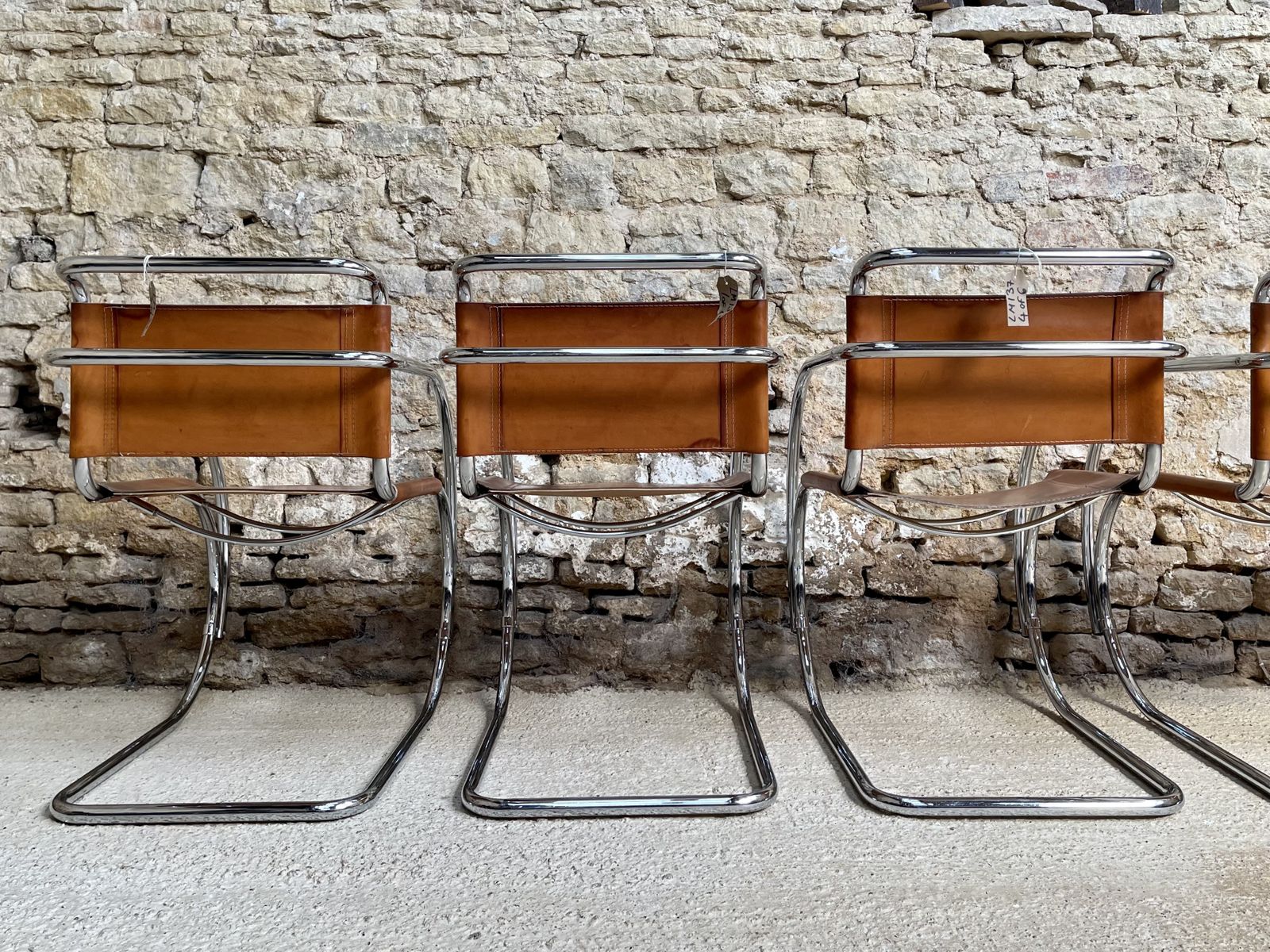
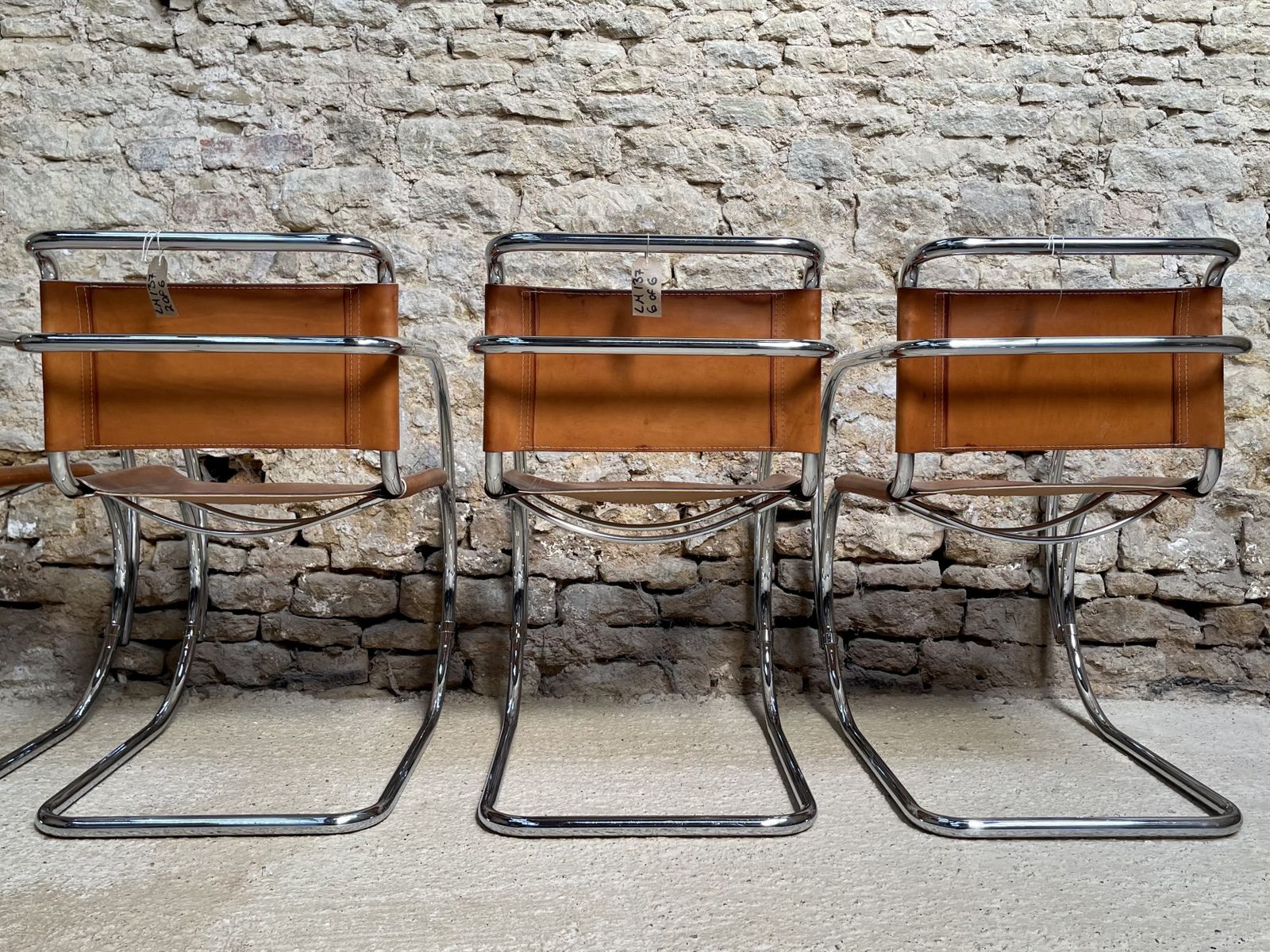
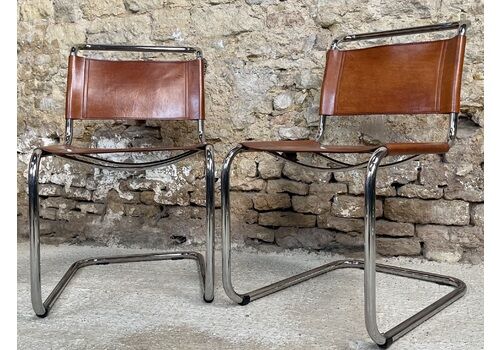
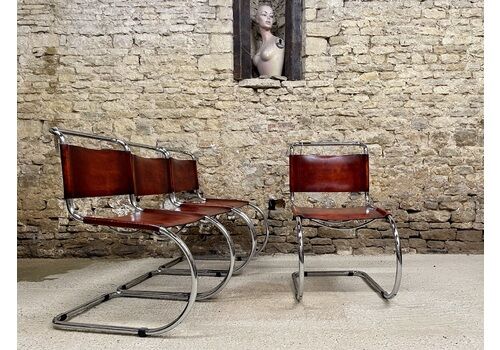
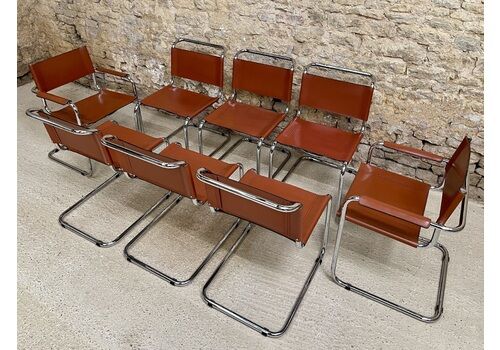
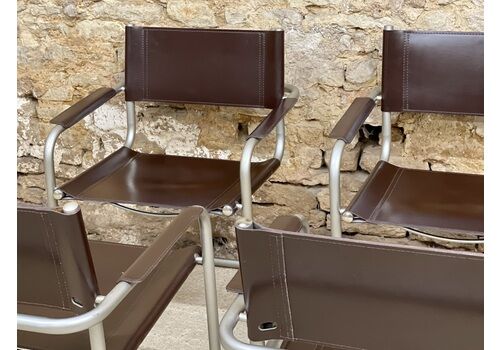
Set Of 4 Four Mies Van Der Rohe Mr 20 Chair Chairs Dinning Club Lounge Occasional Bauhaus Mid Century

 London , United Kingdom

Hassle-free returns
-
 Easy returns (14 days)
-
£75 flat-fee return if you change your mind (UK mainland only)
-
Free return if the item isn't as described
-
Buyer protection
Damage is rare, and you're fully protected if it happens.
Dimensions
Wear Condition
Good
Material
Leather, Chrome
Style
Mid Century Modern, Modernist, Vintage
Product Details
Description
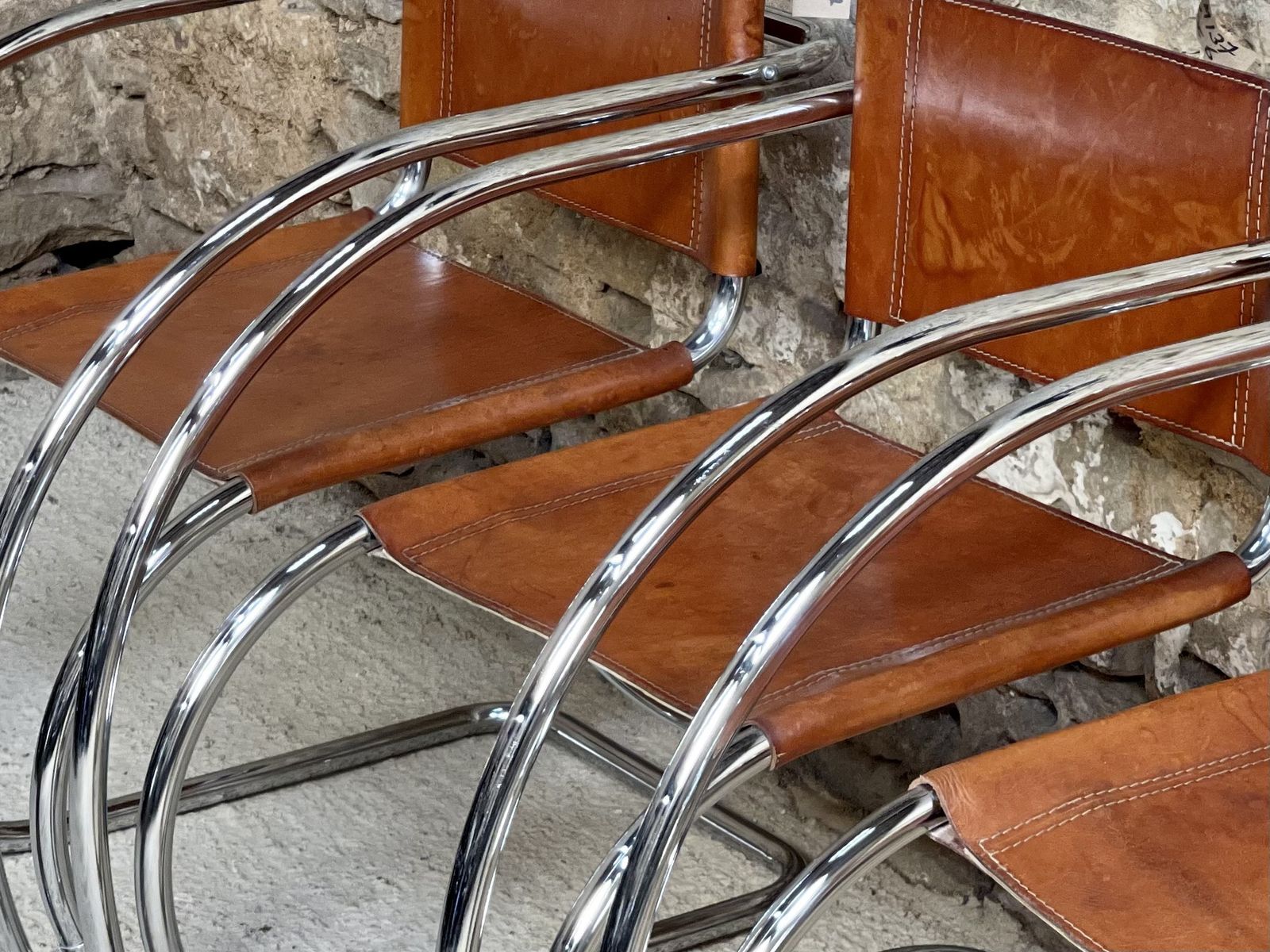
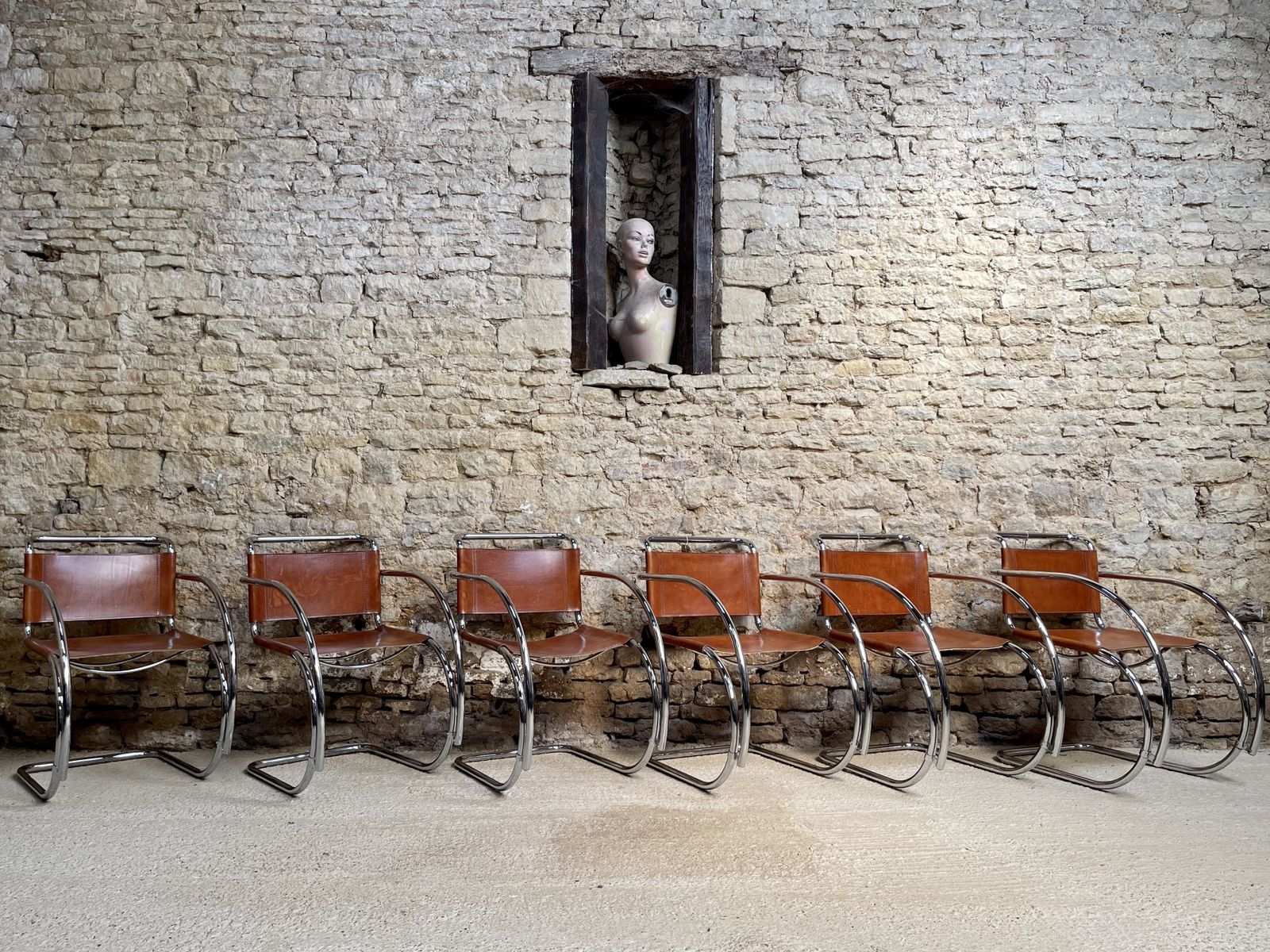
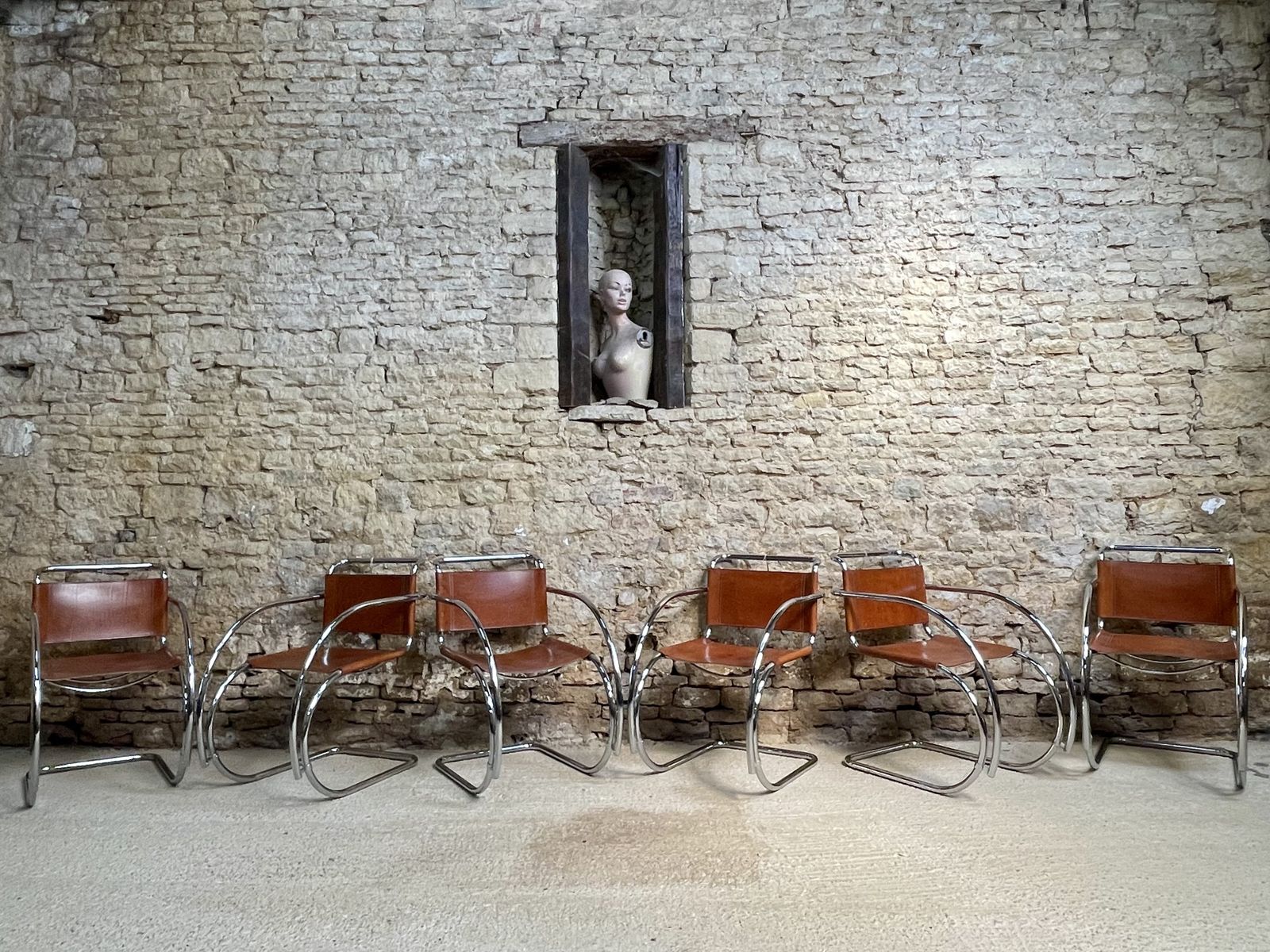
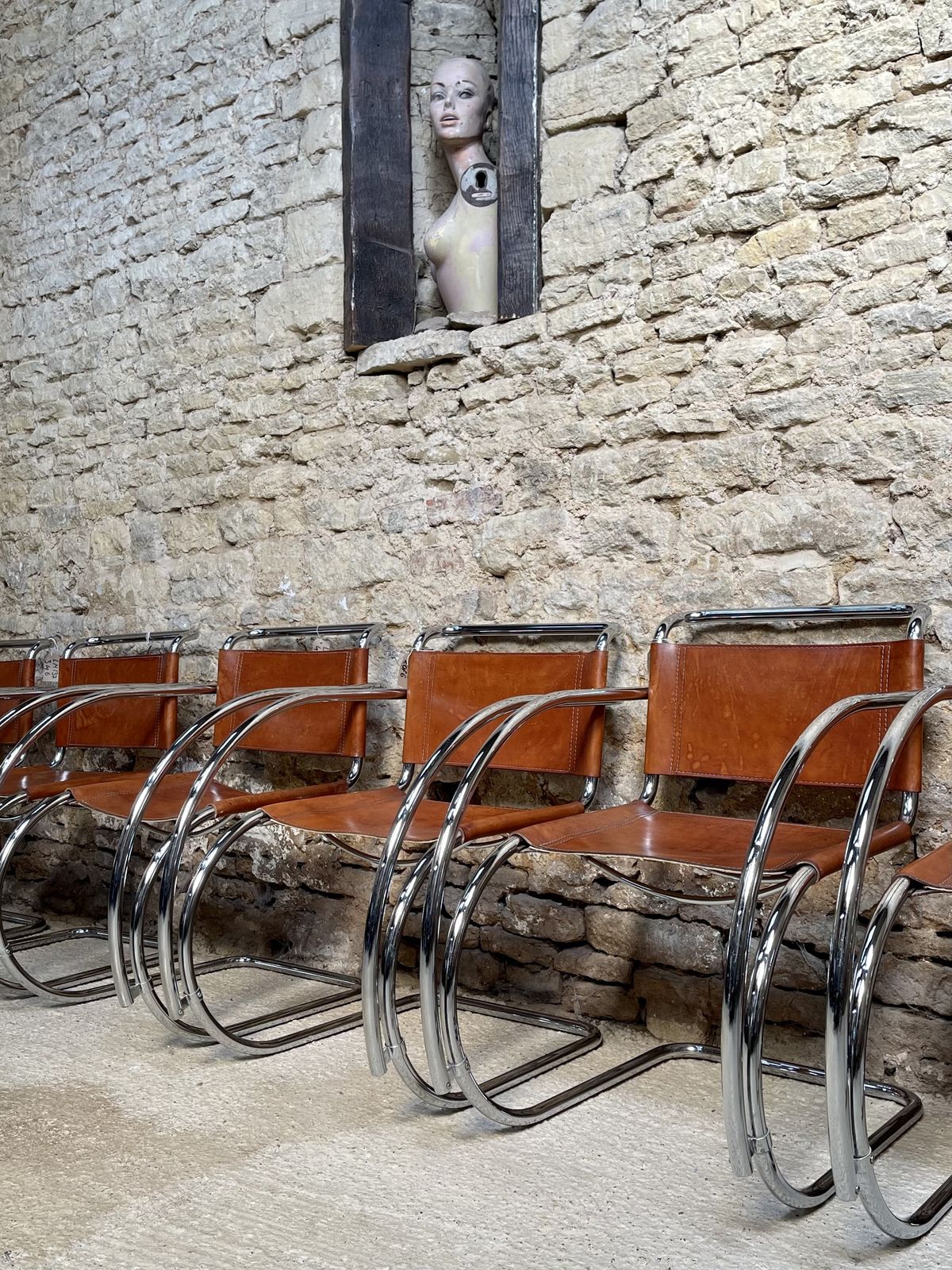
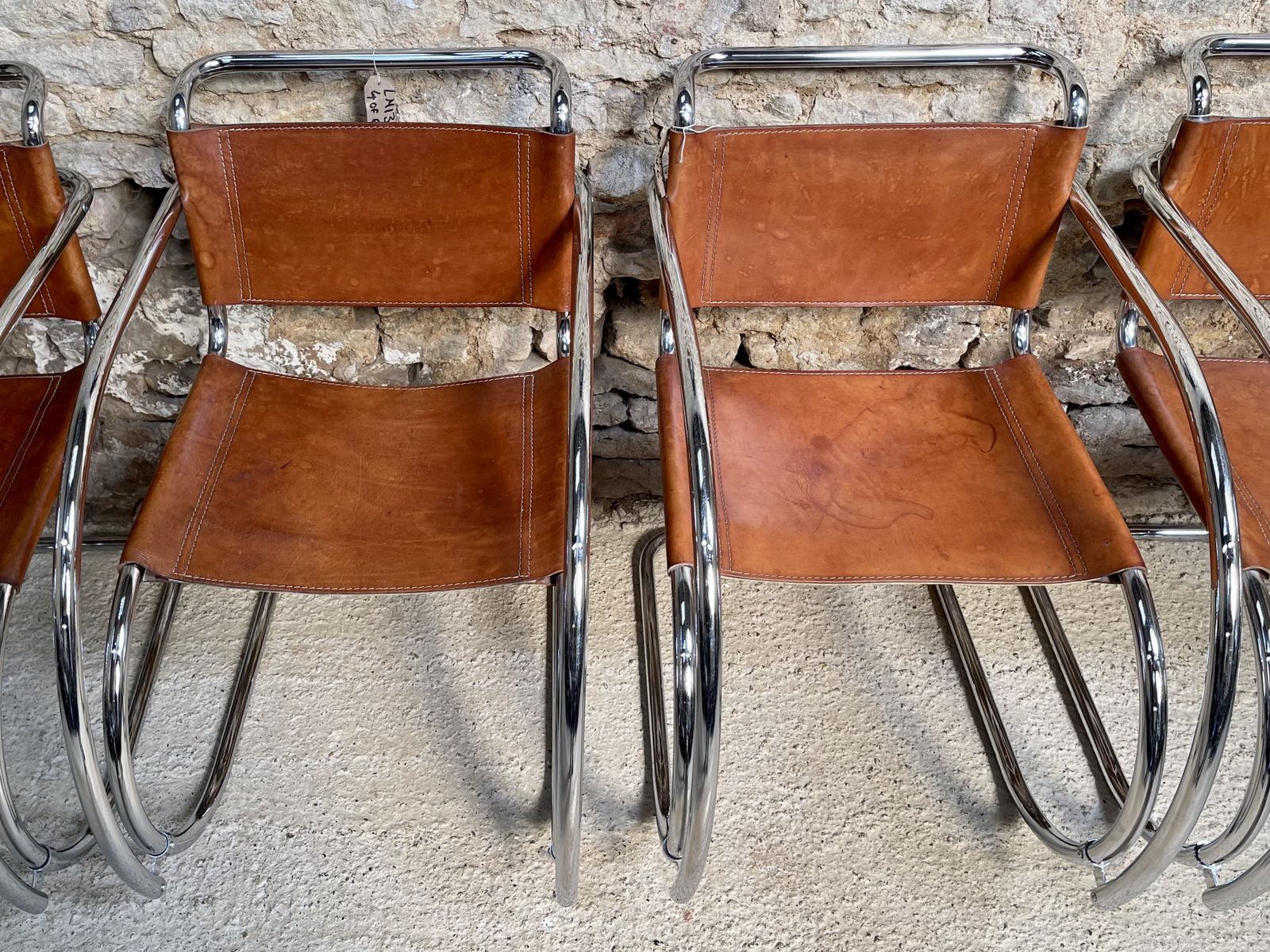
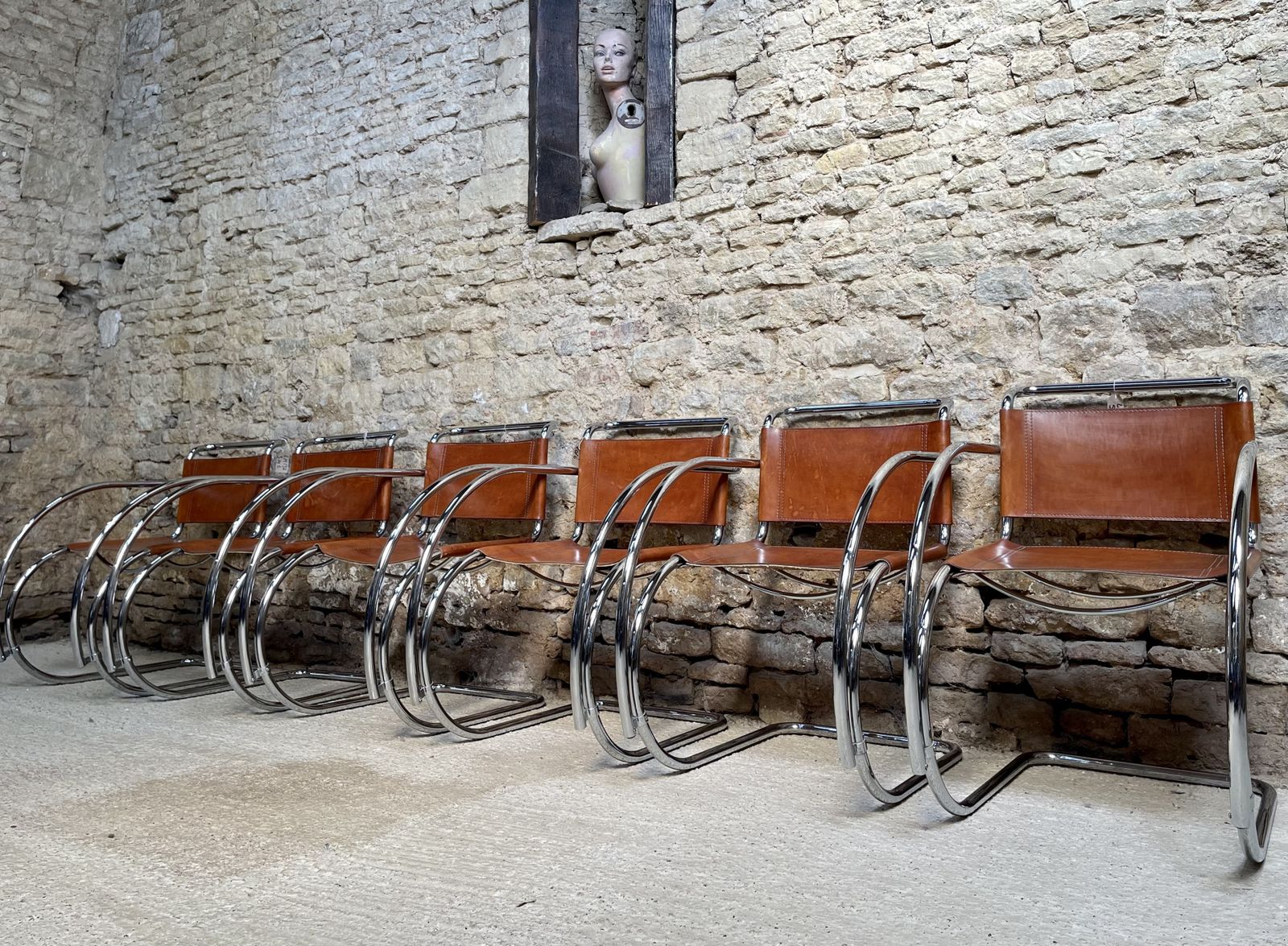
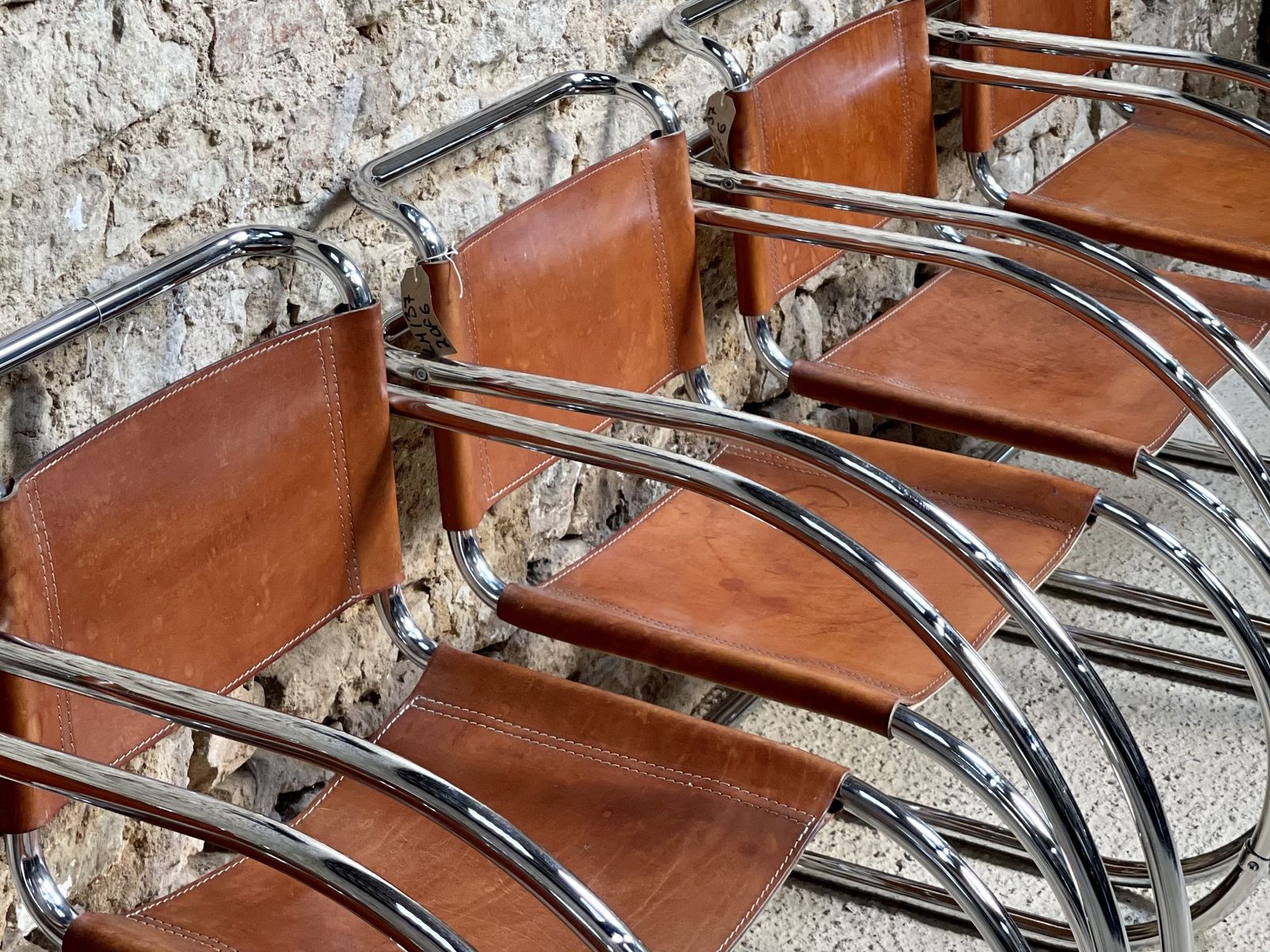
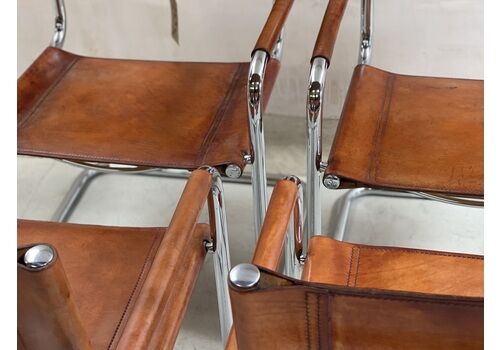
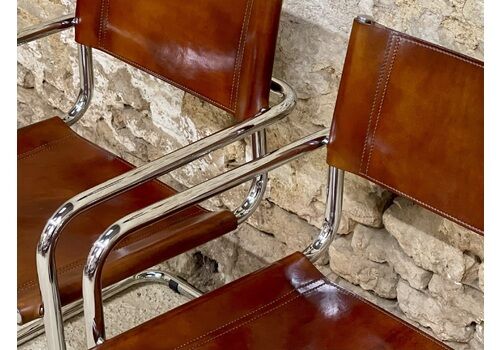
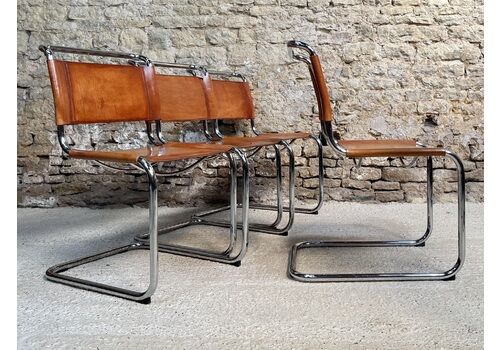
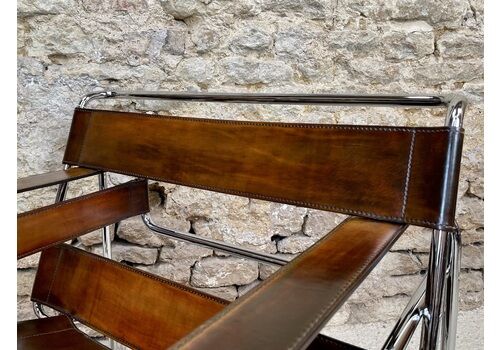
A “hard to find” set of Mies van de Rohe MR20 chairs.
Just in from Rome following their whole life within a private library/gallery room since purchase in 1974.
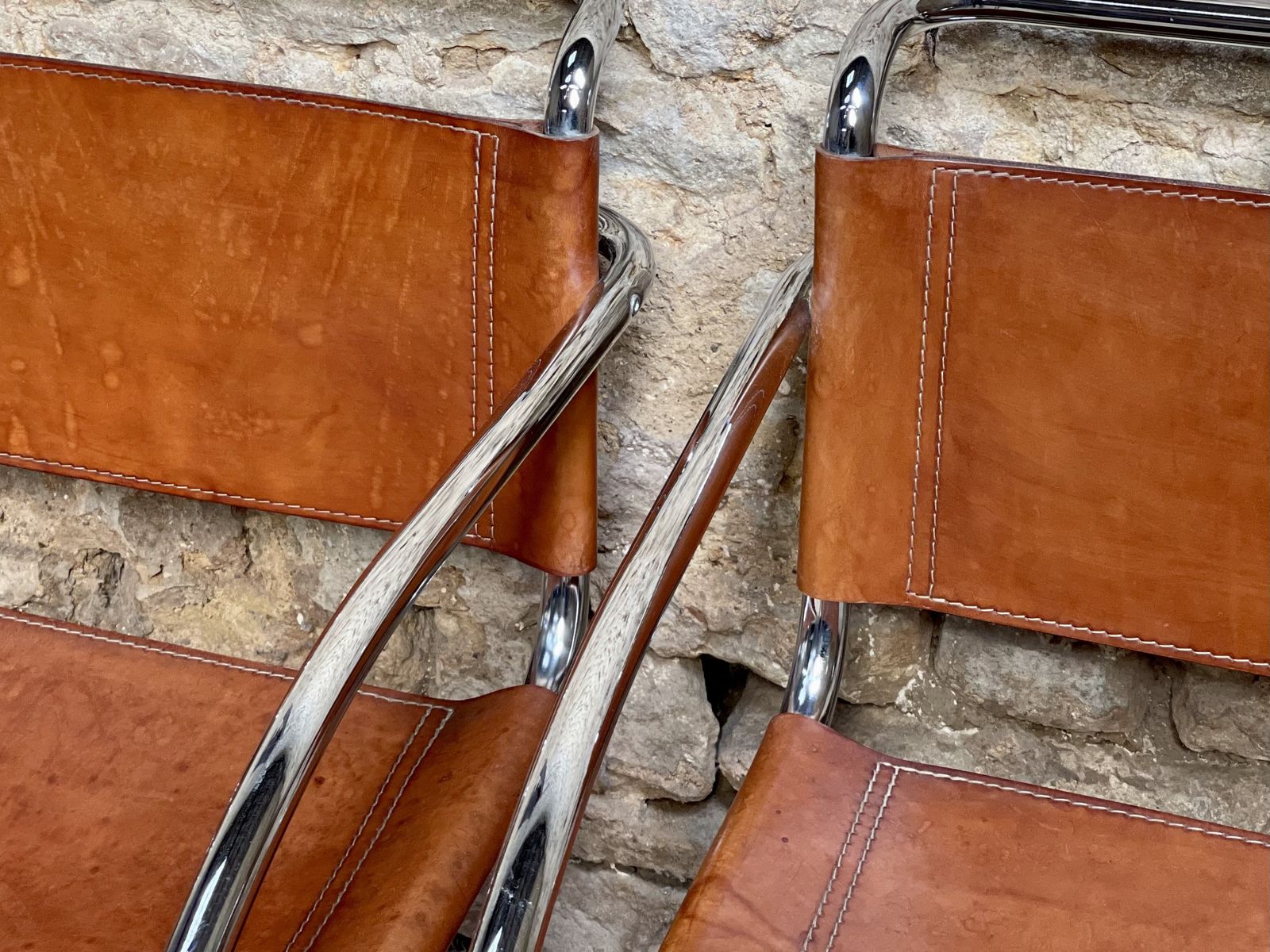
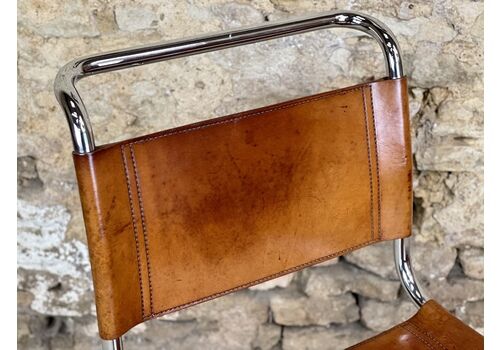
A1 condition.
No rips.
No rust.
No missing bits.
Chair Design.
The origins of the bent-steel cantilevered chair are somewhat murky, but generally three names come up in the discussion. Marcel Breuer is widely credited with pioneering the exploration of the material, Mart Stam seems to be the first to conceive a “chair without back legs”, and Mies van der Rohe is remembered as the one who made it beautiful.
It is believed that Mart Stam described his idea—a continuous loop of steel (he used a thinner gauge gas pipe in the earliest versions) with a cantilevered seat—at a meeting of the Werkbund in 1926. In attendance were Marcel Breuer and Mies van der Rohe, both of whom were inspired to design cantilever chairs of their own in the coming months. Mies replaced the right angles on the front legs with a graceful curve which had the advantage of increasing elasticity while preventing material fatigue. Mies first showed the MR 10 and MR20 at the Stuttgart Weissenhof Estate — a seminal Werkbund exhibition, which first brought modernist works to the public, with buildings designed by Peter Behrens, Walter Gropius, Le Corbusier, Mies van der Rohe and others.
Over the next five years, Mies would develop an entire series of tubular steel designs.
Mies van de Rohe
Who is Ludwig Mies van der Rohe?
Ludwig Mies van der Rohe was a pioneering architect whose works – alongside Le Corbusier’s and Walter Gropius’ – defined a separate strain of modern architecture known as International Style. He was a true modernist pioneer and an iconic figure of 20th-century architecture and design. Sustained by his famous trenchant statements like ‘less is more’ and ‘God is in the details’, the textures of his Barcelona Pavilion (1929/1986), the steel-and-glass aesthetic of the Seagram Building (1956-1958) and his paradigmatic examples of domestic architecture like the Farnsworth House in Plano, Illinois (1945-1951), have become some of the world’s most emblematic and widely-recognized architectural elements and structures built in the last century.
Biography of Ludwig Mies van der Rohe
Born in Germany as Maria Ludwig Michael Mies, the young Ludwig acquired an interest in architecture thanks to his stonemason father. After seconday school, he moved to Berlin where he was able to receive several apprenticeships without ever receiving any formal architectural training. Only after a couple of years working alongside furniture designer Bruno Paul, Mies received his first indepented commission to design a house in the suburbs. His exceptional style and perfect execution impressed prominent architect Peter Behrens, who invited him to join his studio and work alongside figures who later became pioneering artists themselves such as Le Corbusier or Walter Gropius. Even though the democratic Weimar Republic inspired my artists and creative ideas to flourish after World War I, the most important works of Mies from this period remained on paper.
Preoccupied with the necessity of a new architectural vision encapsulating the spirit of modern times, he developed avant-garde ideas that reformed the man-made environment: simplicity of forms; industrial materials such as industrial steel and plate glass; clean, unadorned interiors would become the main elements of his style. In the 1920s and early 1930s, van der Rohe’s reputation took off and he briefly served as the Bauhaus’s third and final director until 1933, when the school closed down due to political pressure. In 1937, he relocated to Chicago, where he continued to design, build and educate. He took up a role as the head of the College of Architecture at the Armour Institute in Chicago, a position that would leave a lasting legacy on both his curriculum and the campus.
The abundent commissions he received after the turmoil of World War II gave van der Rohe an opportunity to execute his first large-scale projects including his pioneering skysrapers of steel covered by large surface areas of glass windows. The Lake Shore Drive Apartments (1949–51) in Chicago and the Seagram Building (1956–58) in New York City are among his major commissions that follow this concept. In the 1960s, van der Rohe continued to design and create public centres like The Neue Nationalgalerie (1968) in Berlin, urban-renewal projects such as Detroit’s Lafayette Park (1959), libraries and offices across the Americas, Mexico and Europe. Despite his stellar reputation, van der Rohe continued to live alone in his spacious Chicago apartment by Lake Michigan until his death in 1969.
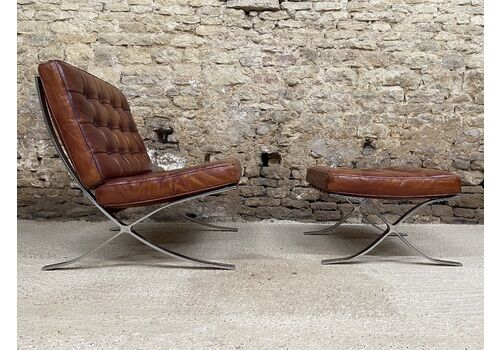
Together with designer Lilly Reich, Ludwig Mies van der Rohe was commisioned to design the German pavilion for the Barcelona Exposition in 1929. This building later became known as the Barcelona Pavilion. The use of different kinds of marble from all over the world, the combination of glass and stee made the stucture stand out from the the exhibition program. The pavilion also held an official reception of the King of Spain at the time. The Barcelona Pavilion also showcased Mies’s iconic Barcelona chair and served as an introduction of new architectural trends to the world. The building was dismantled after the exposition and its element were sent back to Germany to be reused for other buildings. Fifty years later, realising the architectural importance of van der Rohe’s pavilion, the Barcelona City Council urged to reconstruct it. The city ensured that materials for the reconstrucion would be sourced from the same locations as the original building, with different marbles coming from Rome, Greece and the Atlas Mountains. Construction was completed in 1986.
The Exposition brought critical acclaim to Rohe, as the wealthy of Europe started showing great interest and fascination towards spacious modern homes and villas, like the Tugendhat House designed by Mies in 1930, built in Brno. Clients of the project were elite newlyweds Grete and Fritz Tugendhat, who had met Mies in Berlin in 1927 and were already impressed by his simple and spacious design for the Zehlendorf House of Edward Fuchs (1928).
What is Bauhaus
Bauhaus was an influential art and design movement that began in 1919 in Weimar, Germany. The movement encouraged teachers and students to pursue their crafts together in design studios and workshops. The school moved to Dessau in 1925 and then to Berlin in 1932, after which Bauhaus—under constant harassment by the Nazis—finally closed. The Bauhaus movement championed a geometric, abstract style featuring little sentiment or emotion and no historical nods, and its aesthetic continues to influence architects, designers and artists.
Condition report:
A1 , save for some minor usage signs and a few chips. No nasties.
Wear Condition
Good
Cancellations
We offer free cancellations and full refund for orders cancelled before dispatching. View full policy.
Returns
We have a 14-day return guarantee for orders from individual sellers, within the UK and European Union. View full policy.
Additional Delivery Info from Seller
Estimated delivery time
Less than one week
Free collection available
Yes
Made to Last
The average lifespan of a Vinterior piece is 100 years, while modern flat-pack typically takes just 3 years to reach landfill. When you choose pre-loved, you can shop with confidence in quality, craftsmanship and longevity. With our top-rated customer service team and price match guarantee, there's no better way to shop pre-loved.


Shopping at Vinterior


Similar Dining Chairs
Similar Dining Chairs
You may also like
You may also like
Add to a wishlist
Create Wishlist
Completethe room
Good design is all in the layering. Whether you're adding impact or refining the details, now’s the time to find what’s missing.
Reviews
5.0

Based on 36 reviews





Wear conditions
Excellent
Shows little to no signs of wear and tear.
Good
May show slight traces of use in keeping with age. Most vintage and antique items fit into this condition.
Average
Likely to show signs of some light scratching and ageing but still remains in a fair condition.
Apparent Wear and Tear
Visible signs of previous use including scratches, chips or stains.
Please refer to condition report, images or make a seller enquiry for additional information.
Cancellations and Returns
Last updated: 12/02/2026
Clear, predictable protection for every pre-loved purchase.
Simple £75 flat return fee for UK-to-UK mainland furniture when you change your mind.
Applies to furniture with a final selling price of up to £5,000 (excluding delivery and service fees) and delivered from a UK mainland seller to mainland UK addresses. Excludes Northern Ireland, Channel Islands, Scottish Highlands & Islands, Isle of Wight and Isles of Scilly.
Buying vintage should feel inspiring, not uncertain.
Every order on Vinterior is backed by straightforward returns, free cancellations, and extra peace of mind for UK furniture purchases.
1. Free cancellations
Changed your mind before dispatch?
You can cancel any order before it's shipped for a full refund, including delivery.
To cancel an order, click Create cancellation on the order page.
Once an item has been dispatched, delivery costs are not refundable.
Bespoke, personalised or made-to-order pieces cannot be cancelled.
2. Returning an item
You have 14 days from delivery to request a return.
There are two return types:
A. The item isn't as described (free return)
If your piece arrives and it doesn't match the listing in any material way (incorrect description, undisclosed damage, inaccurate measurements, misleading photos), you are fully protected:
- Free return
- The seller or Vinterior arranges pickup
- Full refund, including outbound delivery costs once the seller receives the item
This applies to all purchases.
B. You changed your mind
UK-to-UK furniture deliveries:
To make UK furniture returns predictable and stress-free, we offer a simple flat return fee of £75.
- Applies to furniture delivered from a UK mainland seller to a mainland UK address. Excludes Northern Ireland, Channel Islands, Scottish Highlands & Islands, Isle of Wight and Isles of Scilly.
- Pickup arranged for you
- One clear fee, no surprises
We coordinate the return with either the seller's chosen courier or our trusted delivery partner.
All other items
Most smaller items are straightforward to return.
You can still return your item within 14 days.
- For smaller or parcel-sized items, you can choose to post the item back yourself using a tracked service, or the seller can suggest a preferred courier.
- For larger or more fragile pieces, the seller may recommend the safest return method.
- Return delivery costs vary depending on size and courier.
The seller will confirm the best option based on the item.
3. If your item arrives damaged
Damage on arrival is uncommon, especially for UK furniture deliveries.
But if something does go wrong, you're fully protected.
- Let us know as soon as possible (ideally within 72 hours of delivery) so we can resolve things quickly
- Share photos so we understand what happened
- We’ll help arrange a return and refund if needed
You’re always protected when something goes wrong in transit.
Your statutory rights apply for up to 30 days from delivery.
4. What can't be returned
Some items cannot be returned:
- Bespoke, personalised, or made-to-order pieces
- Items altered after delivery
5. How to start a return
- Log in to your Vinterior account
- Open your order
- Click Create a return
- Add notes + photos if relevant
We'll guide you through the rest.
6. What happens next
- We review your request, confirm the return and advise on next steps
- Pickup or return method is arranged
- The item is returned to the seller
- We issue your refund once the seller confirms the item's condition
Returns are completed smoothly once the pickup is arranged.
7. Refunds
Once the seller receives the piece back in the same condition it was sent, we'll issue your refund to your original payment method.
Once a refund is issued, it may take up to 5–10 working days for the funds to appear back on your original payment method, depending on your bank or card provider.
If the item is returned with new damage that wasn't present at delivery, the refund may be adjusted following review.
Need help?
If you have questions about a return or your order, our support team is here to help. Email us at [email protected] or find other ways to contact us here.
What your service fee covers
-
 14-day return guarantee
-
Flat-fee return shipping on UK furniture
-
Seller vetting
-
Dedicated customer support
| Order Value (£) | Fee (£) |
|---|---|
| 0 — 49.99 | 2.75 |
| 50 — 99.99 | 5.50 |
| 100 — 199.99 | 11.00 |
| 200 — 399.99 | 21.00 |
| 400 — 599.99 | 30.00 |
| 600 — 799.99 | 40.00 |
| 800 — 999.99 | 50.00 |
| 1,000 — 1,499.99 | 55.00 |
| 1,500 — 1,999.99 | 60.00 |
| 2,000 — 4,999.99 | 82.50 |
| 5,000+ | 110.00 |
Added at checkout, based on your basket total.
