


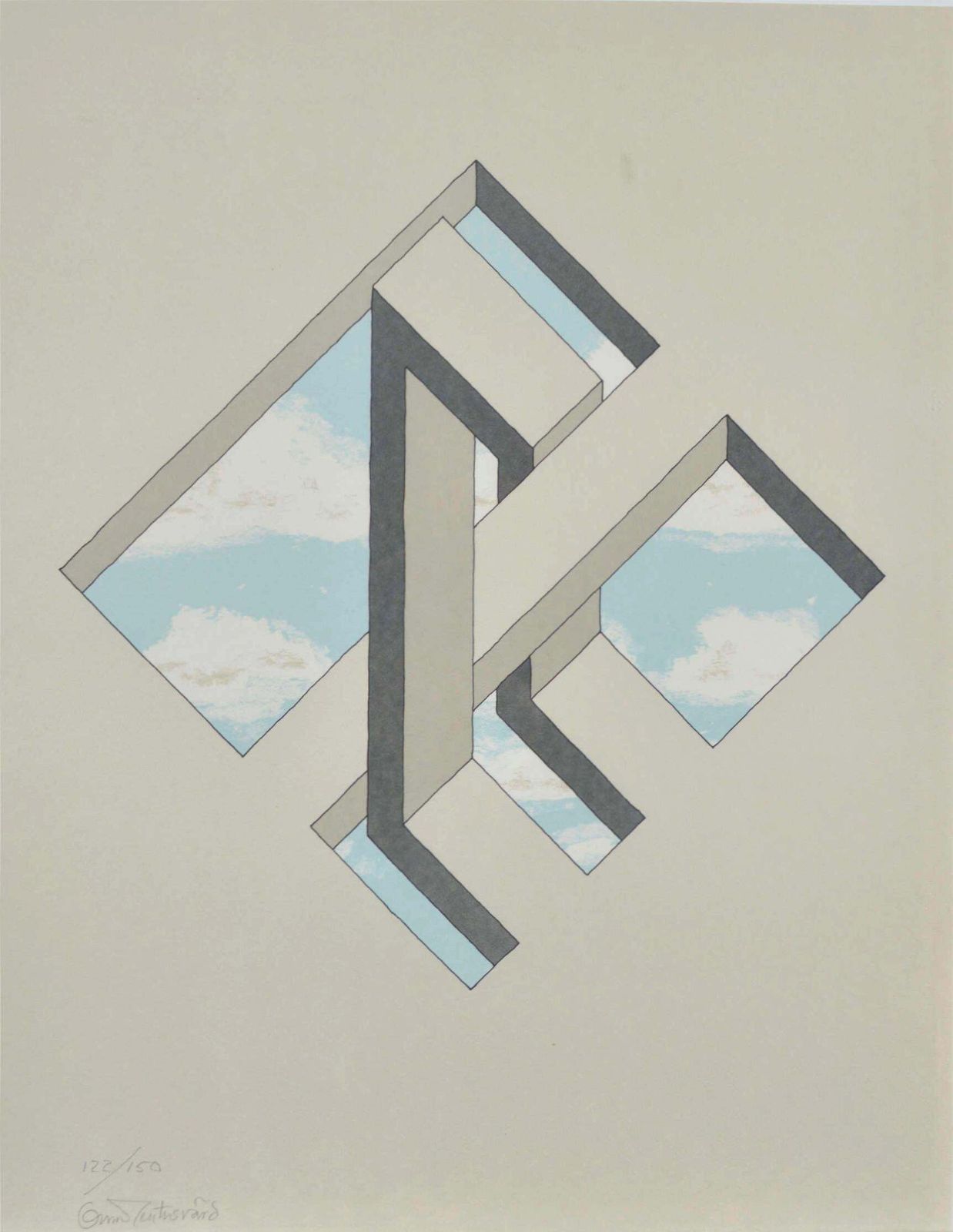
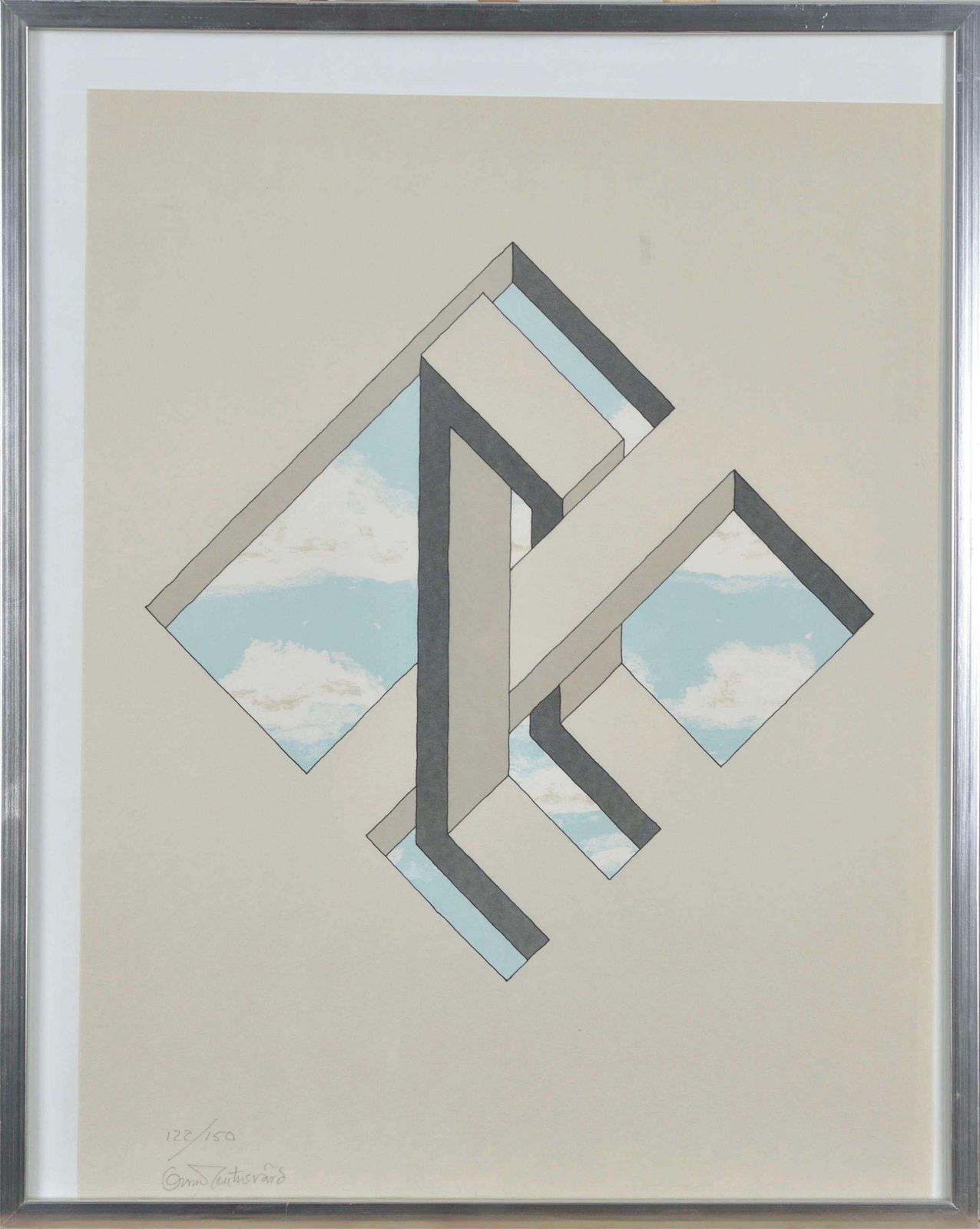
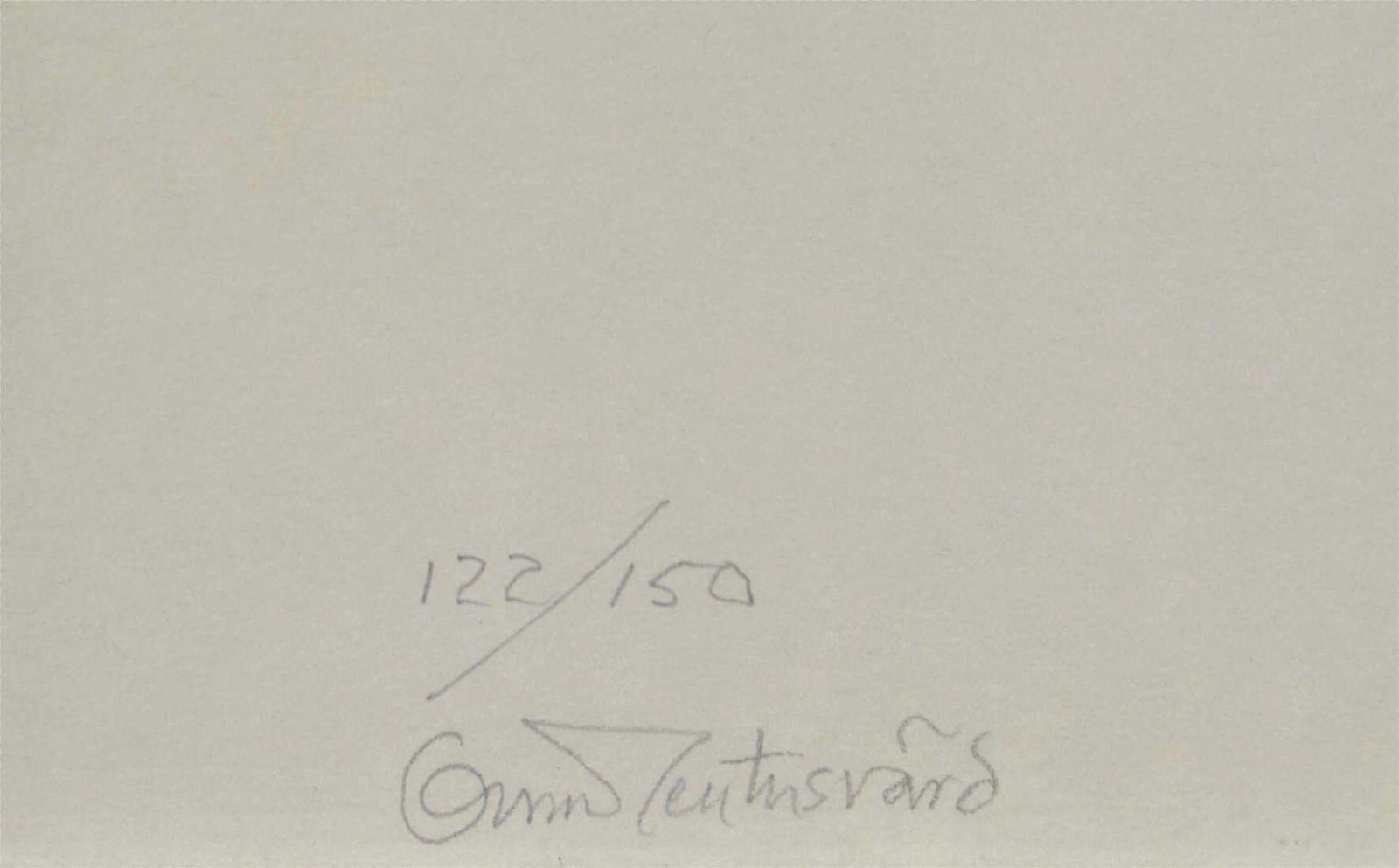
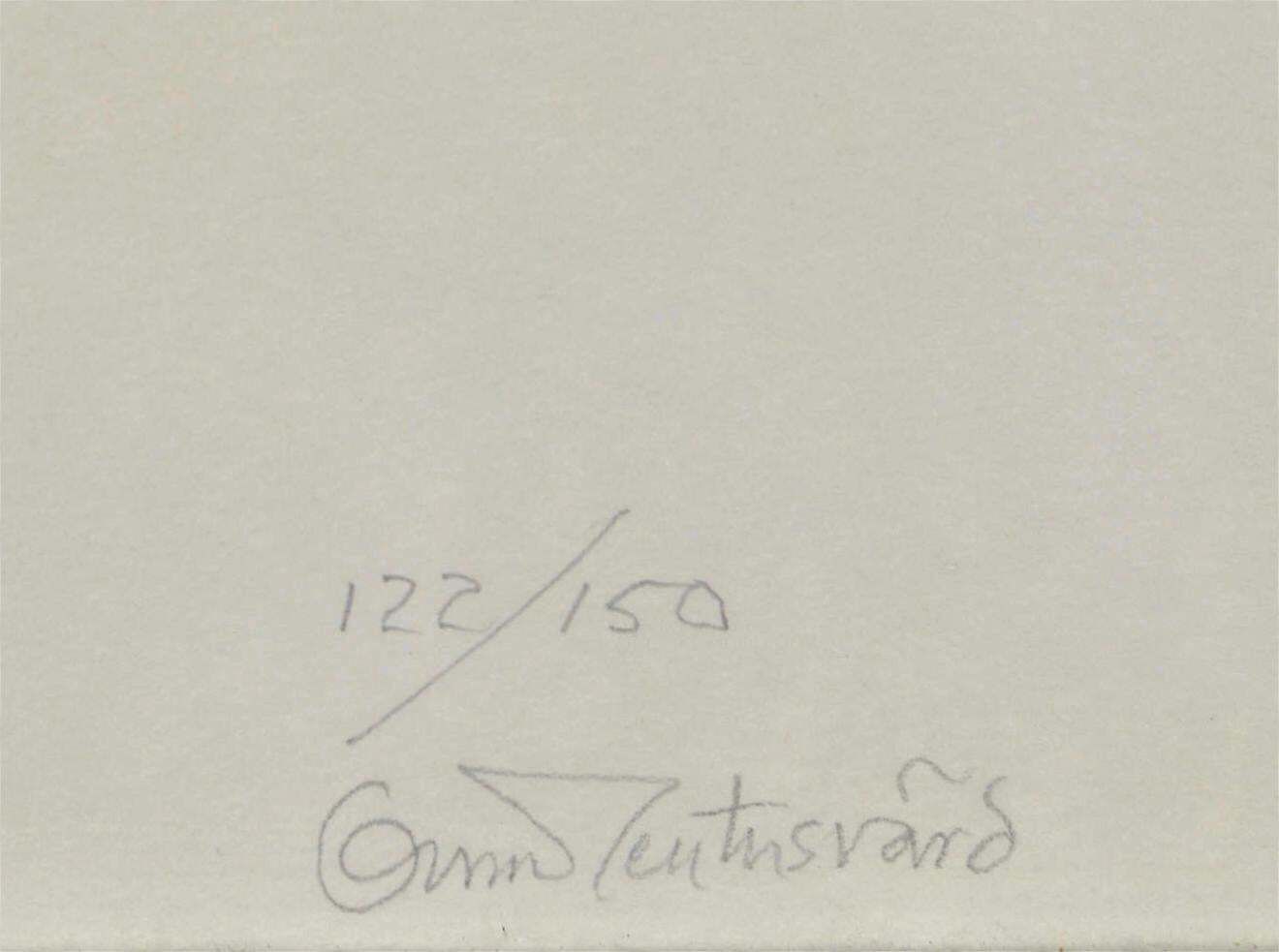
Oscar Reutersvärd Constructive Graphic, By Oscar Reutersvärd. Ofort. 122/150. 31x31 Cm

 Rīga, Latvia

Hassle-free returns
-
 Easy returns (14 days)
-
Free return if the item isn't as described
-
Buyer protection
Damage is rare, and you're fully protected if it happens.
Dimensions
Wear Condition
Good
Material
Paper
Style
Modernist, Vintage, Oriental, Minimalist, Traditional
Product Details
Description
Oscar Reutersvärd (1915–2002) was a Swedish artist, art historian, and professor renowned as the "father of the impossible figure" for his pioneering work in creating optical illusions and geometrically impossible objects that challenge spatial perception and logic.
Born on 29 November 1915 in Stockholm, Reutersvärd trained in the arts under Michael Katz, a Russian professor from the St. Petersburg Academy of Arts, and later studied art history, becoming a lecturer at Stockholm University from 1953 and a professor of art history and theory at Lund University from 1964 to 1981.[1][2] In 1950, he received a grant to study with Fernand Léger in Paris; in 1953, he organized the exhibition L'art Suédois – 1913-1953, while also working as a draftsman, painter, graphic artist, designer, and sculptor who advocated for abstract art in Sweden.[2] A founder and fellow of the International Association of Art Critics since 1950, he contributed to scholarly journals such as the American Journal of Aesthetics and Art Criticism and published art-theoretical works.[1]
Reutersvärd's most defining contributions began in his youth, when he invented the first impossible triangle in 1934 at age 18, rendered as a series of cubes in parallel perspective, predating similar concepts by mathematicians Roger and Lionel Penrose by over two decades.[1][2][3] He followed this in 1937 with an impossible staircase, and over his lifetime produced more than 2,500 such figures—exclusively in isometric or "Japanese" perspective using block forms—exploring visual paradoxes like the "Window in the Floor" series and representations of European flags.[1][2] These works, which he termed "perspective japonaise" from the 1960s onward, influenced optical art, mathematics, and cognitive science, though M.C. Escher drew from the Penroses' figures rather than Reutersvärd's directly.[2][3]
His legacy includes a 1982 book of his drawings, a 1991 retrospective exhibition in Stockholm featuring 150 sculptures, and Swedish postage stamps issued in 1982 honoring his impossible figures, cementing his role in popularizing these mind-bending forms.[1][2] Reutersvärd passed away on February 2, 2002, leaving a profound impact on exhibitions of optical illusions and geometric art worldwide.[2]
Biography
Early Life
Oscar Reutersvärd was born on 29 November 1915 in Stockholm, Sweden, to Oscar Reuterswärd Sr., a dentist who had returned from the United States, and his wife Blanche.[4] The family resided in a spacious apartment at Strandvägen 5A in the affluent Östermalm district, where they employed household staff to care for their three children—Clarence, Blanche, and Oscar—while the parents were often occupied during the week, limiting family interactions primarily to weekends.[4] Reutersvärd's grandfather, Philip Gottschalk, a professional magician, played a notable role in his early years by introducing him to concepts like the Möbius strip, fostering an environment of curiosity and creative play.[4]
During his childhood, Reutersvärd faced significant challenges due to undiagnosed dyslexia, which caused difficulties with reading and perceiving text, leading to frustration in school settings where letters appeared to "jump" off the page.[5] He later received a formal diagnosis in August 1950, reflecting on it in his diary: “Idag fick jag veta orsaken till alla mina uppfattningssvårigheter. Av en specialist. Jag är ordblind, utpräglat ordblind” (Today I learned the reason for all my perception difficulties. From a specialist. I am word-blind, distinctly word-blind).[4] Despite these hurdles, his family provided a supportive and privileged backdrop that encouraged alternative forms of expression, allowing him to channel his energies into drawing and other non-verbal creative outlets rather than struggling with traditional academic demands.[4][5]
Reutersvärd's early exposure to art occurred within his Stockholm schooling at Sofi Almquists samskola, where he thrived under the guidance of teacher Ingrid Alexanderson, who taught him advanced watercolor techniques.[4] While peers engaged in outdoor activities like skiing, he preferred staying indoors to paint, honing his skills in color and form.[4] In adolescence, his initial artistic experiments included creating meticulously precise color circles, which were showcased at school and earned praise from prominent art collector Ernest Thiel, hinting at his budding interest in geometric precision and visual harmony.[4] These early endeavors laid the groundwork for his lifelong fascination with perspective, though he would soon transition to more formal studies.
Education and Early Career
Reutersvärd began his formal artistic education in Stockholm during the 1930s, training under Russian émigré professor Michael Katz, a former instructor at the St. Petersburg Academy of Arts, as well as Otto G. Carlsund. He also attended Otte Sköld's Painting School from 1935 to 1936, where he honed his skills as a graphic artist and illustrator.[1][6][7]
Following this practical training, Reutersvärd pursued academic studies in art history in Stockholm, which provided a theoretical foundation for his dual career in art and scholarship. In the summer of 1939, as a young art historian, he traveled to Paris to engage directly with contemporary and historical artworks, broadening his understanding of European art movements. During his early studies, he encountered Japanese art and its distinctive parallel perspective techniques, elements that later informed his illustrative style.[2][8][9]
In 1950, Reutersvärd received a grant that allowed him to return to Paris and study under the cubist painter Fernand Léger, further refining his approach to form and perspective. His early career as an art historian and illustrator included minor commissions and initial publications, such as his 1948 article "Carlsund och neoplasticismen," which analyzed the influence of Piet Mondrian on his former teacher Otto Carlsund. These efforts established his reputation in Swedish art circles before his academic ascent.[2][10]
By 1953, Reutersvärd had been appointed associate professor of art history at Stockholm University, transitioning into a more formal academic role. He advanced to full professor of art history and theory at Lund University in 1964, where he lectured on topics ranging from impressionism to theoretical perspectives in visual art.[11][2]
Personal Life and Later Years
Reutersvärd was born into an artistic family in Stockholm that actively encouraged his early interests in painting and sculpture, shaping his personal development alongside his creative inclinations. He was married to Britt Ingrid Margareta Lundbohm-Reutersvärd (born 1917), an artist and designer; they had at least two sons, Anders and Pontus.[12][13][14] Throughout his adult life, his daily routine intertwined personal reflection with artistic endeavors, often conducted in solitude to accommodate his unique perceptual challenges. He maintained a long-term residence in Lund, Sweden, closely linked to his role as a professor of art history and theory at Lund University from 1964 to 1981.[15]
A persistent health issue from childhood, dyslexia, continued to affect Reutersvärd into adulthood, causing difficulties in estimating distances and sizes of objects. This condition influenced his work habits, prompting him to rely on intuitive drawing methods and extended periods of focused visualization rather than conventional measurement techniques. Despite these challenges, he adapted by integrating his perceptual experiences into his creative process, maintaining a disciplined routine that balanced academic duties with personal artistic exploration.[15]
In his later years following retirement, Reutersvärd remained in Lund, continuing to engage with art and theory until his health declined. He died on 2 February 2002 in Lund at the age of 86, marking the end of a life dedicated to visual innovation amid personal perceptual hurdles.[2]
Artistic Work
Development of Impossible Figures
Oscar Reutersvärd created his first impossible figure, the impossible triangle, in 1934 at the age of 18 while doodling during a Latin class. This pioneering work depicted the triangle as a series of nine cubes arranged in a parallel perspective that appeared coherent from one viewpoint but revealed inherent contradictions upon closer inspection, challenging Euclidean geometry.[16][17]
In 1937, Reutersvärd expanded his explorations with the invention of the impossible stairs, an optical illusion rendering a staircase that suggests perpetual ascent or descent without net elevation change, exploiting ambiguities in spatial continuity. That same year, he developed foundational concepts leading to the impossible fork—also known as the blivet—a pronged object that ambiguously morphs between two and three tines depending on the viewer's focus.[18][1]
Reutersvärd's methodology underwent a conceptual shift from emulating realistic perspectives, briefly informed by Japanese parallel projection techniques encountered in his studies, to crafting deliberate optical illusions through solitary experimentation with basic geometric elements like cubes and lines. This transition emphasized the interplay between two-dimensional representation and three-dimensional perception, intentionally subverting viewer expectations to reveal perceptual paradoxes. From the 1960s onward, he termed his approach "perspective japonaise."[19][1][2]
Throughout his career, Reutersvärd generated over 2,500 impossible figures, with the 1930s and 1940s marking the formative era of intensive innovation before he temporarily set aside the pursuit for academic and other professional commitments.[1][20]
Techniques and Materials
Reutersvärd primarily employed India ink on Japanese washi paper to achieve precise, fluid lines and a subtle texture that enhanced the illusory quality of his impossible figures.[21] This combination allowed for meticulous hand-drawn details without the aid of rulers or mechanical tools, emphasizing organic distortions in his compositions.[22]
His technique drew from Japanese artistic traditions, incorporating parallel perspective akin to ukiyo-e prints to create depth and ambiguity without traditional Western vanishing points.[2] This approach, evident in his "Perspective Japonaise" series, flattened spatial elements to heighten perceptual paradoxes.[2]
Geometrically, Reutersvärd constructed his figures using modular cubes as foundational units, applying linear distortions to manipulate edges and angles for visual inconsistency.[23] These methods relied on isometric projections, where parallel lines maintained equidistance to sustain the illusion of three-dimensionality in two dimensions.[2]
Over time, his style evolved from initial rough sketches—such as the 1934 impossible triangle composed of nine cubes—to highly refined, monochromatic illustrations that prioritized purity and undecorated forms.[23] This progression refined his line work for greater clarity and impact, focusing on essential geometric elements to provoke viewer disorientation.[2]
Notable Works and Series
One of Oscar Reutersvärd's earliest and most iconic works is the impossible triangle, created in 1934 at the age of 18 and designated as Opus 1. This piece consists of a series of cubes arranged in a perspective that defies three-dimensional realization, forming a closed triangular shape where each corner appears to connect impossibly to the others, challenging the viewer's perception of spatial logic.[9][24] The work's minimalistic design, rendered in a parallel or "Japanese" perspective, emphasizes pure geometric form without additional embellishments.[9]
In 1937, Reutersvärd produced the impossible stairs and developed concepts leading to the impossible fork. The stairs depict a continuous flight that loops endlessly without ascending or descending, creating a paradox of perpetual motion in a static image.[9] The fork, meanwhile, illustrates a three-pronged utensil where the tines inexplicably merge into a single bar at the handle, generating a visual ambiguity that shifts between plausible and contradictory interpretations upon closer inspection.[24] Both pieces exemplify Reutersvärd's early exploration of perceptual deception through simple line drawings.[9]
From the 1950s through the 1990s, Reutersvärd developed extensive series of impossible figures, amassing over 2,500 such works in total, many cataloged with opus numbers. These later series included architectural forms like buildings with staircases and facades that violate Euclidean geometry; and abstract shapes exploring twisted polyhedra and interlocking voids.[9] In his final decades, he incorporated watercolors into these designs, adding subtle color gradients to heighten the illusory depth while maintaining the core geometric purity.[9]
Beyond impossible figures, Reutersvärd created realistic illustrations and graphic designs, often featuring precise renderings of everyday objects and landscapes stripped to their essential lines, reflecting his training in commercial art and commitment to clarity over ornamentation.[2] These non-illusory works, produced throughout his career, demonstrate his versatility as a draftsman while underscoring a consistent focus on form and perspective.[24]
Recognition and Legacy
Exhibitions and Public Commissions
Reutersvärd's first major exhibition took place in Stockholm galleries in 1963, showcasing his early impossible figures and marking a significant step in gaining public recognition for his innovative geometric drawings.[15] This debut highlighted works developed over the preceding decades, drawing attention to his pioneering approach to optical illusions.[15]
In 1991, a retrospective exhibition was held in Stockholm, featuring approximately 150 of his sculptures.[2]
In the mid-1990s, his oeuvre received prominent institutional validation through displays at Sweden's Nationalmuseum and Moderna Museet in Stockholm, where selections from his extensive body of over 2,500 pieces were presented to emphasize his contributions to modern art and visual perception.[15] These exhibitions underscored the enduring appeal of his impossible figures in a museum context, attracting audiences interested in the intersection of art, mathematics, and psychology.
Throughout his career, Reutersvärd received numerous public commissions for installations in Swedish spaces, integrating his designs into urban and natural environments. Notable examples include large-scale sculptures and architectural elements, such as the concrete labyrinth at Tunaskolan in Lund, designed in 1964 and constructed in 1968 to provide a safe play area with a protective ditch.[25] In the 1990s, he created hedge mazes for public parks, including a hornbeam labyrinth in Lund's Stadsparken (1996), a double spiral at Sofiero Palace Garden in Helsingborg (1998), a B-shaped hedge in Borås (1998), and an S-formed hedge paired with a fire maze in Skövde (2001), the latter tied to a retrospective show.[25] These commissions demonstrated his ability to translate two-dimensional illusions into interactive, three-dimensional public art that engaged communities with perceptual challenges.[15]
Academic recognition came through his appointment as a professor of art history and theory at Lund University, where he taught and influenced generations of scholars on topics including modern art and visual theory from the mid-20th century onward.[25] This position affirmed his dual role as practitioner and theorist, allowing him to formalize the intellectual foundations of impossible figures within academic discourse.[26]
Postage Stamps
In 1982, the Swedish postal authority issued a series of three definitive postage stamps honoring Oscar Reutersvärd's pioneering work in impossible figures, marking a significant official acknowledgment of his contributions to optical art. The stamps were based on watercolors by Reutersvärd and engraved by the acclaimed stamp designer Czesław Słania, whose intricate line work captured the paradoxical geometries with precision.[27] Released on February 16, 1982, the set featured values of 25 öre (black lilac), 30 öre (dark brown olive), and 75 öre (dark blue), each reproducing a distinct impossible figure to highlight the artist's innovative approach to visual deception.[28][29][30]
Among the selected designs was Reutersvärd's iconic impossible triangle from 1934, a foundational example of his style composed of interlocking cubes that defy three-dimensional logic.[2] The other two stamps depicted related illusions: a contorted geometric form suggesting an impossible chair or ladder, and a more complex polyhedral structure evoking an unattainable ring or frame, all rendered in minimalist line art to emphasize their perceptual ambiguity.[31] These choices reflected Reutersvärd's academic and artistic reputation, built through decades of teaching art history at Lund University and exhibiting his illusionistic drawings internationally, which prompted the postal service to commission the series as a tribute to his influence on modern visual perception.[6]
The stamps' release had a notable cultural impact in Sweden, serving as national endorsement of Reutersvärd's art and sparking renewed public interest in his oeuvre at a time when his work was gaining broader appreciation beyond academic circles.[2] First-day covers bearing the set, some autographed by the artist, became sought-after collectibles, further embedding his impossible figures in everyday Swedish life and philatelic culture.[32]
Influence on Art and Science
Oscar Reutersvärd is widely recognized as the "father of impossible figures" for pioneering the art of three-dimensional drawings that appear feasible but cannot exist in physical space, influencing mathematical art and the field of optical illusions.[2] His 1934 impossible triangle, composed of nine cubes, laid the groundwork for this genre and was independently rediscovered decades later.[33] This recognition extends to interdisciplinary fields where his figures challenge Euclidean geometry and perceptual norms, inspiring artists and scientists alike.[6]
In 1982, a book featuring his drawings was published, further disseminating his work.[1]
Reutersvärd's work significantly inspired M.C. Escher's later creations following the 1958 publication by Lionel and Roger Penrose on impossible objects, which unknowingly built on Reutersvärd's earlier inventions. The Penroses introduced Escher to concepts like the impossible triangle and staircase—first drawn by Reutersvärd in 1934 and 1937, respectively—leading to Escher's iconic lithographs such as Waterfall (1961) and Ascending and Descending (1960). Roger Penrose later acknowledged Reutersvärd's precedence in 1984, highlighting how Reutersvärd's isometric projections influenced Escher's exploration of paradoxical architecture despite no direct contact between the artists.[2]
His impossible figures have contributed to studies in visual perception and Gestalt psychology by demonstrating how the brain integrates local cues into a coherent whole, even when global inconsistencies arise, revealing the rigidity of perceptual rules. Psychologists have used Reutersvärd's designs to illustrate principles of figure-ground organization and the precedence of holistic gestalt over fragmented parts, as seen in analyses of paradoxical perceptions where local elements appear valid but form an impossible totality.[34] These contributions underscore the interplay between art and cognitive science, showing how two-dimensional illusions exploit three-dimensional interpretation biases.[35]
Reutersvärd's legacy endures in museums, scholarly books, and digital media as of 2025, with his works featured in collections like the Escher in the Palace museum, which dedicates space to his foundational role in impossible art. The 2022 book The Impossible Arises: Oscar Reutersvärd and His Contemporaries examines his philosophical approach and impact, drawing on his over 2,500 creations to connect art history with geometry and perception.[36][2] Digitally, his figures inspire video games such as Echochrome (2008) and Monument Valley (2014), where impossible geometries create immersive illusions, ensuring his influence in contemporary visual culture.
Condition report:
Good
Wear Condition
Good
Cancellations
We offer free cancellations and full refund for orders cancelled before dispatching. View full policy.
Returns
We have a 14-day return guarantee for orders from individual sellers, within the UK and European Union. View full policy.
Additional Delivery Info from Seller
Estimated delivery time
Less than one week
Free collection available
Yes
Made to Last
The average lifespan of a Vinterior piece is 100 years, while modern flat-pack typically takes just 3 years to reach landfill. When you choose pre-loved, you can shop with confidence in quality, craftsmanship and longevity. With our top-rated customer service team and price match guarantee, there's no better way to shop pre-loved.

Professional Seller
Shopping at Vinterior


Similar Drawings and Engravings
Similar Drawings and Engravings
Add to a wishlist
Create Wishlist
Completethe room
Good design is all in the layering. Whether you're adding impact or refining the details, now’s the time to find what’s missing.
Wear conditions
Excellent
Shows little to no signs of wear and tear.
Good
May show slight traces of use in keeping with age. Most vintage and antique items fit into this condition.
Average
Likely to show signs of some light scratching and ageing but still remains in a fair condition.
Apparent Wear and Tear
Visible signs of previous use including scratches, chips or stains.
Please refer to condition report, images or make a seller enquiry for additional information.
Cancellations and Returns
Last updated: 12/02/2026
Clear, predictable protection for every pre-loved purchase.
Simple £75 flat return fee for UK-to-UK mainland furniture when you change your mind.
Applies to furniture with a final selling price of up to £5,000 (excluding delivery and service fees) and delivered from a UK mainland seller to mainland UK addresses. Excludes Northern Ireland, Channel Islands, Scottish Highlands & Islands, Isle of Wight and Isles of Scilly.
Buying vintage should feel inspiring, not uncertain.
Every order on Vinterior is backed by straightforward returns, free cancellations, and extra peace of mind for UK furniture purchases.
1. Free cancellations
Changed your mind before dispatch?
You can cancel any order before it's shipped for a full refund, including delivery.
To cancel an order, click Create cancellation on the order page.
Once an item has been dispatched, delivery costs are not refundable.
Bespoke, personalised or made-to-order pieces cannot be cancelled.
2. Returning an item
You have 14 days from delivery to request a return.
There are two return types:
A. The item isn't as described (free return)
If your piece arrives and it doesn't match the listing in any material way (incorrect description, undisclosed damage, inaccurate measurements, misleading photos), you are fully protected:
- Free return
- The seller or Vinterior arranges pickup
- Full refund, including outbound delivery costs once the seller receives the item
This applies to all purchases.
B. You changed your mind
UK-to-UK furniture deliveries:
To make UK furniture returns predictable and stress-free, we offer a simple flat return fee of £75.
- Applies to furniture delivered from a UK mainland seller to a mainland UK address. Excludes Northern Ireland, Channel Islands, Scottish Highlands & Islands, Isle of Wight and Isles of Scilly.
- Pickup arranged for you
- One clear fee, no surprises
We coordinate the return with either the seller's chosen courier or our trusted delivery partner.
All other items
Most smaller items are straightforward to return.
You can still return your item within 14 days.
- For smaller or parcel-sized items, you can choose to post the item back yourself using a tracked service, or the seller can suggest a preferred courier.
- For larger or more fragile pieces, the seller may recommend the safest return method.
- Return delivery costs vary depending on size and courier.
The seller will confirm the best option based on the item.
3. If your item arrives damaged
Damage on arrival is uncommon, especially for UK furniture deliveries.
But if something does go wrong, you're fully protected.
- Let us know as soon as possible (ideally within 72 hours of delivery) so we can resolve things quickly
- Share photos so we understand what happened
- We’ll help arrange a return and refund if needed
You’re always protected when something goes wrong in transit.
Your statutory rights apply for up to 30 days from delivery.
4. What can't be returned
Some items cannot be returned:
- Bespoke, personalised, or made-to-order pieces
- Items altered after delivery
5. How to start a return
- Log in to your Vinterior account
- Open your order
- Click Create a return
- Add notes + photos if relevant
We'll guide you through the rest.
6. What happens next
- We review your request, confirm the return and advise on next steps
- Pickup or return method is arranged
- The item is returned to the seller
- We issue your refund once the seller confirms the item's condition
Returns are completed smoothly once the pickup is arranged.
7. Refunds
Once the seller receives the piece back in the same condition it was sent, we'll issue your refund to your original payment method.
Once a refund is issued, it may take up to 5–10 working days for the funds to appear back on your original payment method, depending on your bank or card provider.
If the item is returned with new damage that wasn't present at delivery, the refund may be adjusted following review.
Need help?
If you have questions about a return or your order, our support team is here to help. Email us at [email protected] or find other ways to contact us here.
What your service fee covers
-
 14-day return guarantee
-
Flat-fee return shipping on UK furniture
-
Seller vetting
-
Dedicated customer support
| Order Value (£) | Fee (£) |
|---|---|
| 0 — 49.99 | 2.75 |
| 50 — 99.99 | 5.50 |
| 100 — 199.99 | 11.00 |
| 200 — 399.99 | 21.00 |
| 400 — 599.99 | 30.00 |
| 600 — 799.99 | 40.00 |
| 800 — 999.99 | 50.00 |
| 1,000 — 1,499.99 | 55.00 |
| 1,500 — 1,999.99 | 60.00 |
| 2,000 — 4,999.99 | 82.50 |
| 5,000+ | 110.00 |
Added at checkout, based on your basket total.
