


 Back to articles
THE DIGEST
Inside hotelier Timothy Griffin’s Islington home
Timothy Griffin opens the door to his Islington home, filled with pieces picked up over decades, from Brooklyn vintage finds and local art to furniture and objects passed down through his family.
For hotelier Timothy Griffin, a good interior isn’t something you finish. It’s something you build up over time.
The co-founder of Levin Hotels and Hospitality has lived in Islington for around 12 years, aside from a five-year stint in New York. Today, his late-19th-century home brings both places together - not through any grand design scheme, but through the things he and his partner have collected along the way. And there are plenty of them.
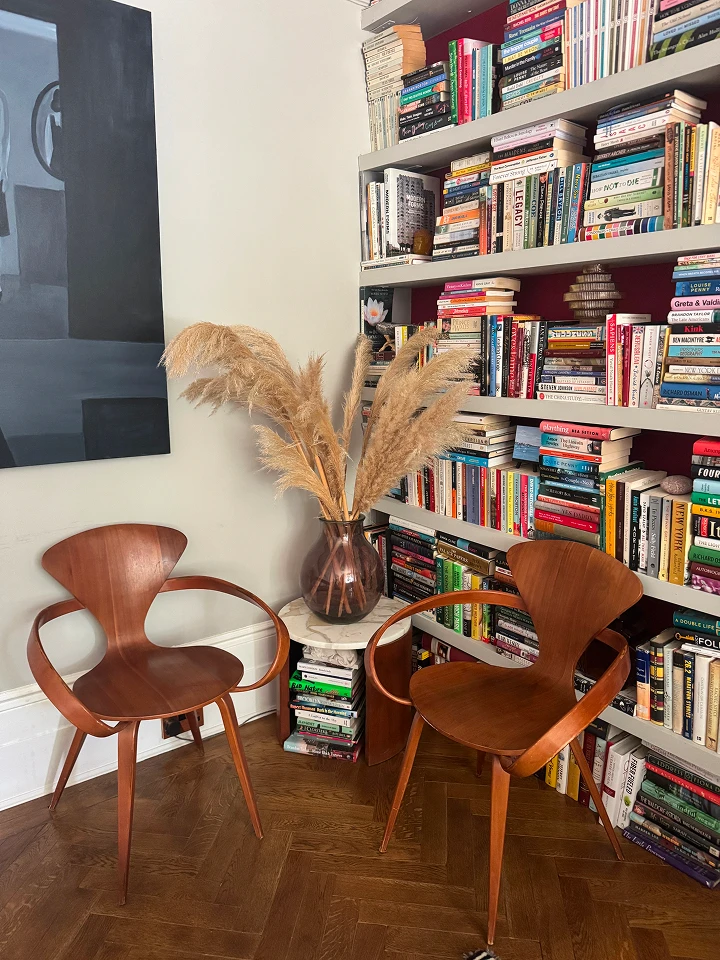
A pair of Diamond chairs came home from Brooklyn. A 1970s floor lamp was spotted in the window of a shop on New York’s Lower East Side. An architectural drawing of the Waldorf Astoria, where Timothy spent part of his early career, hangs in the kitchen. Even a New York fire hydrant has made its way to Islington, or the top of one, at least. It now works as a doorstop in the kitchen.
Other pieces have been with him much longer. A 1920s-style marble lamp was bought from an antique shop in Shepherd’s Bush when Timothy was 18, after he saved up to buy it. His grandmother’s Liberty clock sits in the study, while a Regency writing slope given to him as a wedding present by his parents dates to around the 1820s or '30s.
The house itself provides a suitably good backdrop. Built in the 1890s, it still has its original ceiling roses, stained glass and decorative details. Instead of competing with them, Timothy and his partner have picked up on what was already there. Late-19th-century gilt push plates were added to the front door, chosen partly because their floral motifs echo those found elsewhere in the house.
There’s plenty of colour, too. Smaller rooms are treated as an excuse to go bolder - the study is drenched entirely in Stiffkey Blue, while the bathroom is wrapped in House of Hackney’s fern-covered wallpaper. Elsewhere, painted lines break up the tall walls rather than trying to disguise their scale.
It’s considered, but not overly coordinated. Art found locally in Islington sits alongside pieces discovered at fairs and on trips. Mid-century furniture shares space with Regency antiques. Cocktail paraphernalia includes family silver, onyx objects of slightly mysterious original purpose and boiled egg warmers which, given that Timothy and his partner are vegan, have been reassigned to holding olives and nuts.
Then there are the books. Lots of books. Timothy and his partner are avid readers and have no television, so shelves stretch high across the sitting room, reached with a slightly wobbly, but still functional 1920s library ladder found in Chiswick.
“When you find pieces that have a story and that are highly unusual, and you immediately know that it’s right for you and right for the space, you’ve got to go for it”
Timothy Griffin
There’s no shopping list or perfectly mapped-out plan, it’s spotting something unexpected in a Brooklyn shop window, wandering into an antique shop in London, or coming across a piece that simply feels right.
That approach runs throughout the house. Pieces from different periods sit together without much concern for whether they technically 'match'. What connects them is more personal, where they were found, who they belonged to, or the memory attached to them.
It’s less about decorating a room in one go, and more about giving good things somewhere to land. And, despite the alleged buying ban, we suspect there might still be room for one more.
Feeling inspired?
Shop new arrivals

